



 Chat with AI
Exam 7: Releasing Chemical Energy

Exam 1: The Science of Biology68 Questions
Exam 2: Lifes Chemical Basis79 Questions
Exam 3: Molecules of Life56 Questions
Exam 4: Cell Structure64 Questions
Exam 5: Ground Rules of Metabolism58 Questions
Exam 6: Where It Starts-Photosynthesis87 Questions
Exam 7: Releasing Chemical Energy80 Questions
Exam 8: DNA Structure and Function75 Questions
Exam 9: From DNA to Protein65 Questions
Exam 10: Control of Gene Expression61 Questions
Exam 11: How Cells Reproduce75 Questions
Exam 12: Meiosis and Sexual Reproduction68 Questions
Exam 13: Patterns in Inherited Traits54 Questions
Exam 14: Human Inheritance41 Questions
Exam 15: Biotechnology71 Questions
Exam 16: Evidence of Evolution69 Questions
Exam 17: Processes of Evolution83 Questions
Exam 18: Lifes Origin and Early Evolution49 Questions
Exam 19: Viruses, Bacteria, and Archaea42 Questions
Exam 20: The Protists56 Questions
Exam 21: Plant Evolution55 Questions
Exam 22: Fungi50 Questions
Exam 23: Animals I: Major Invertebrate Groups72 Questions
Exam 24: Animals Ii: the Chordates76 Questions
Exam 25: Plant Tissues67 Questions
Exam 26: Plant Nutrition and Transport67 Questions
Exam 27: Plant Reproduction and Development71 Questions
Exam 28: Animal Tissues and Organ Systems78 Questions
Exam 29: Neural Control80 Questions
Exam 30: Sensory Perception62 Questions
Exam 31: Endocrine Control65 Questions
Exam 32: Structural Support and Movement52 Questions
Exam 33: Circulation66 Questions
Exam 34: Immunity57 Questions
Exam 35: Respiration63 Questions
Exam 36: Digestion and Human Nutrition57 Questions
Exam 37: Maintaining the Internal Environment63 Questions
Exam 38: Reproduction and Development88 Questions
Exam 39: Animal Behavior73 Questions
Exam 40: Population Ecology55 Questions
Exam 41: Community Ecology73 Questions
Exam 42: Ecosystems52 Questions
Exam 43: The Biosphere74 Questions
Exam 44: Human Effects on the Biosphere73 Questions
Select questions type


Which equation summarizes the overall pathway of aerobic respiration?

Free
(Multiple Choice)
4.8/5  (90)
(90) Correct Answer: Verified
C
Why is the hydrogen ion gradient of the electron transfer chain important for energy production?
Free
(Essay)
4.8/5 (82)
(82) Correct Answer:Verified
VerifiedAs the electrons move through the chains, they give up energy little by little. Some molecules of the transfer chains harness that energy to actively transport the hydrogen ions across the inner membrane, from the matrix to the intermembrane space. The accumulating ions form a hydrogen ion gradient across the inner mitochondrial membrane. This gradient attracts the ions back toward the matrix. However, ions cannot diffuse through a lipid bilayer on their own. Hydrogen ions cross the inner mitochondrial membrane only by flowing through ATP synthases embedded in the membrane. The flow of hydrogen ions through ATP synthases causes these proteins to attach phosphate groups to ADP, so ATP forms.
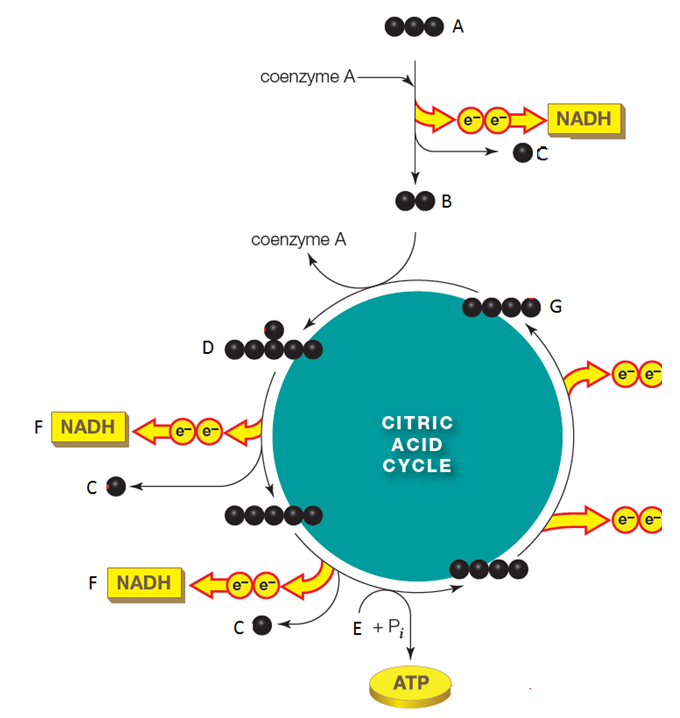 Match the process/substance in the citric acid cycle with the correct description.
-carbon leaves the cell in CO2
Match the process/substance in the citric acid cycle with the correct description.
-carbon leaves the cell in CO2Free
(Multiple Choice)
4.7/5 (77)
(77) Correct Answer:Verified
VerifiedC
In order to use the energy stored in sugars, cells must first convert it to energy stored in ____, which is synthesized during aerobic respiration.
(Multiple Choice)
4.9/5 (80)
(80) Match the cellular respiration process to the correct description. Some answers may be used more than once.
-produces less ATP than aerobic respiration
(Multiple Choice)
4.8/5 (76)
(76) When hydrogen ions accumulate in the mitochondrial intermembrane space, what prevents them from moving back into the mitochondrial matrix without flowing through ATP synthase?
(Multiple Choice)
4.9/5 (84)
(84) Carbon dioxide, water, sugar, and oxygen cycle through the world via ____ (energy capture) and ____ (energy release).
(Multiple Choice)
4.9/5 (86)
(86) The ultimate source of energy for living organisms is ____.
(Multiple Choice)
4.8/5 (78)
(78)
Match the process/substance in the citric acid cycle with the correct description.
-ADP; substrate-level phosphorylation
Match the process/substance in the citric acid cycle with the correct description.
-ADP; substrate-level phosphorylation (Multiple Choice)
4.8/5 (83)
(83) Match the following processes or items with their correct cellular location. Some answers may be used more than once.
-ATP synthases
(Multiple Choice)
4.7/5 (84)
(84)
Match the process/substance in the citric acid cycle with the correct description.
-acetyl-CoA
Match the process/substance in the citric acid cycle with the correct description.
-acetyl-CoA (Multiple Choice)
4.9/5 (86)
(86) Aerobic organisms use ____ as the final electron acceptor in electron transport phosphorylation.
(Multiple Choice)
4.9/5 (70)
(70) How did oxygen gas accumulate in Earth's atmosphere following the evolution of photosynthesis?
(Essay)
4.8/5 (89)
(89) When intense exercise depletes oxygen in muscle cells faster than it can be replenished, these cells will produce ____ by ____.
(Multiple Choice)
4.9/5 (75)
(75) The last intermediate produced in the citric acid cycle is ____, which is also a substrate for the first reaction in this pathway, making the citric acid cycle a(n) ____ metabolic pathway.
(Multiple Choice)
4.9/5 (83)
(83) The breakdown of glucose in glycolysis and the citric acid cycle yields twelve ____ coenzymes, which will deliver electrons to the electron transfer chain to drive ATP synthesis by ____.
(Multiple Choice)
4.8/5 (76)
(76) 
Filters
- Essay(0)
- Multiple Choice(0)
- Short Answer(0)
- True False(0)
- Matching(0)