



 Chat with AI
Exam 7: Releasing Chemical Energy

Exam 1: The Science of Biology68 Questions
Exam 2: Lifes Chemical Basis79 Questions
Exam 3: Molecules of Life56 Questions
Exam 4: Cell Structure64 Questions
Exam 5: Ground Rules of Metabolism58 Questions
Exam 6: Where It Starts-Photosynthesis87 Questions
Exam 7: Releasing Chemical Energy80 Questions
Exam 8: DNA Structure and Function75 Questions
Exam 9: From DNA to Protein65 Questions
Exam 10: Control of Gene Expression61 Questions
Exam 11: How Cells Reproduce75 Questions
Exam 12: Meiosis and Sexual Reproduction68 Questions
Exam 13: Patterns in Inherited Traits54 Questions
Exam 14: Human Inheritance41 Questions
Exam 15: Biotechnology71 Questions
Exam 16: Evidence of Evolution69 Questions
Exam 17: Processes of Evolution83 Questions
Exam 18: Lifes Origin and Early Evolution49 Questions
Exam 19: Viruses, Bacteria, and Archaea42 Questions
Exam 20: The Protists56 Questions
Exam 21: Plant Evolution55 Questions
Exam 22: Fungi50 Questions
Exam 23: Animals I: Major Invertebrate Groups72 Questions
Exam 24: Animals Ii: the Chordates76 Questions
Exam 25: Plant Tissues67 Questions
Exam 26: Plant Nutrition and Transport67 Questions
Exam 27: Plant Reproduction and Development71 Questions
Exam 28: Animal Tissues and Organ Systems78 Questions
Exam 29: Neural Control80 Questions
Exam 30: Sensory Perception62 Questions
Exam 31: Endocrine Control65 Questions
Exam 32: Structural Support and Movement52 Questions
Exam 33: Circulation66 Questions
Exam 34: Immunity57 Questions
Exam 35: Respiration63 Questions
Exam 36: Digestion and Human Nutrition57 Questions
Exam 37: Maintaining the Internal Environment63 Questions
Exam 38: Reproduction and Development88 Questions
Exam 39: Animal Behavior73 Questions
Exam 40: Population Ecology55 Questions
Exam 41: Community Ecology73 Questions
Exam 42: Ecosystems52 Questions
Exam 43: The Biosphere74 Questions
Exam 44: Human Effects on the Biosphere73 Questions
Select questions type


How many rounds of the citric acid cycle does it take to harvest the energy from one molecule of glucose?
(Multiple Choice)
4.9/5  (69)
(69) Match the following processes or items with their correct cellular location. Some answers may be used more than once.
-glycolysis
(Multiple Choice)
4.7/5 (85)
(85) What occurs when glucose molecules are broken apart during cellular respiration?
(Multiple Choice)
4.9/5 (80)
(80) When fats are broken down as energy sources, the fatty acids are converted to ____ and enter ____.
(Multiple Choice)
4.8/5 (91)
(91) Match the following processes or items with their correct cellular location. Some answers may be used more than once.
-glucose enters this space through a glucose transporter
(Multiple Choice)
4.9/5 (86)
(86) Glycolysis converts glucose to ____, with a net yield of ____ ATP and ____ NADH.
(Multiple Choice)
4.9/5 (76)
(76) 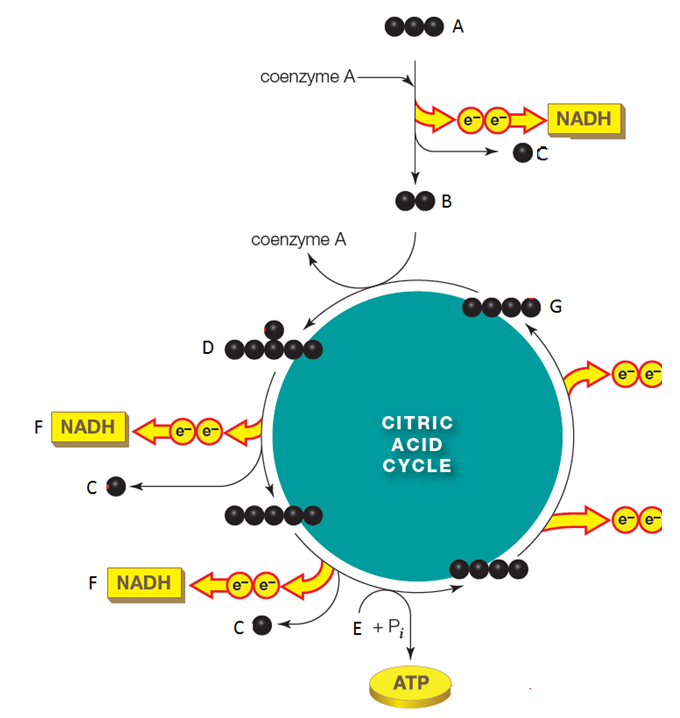 Match the process/substance in the citric acid cycle with the correct description.
-?electrons and hydrogen ions are transferred from an intermediate to coenzymes, which then become reduced
Match the process/substance in the citric acid cycle with the correct description.
-?electrons and hydrogen ions are transferred from an intermediate to coenzymes, which then become reduced (Multiple Choice)
4.8/5 (62)
(62) The flow of electrons through the electron transfer chain generates a(n) ____ gradient that drives ____ by ____.
(Multiple Choice)
4.8/5 (76)
(76) Match the cellular respiration process to the correct description. Some answers may be used more than once.
-used by some hibernating turtles that become trapped under ice
(Multiple Choice)
4.7/5 (78)
(78) What prevents the first reactions of glycolysis from running in reverse, thereby building and metabolizing glucose at the same time?
(Multiple Choice)
4.9/5 (66)
(66)
Match the process/substance in the citric acid cycle with the correct description.
-the product of the final reaction, which is also a substrate in the first reaction
Match the process/substance in the citric acid cycle with the correct description.
-the product of the final reaction, which is also a substrate in the first reaction (Multiple Choice)
4.9/5 (79)
(79) Match the following processes or items with their correct cellular location. Some answers may be used more than once.
-the destination of hydrogen ions that are pumped from the mitochondrial matrix, driven by electron flow
(Multiple Choice)
4.9/5 (71)
(71) The first aerobic organisms could live in the presence of oxygen without harm due to the presence of ____.
(Multiple Choice)
4.8/5 (79)
(79) Match the cellular respiration process to the correct description. Some answers may be used more than once.
-yogurt production
(Multiple Choice)
4.9/5 (76)
(76) During glycolysis, glucose is first phosphorylated twice, and then split into two three-carbon compounds called ____.
(Multiple Choice)
4.8/5 (89)
(89) The ultimate electron acceptor in aerobic respiration is ____.
(Multiple Choice)
4.7/5 (78)
(78) When O2 accepts electrons in aerobic respiration, it is converted to ____.
(Multiple Choice)
4.8/5 (75)
(75) Before photosynthesis evolved, ____ was a very small component of Earth's early atmosphere.
(Multiple Choice)
4.7/5 (80)
(80) 
Filters
- Essay(0)
- Multiple Choice(0)
- Short Answer(0)
- True False(0)
- Matching(0)