



 Chat with AI
Exam 6: Where It Starts-Photosynthesis

Exam 1: The Science of Biology68 Questions
Exam 2: Lifes Chemical Basis79 Questions
Exam 3: Molecules of Life56 Questions
Exam 4: Cell Structure64 Questions
Exam 5: Ground Rules of Metabolism58 Questions
Exam 6: Where It Starts-Photosynthesis87 Questions
Exam 7: Releasing Chemical Energy80 Questions
Exam 8: DNA Structure and Function75 Questions
Exam 9: From DNA to Protein65 Questions
Exam 10: Control of Gene Expression61 Questions
Exam 11: How Cells Reproduce75 Questions
Exam 12: Meiosis and Sexual Reproduction68 Questions
Exam 13: Patterns in Inherited Traits54 Questions
Exam 14: Human Inheritance41 Questions
Exam 15: Biotechnology71 Questions
Exam 16: Evidence of Evolution69 Questions
Exam 17: Processes of Evolution83 Questions
Exam 18: Lifes Origin and Early Evolution49 Questions
Exam 19: Viruses, Bacteria, and Archaea42 Questions
Exam 20: The Protists56 Questions
Exam 21: Plant Evolution55 Questions
Exam 22: Fungi50 Questions
Exam 23: Animals I: Major Invertebrate Groups72 Questions
Exam 24: Animals Ii: the Chordates76 Questions
Exam 25: Plant Tissues67 Questions
Exam 26: Plant Nutrition and Transport67 Questions
Exam 27: Plant Reproduction and Development71 Questions
Exam 28: Animal Tissues and Organ Systems78 Questions
Exam 29: Neural Control80 Questions
Exam 30: Sensory Perception62 Questions
Exam 31: Endocrine Control65 Questions
Exam 32: Structural Support and Movement52 Questions
Exam 33: Circulation66 Questions
Exam 34: Immunity57 Questions
Exam 35: Respiration63 Questions
Exam 36: Digestion and Human Nutrition57 Questions
Exam 37: Maintaining the Internal Environment63 Questions
Exam 38: Reproduction and Development88 Questions
Exam 39: Animal Behavior73 Questions
Exam 40: Population Ecology55 Questions
Exam 41: Community Ecology73 Questions
Exam 42: Ecosystems52 Questions
Exam 43: The Biosphere74 Questions
Exam 44: Human Effects on the Biosphere73 Questions
Select questions type


Match each process or structure with its correct location within the chloroplast. Some choices may be used more than once.
-photosystems I and II

Free
(Multiple Choice)
4.8/5  (94)
(94) Correct Answer: Verified
A
Match each process or structure with its correct location within the chloroplast. Some choices may be used more than once.
-ATP synthase
Free
(Multiple Choice)
4.9/5 (87)
(87) Correct Answer:Verified
VerifiedA
Twelve PGAL molecules form when six carbon dioxide molecules are attached to six RuBP molecules. Only two of these PGAL molecules are needed to form a 6-carbon sugar. What is the fate of the 10 remaining PGAL molecules?
Free
(Multiple Choice)
4.8/5 (73)
(73) Correct Answer:Verified
VerifiedE
Why do the cells of photosynthetic organisms contain accessory pigments?
(Multiple Choice)
4.9/5 (85)
(85) Why is photorespiration an inefficient way to produce sugars?
(Multiple Choice)
4.9/5 (94)
(94) 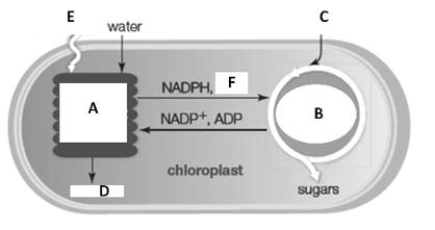 -In the accompanying figure, what does letter E represent?
Four of the five items listed below participate in photosynthesis. Select the exception.
(Multiple Choice)
4.8/5 (75)
(75) Match the process to the correct description.
-PGA to PGAL conversion
(Multiple Choice)
4.8/5 (72)
(72) Match each process or structure with its correct location within the chloroplast. Some choices may be used more than once.
-accumulation of hydrogen ions
(Multiple Choice)
5.0/5 (71)
(71) About 200 years ago, Jan Baptista van Helmont wondered how growing plants obtained the materials necessary for growth. He planted a tree seedling weighing 5 pounds in a barrel filled with 200 pounds of soil and then watered the tree regularly. After five years, the tree weighed 169 pounds, 3 ounces, and the soil weighed 199 pounds, 14 ounces. Because the tree had gained so much weight and the soil had lost so little, he concluded that the tree had gained all of its additional weight by absorbing the water he had added to the barrel. Of course he was incorrect. What really happened?
(Essay)
5.0/5 (81)
(81) What do photosynthetic autotrophs use as a carbon source? What do they use as an energy source?
(Essay)
4.9/5 (84)
(84) Match the description to the correct photosynthetic pathway.
-This process involves a photolysis step, breaking water into hydrogen ions and oxygen.
(Multiple Choice)
4.7/5 (78)
(78) 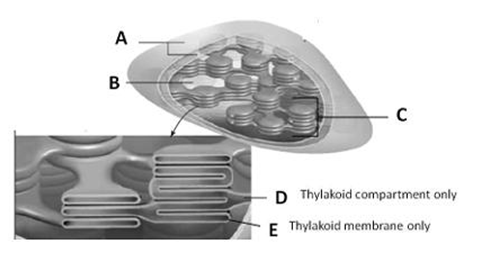 -According to the accompanying diagram, where are hydrogen ions sequestered?
 (Multiple Choice)
4.9/5 (74)
(74) The cyclic pathway of light-dependent reactions uses ____ to absorb light energy and emit electrons.
(Multiple Choice)
4.7/5 (90)
(90) What are the products of the light-dependent reactions of photosynthesis?
(Multiple Choice)
4.7/5 (77)
(77) Match each process or structure with its correct location within the chloroplast. Some choices may be used more than once.
-electron transport chain
(Multiple Choice)
4.9/5 (67)
(67) 
Filters
- Essay(0)
- Multiple Choice(0)
- Short Answer(0)
- True False(0)
- Matching(0)