



 Chat with AI
Exam 6: Where It Starts-Photosynthesis

Exam 1: The Science of Biology68 Questions
Exam 2: Lifes Chemical Basis79 Questions
Exam 3: Molecules of Life56 Questions
Exam 4: Cell Structure64 Questions
Exam 5: Ground Rules of Metabolism58 Questions
Exam 6: Where It Starts-Photosynthesis87 Questions
Exam 7: Releasing Chemical Energy80 Questions
Exam 8: DNA Structure and Function75 Questions
Exam 9: From DNA to Protein65 Questions
Exam 10: Control of Gene Expression61 Questions
Exam 11: How Cells Reproduce75 Questions
Exam 12: Meiosis and Sexual Reproduction68 Questions
Exam 13: Patterns in Inherited Traits54 Questions
Exam 14: Human Inheritance41 Questions
Exam 15: Biotechnology71 Questions
Exam 16: Evidence of Evolution69 Questions
Exam 17: Processes of Evolution83 Questions
Exam 18: Lifes Origin and Early Evolution49 Questions
Exam 19: Viruses, Bacteria, and Archaea42 Questions
Exam 20: The Protists56 Questions
Exam 21: Plant Evolution55 Questions
Exam 22: Fungi50 Questions
Exam 23: Animals I: Major Invertebrate Groups72 Questions
Exam 24: Animals Ii: the Chordates76 Questions
Exam 25: Plant Tissues67 Questions
Exam 26: Plant Nutrition and Transport67 Questions
Exam 27: Plant Reproduction and Development71 Questions
Exam 28: Animal Tissues and Organ Systems78 Questions
Exam 29: Neural Control80 Questions
Exam 30: Sensory Perception62 Questions
Exam 31: Endocrine Control65 Questions
Exam 32: Structural Support and Movement52 Questions
Exam 33: Circulation66 Questions
Exam 34: Immunity57 Questions
Exam 35: Respiration63 Questions
Exam 36: Digestion and Human Nutrition57 Questions
Exam 37: Maintaining the Internal Environment63 Questions
Exam 38: Reproduction and Development88 Questions
Exam 39: Animal Behavior73 Questions
Exam 40: Population Ecology55 Questions
Exam 41: Community Ecology73 Questions
Exam 42: Ecosystems52 Questions
Exam 43: The Biosphere74 Questions
Exam 44: Human Effects on the Biosphere73 Questions
Select questions type


Which type(s) of plants have adapted to hot, dry conditions by minimizing photorespiration?
(Multiple Choice)
4.8/5  (80)
(80) What are the molecular reactants for photosynthesis in plants?
(Multiple Choice)
5.0/5 (83)
(83) Match the process to the correct description.
-noncyclic pathway
(Multiple Choice)
4.9/5 (76)
(76) Match the process to the correct description.
-formation of glucose
(Multiple Choice)
4.8/5 (92)
(92) Openings in leaves through which gases enter and exit are called ____.
(Multiple Choice)
4.8/5 (92)
(92) The wavelength of visible light with the highest energy is ____.
(Multiple Choice)
4.8/5 (84)
(84) How did Theodor Engelmann determine which colors of light were optimal for driving photosynthesis?
(Essay)
4.8/5 (73)
(73) How is the process of carbon fixation necessary for plant growth?
(Multiple Choice)
4.7/5 (82)
(82) 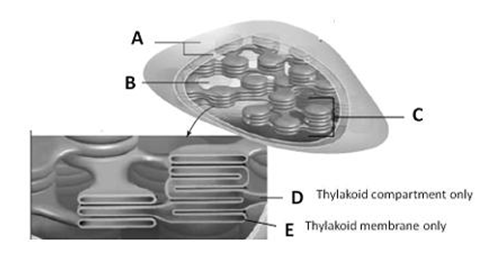 -According to the accompanying diagram, which letter indicates the chloroplast membrane?
 (Multiple Choice)
4.9/5 (68)
(68) How does the cyclic pathway of light-dependent reactions differ from noncyclic reactions?
(Multiple Choice)
4.8/5 (84)
(84) In Engelmann's 1882 experiment, why did bacteria cluster in areas of red or blue wavelengths of light?
(Multiple Choice)
4.8/5 (89)
(89) The electrons that are accepted by NADP+ to form NADPH during the noncyclic pathways of the light-dependent reactions are emitted by ____.
(Multiple Choice)
4.8/5 (70)
(70) Match the description to the correct photosynthetic pathway.
-In this process, rubisco attaches oxygen (instead of carbon dioxide) to RuBP.
(Multiple Choice)
4.8/5 (89)
(89) Match the process to the correct description.
-cyclic pathway
(Multiple Choice)
4.9/5 (61)
(61) What role(s) do ATP and NADPH from the light-dependent reactions play in the conversion of PGA to PGAL in the Calvin-Benson cycle?
(Multiple Choice)
5.0/5 (74)
(74) During times of high sugar production, some PGAL molecules that remain in the chloroplast ____.
(Multiple Choice)
4.8/5 (77)
(77) Why might a photosynthetic algal species living in deep ocean water have a different combination of pigments than a tree living above sea level?
(Essay)
4.7/5 (87)
(87) Chlorophyll a, the most common photosynthetic pigment in plants, ____, giving plants their green color.
(Multiple Choice)
4.8/5 (63)
(63) 
Filters
- Essay(0)
- Multiple Choice(0)
- Short Answer(0)
- True False(0)
- Matching(0)