



 Chat with AI
Exam 12: Meiosis and Sexual Reproduction

Exam 1: The Science of Biology68 Questions
Exam 2: Lifes Chemical Basis79 Questions
Exam 3: Molecules of Life56 Questions
Exam 4: Cell Structure64 Questions
Exam 5: Ground Rules of Metabolism58 Questions
Exam 6: Where It Starts-Photosynthesis87 Questions
Exam 7: Releasing Chemical Energy80 Questions
Exam 8: DNA Structure and Function75 Questions
Exam 9: From DNA to Protein65 Questions
Exam 10: Control of Gene Expression61 Questions
Exam 11: How Cells Reproduce75 Questions
Exam 12: Meiosis and Sexual Reproduction68 Questions
Exam 13: Patterns in Inherited Traits54 Questions
Exam 14: Human Inheritance41 Questions
Exam 15: Biotechnology71 Questions
Exam 16: Evidence of Evolution69 Questions
Exam 17: Processes of Evolution83 Questions
Exam 18: Lifes Origin and Early Evolution49 Questions
Exam 19: Viruses, Bacteria, and Archaea42 Questions
Exam 20: The Protists56 Questions
Exam 21: Plant Evolution55 Questions
Exam 22: Fungi50 Questions
Exam 23: Animals I: Major Invertebrate Groups72 Questions
Exam 24: Animals Ii: the Chordates76 Questions
Exam 25: Plant Tissues67 Questions
Exam 26: Plant Nutrition and Transport67 Questions
Exam 27: Plant Reproduction and Development71 Questions
Exam 28: Animal Tissues and Organ Systems78 Questions
Exam 29: Neural Control80 Questions
Exam 30: Sensory Perception62 Questions
Exam 31: Endocrine Control65 Questions
Exam 32: Structural Support and Movement52 Questions
Exam 33: Circulation66 Questions
Exam 34: Immunity57 Questions
Exam 35: Respiration63 Questions
Exam 36: Digestion and Human Nutrition57 Questions
Exam 37: Maintaining the Internal Environment63 Questions
Exam 38: Reproduction and Development88 Questions
Exam 39: Animal Behavior73 Questions
Exam 40: Population Ecology55 Questions
Exam 41: Community Ecology73 Questions
Exam 42: Ecosystems52 Questions
Exam 43: The Biosphere74 Questions
Exam 44: Human Effects on the Biosphere73 Questions
Select questions type


Match the following stages with the corresponding chromosome number in human cells.
-zygote
(Multiple Choice)
4.8/5  (75)
(75) The stage of meiosis that makes descendant cells haploid is ____.
(Multiple Choice)
4.8/5 (89)
(89) Which reproductive strategy would allow the most rapid adaptation to a changing environment?
(Multiple Choice)
4.9/5 (76)
(76) Crossing over is one of the most important events in meiosis because ____.
(Multiple Choice)
4.7/5 (71)
(71) 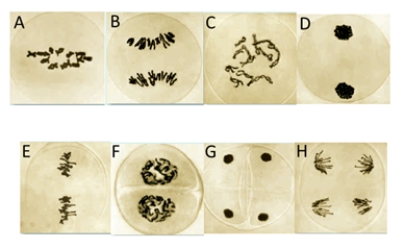 Use the accompanying figure to match the cells in the figure to the correct phase in meiosis. The top figure panel is phases of meiosis I; the bottom panel is phases of meiosis II.
-telophase I?
Use the accompanying figure to match the cells in the figure to the correct phase in meiosis. The top figure panel is phases of meiosis I; the bottom panel is phases of meiosis II.
-telophase I? (Multiple Choice)
4.8/5 (92)
(92)
Use the accompanying figure to match the cells in the figure to the correct phase in meiosis. The top figure panel is phases of meiosis I; the bottom panel is phases of meiosis II.
-anaphase I
Use the accompanying figure to match the cells in the figure to the correct phase in meiosis. The top figure panel is phases of meiosis I; the bottom panel is phases of meiosis II.
-anaphase I (Multiple Choice)
4.9/5 (88)
(88) Match the following stages with the corresponding chromosome number in human cells.
-daughter cell after mitosis
(Multiple Choice)
4.8/5 (69)
(69) If meiosis did not occur in sexually reproducing organisms, ____.
(Multiple Choice)
4.7/5 (95)
(95) Match the following stages with the corresponding chromosome number in human cells.
-daughter cell after meiosis II
(Multiple Choice)
4.9/5 (82)
(82)
Use the accompanying figure to match the cells in the figure to the correct phase in meiosis. The top figure panel is phases of meiosis I; the bottom panel is phases of meiosis II.
-prophase I
Use the accompanying figure to match the cells in the figure to the correct phase in meiosis. The top figure panel is phases of meiosis I; the bottom panel is phases of meiosis II.
-prophase I (Multiple Choice)
4.8/5 (69)
(69) What adaptation have the freshwater bdelloid rotifers used to allow them to acquire genetic diversity while reproducing only via asexual reproduction?
(Essay)
4.8/5 (82)
(82) In asexual reproduction, new combinations of genes arise by ____.
(Multiple Choice)
5.0/5 (75)
(75) 
Filters
- Essay(0)
- Multiple Choice(0)
- Short Answer(0)
- True False(0)
- Matching(0)