



 Chat with AI
Exam 12: Meiosis and Sexual Reproduction

Exam 1: The Science of Biology68 Questions
Exam 2: Lifes Chemical Basis79 Questions
Exam 3: Molecules of Life56 Questions
Exam 4: Cell Structure64 Questions
Exam 5: Ground Rules of Metabolism58 Questions
Exam 6: Where It Starts-Photosynthesis87 Questions
Exam 7: Releasing Chemical Energy80 Questions
Exam 8: DNA Structure and Function75 Questions
Exam 9: From DNA to Protein65 Questions
Exam 10: Control of Gene Expression61 Questions
Exam 11: How Cells Reproduce75 Questions
Exam 12: Meiosis and Sexual Reproduction68 Questions
Exam 13: Patterns in Inherited Traits54 Questions
Exam 14: Human Inheritance41 Questions
Exam 15: Biotechnology71 Questions
Exam 16: Evidence of Evolution69 Questions
Exam 17: Processes of Evolution83 Questions
Exam 18: Lifes Origin and Early Evolution49 Questions
Exam 19: Viruses, Bacteria, and Archaea42 Questions
Exam 20: The Protists56 Questions
Exam 21: Plant Evolution55 Questions
Exam 22: Fungi50 Questions
Exam 23: Animals I: Major Invertebrate Groups72 Questions
Exam 24: Animals Ii: the Chordates76 Questions
Exam 25: Plant Tissues67 Questions
Exam 26: Plant Nutrition and Transport67 Questions
Exam 27: Plant Reproduction and Development71 Questions
Exam 28: Animal Tissues and Organ Systems78 Questions
Exam 29: Neural Control80 Questions
Exam 30: Sensory Perception62 Questions
Exam 31: Endocrine Control65 Questions
Exam 32: Structural Support and Movement52 Questions
Exam 33: Circulation66 Questions
Exam 34: Immunity57 Questions
Exam 35: Respiration63 Questions
Exam 36: Digestion and Human Nutrition57 Questions
Exam 37: Maintaining the Internal Environment63 Questions
Exam 38: Reproduction and Development88 Questions
Exam 39: Animal Behavior73 Questions
Exam 40: Population Ecology55 Questions
Exam 41: Community Ecology73 Questions
Exam 42: Ecosystems52 Questions
Exam 43: The Biosphere74 Questions
Exam 44: Human Effects on the Biosphere73 Questions
Select questions type


Match the following stages with the corresponding chromosome number in human cells.
-daughter cell after meiosis I
(Multiple Choice)
4.9/5  (74)
(74) Copies of chromosomes linked together at their centromeres at the beginning of meiosis are called ____ chromatids.
(Multiple Choice)
4.8/5 (90)
(90) Which process is a nuclear division mechanism that halves the chromosome number and is a necessary part of gamete formation and sexual reproduction?
(Multiple Choice)
4.8/5 (74)
(74) A child more strongly resembles the maternal grandmother than the maternal grandfather. One explanation could be due to random chromosome alignment during which stage of the mother's gamete formation?
(Multiple Choice)
5.0/5 (79)
(79) Dogs have a diploid chromosome number of 78. How many chromosomes do their gametes have?
(Multiple Choice)
5.0/5 (87)
(87) 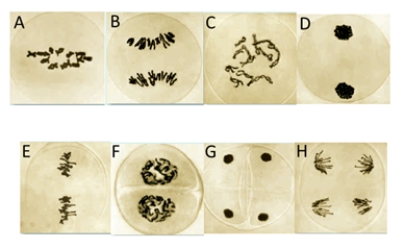 Use the accompanying figure to match the cells in the figure to the correct phase in meiosis. The top figure panel is phases of meiosis I; the bottom panel is phases of meiosis II.
-telophase II
Use the accompanying figure to match the cells in the figure to the correct phase in meiosis. The top figure panel is phases of meiosis I; the bottom panel is phases of meiosis II.
-telophase II (Multiple Choice)
5.0/5 (87)
(87)
Use the accompanying figure to match the cells in the figure to the correct phase in meiosis. The top figure panel is phases of meiosis I; the bottom panel is phases of meiosis II.
-metaphase I?
Use the accompanying figure to match the cells in the figure to the correct phase in meiosis. The top figure panel is phases of meiosis I; the bottom panel is phases of meiosis II.
-metaphase I? (Multiple Choice)
4.8/5 (80)
(80) Imagine that allele "A" of a gene is present on the maternal chromosome and allele "a" is present on the paternal chromosome following crossing over during prophase I. When do the alleles "A" and "a" separate into daughter cells? Does this occur after meiosis I or meiosis II, and why?
(Essay)
4.9/5 (81)
(81) Meiosis typically results in the production of ____ cell(s).
(Multiple Choice)
4.9/5 (78)
(78) 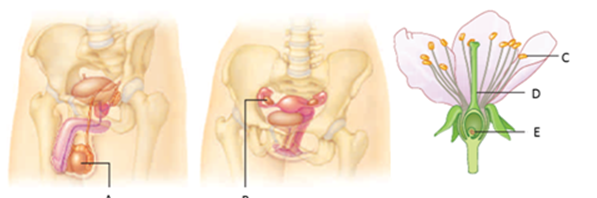 -Identify the locations in the accompanying figure where eggs (ova) are produced.
 (Multiple Choice)
4.7/5 (69)
(69) 
Filters
- Essay(0)
- Multiple Choice(0)
- Short Answer(0)
- True False(0)
- Matching(0)