



 Chat with AI
Exam 19: Community Succession

Exam 1: Introduction: Ecology, Evolution, and the Scientific Method65 Questions
Exam 2: Adaptations to Aquatic Environments 67 Questions
Exam 3: Adaptations to Terrestrial Environments 69 Questions
Exam 4: Adaptations to Variable Environments 65 Questions
Exam 5: Climates and Soils68 Questions
Exam 6: Terrestrial and Aquatic Biomes64 Questions
Exam 7: Evolution and Adaptation 68 Questions
Exam 8: Life Histories66 Questions
Exam 9: Reproductive Strategies65 Questions
Exam 10: Social Behaviors67 Questions
Exam 11: Population Distributions70 Questions
Exam 12: Population Growth and Regulation62 Questions
Exam 13: Population Dynamics Over Space and Time69 Questions
Exam 14: Predation and Herbivory69 Questions
Exam 15: Parasitism and Infectious Diseases68 Questions
Exam 16: Competition67 Questions
Exam 17: Mutualism68 Questions
Exam 18: Community Structure 66 Questions
Exam 19: Community Succession 120 Questions
Exam 20: Movement of Energy in Ecosystems 68 Questions
Exam 21: Movement of Elements in Ecosystems71 Questions
Exam 22: Landscape Ecology and Global Biodiversity 68 Questions
Exam 23: Global Conservation of Biodiversity67 Questions
Select questions type


Why do plants in early seral stages exhibit high levels of tolerance?
(Multiple Choice)
4.9/5  (87)
(87)  (Figure 19.14) In the experiment associated with the figure, acorn barnacles facilitate the growth of algae. If you removed both acorn barnacles and the limpet predators of algae, what would you be likely to observe over time?
 (Multiple Choice)
4.8/5 (75)
(75) Why does stream succession rely less on how fast organisms can move themselves than terrestrial succession?
(Multiple Choice)
4.8/5 (91)
(91) When considering the effect of one species on the probability of a second species becoming established, facilitation is _____, inhibition is _____, and tolerance is _____.
(Multiple Choice)
4.8/5 (77)
(77) In deciduous forests of Pennsylvania, the climax community used to be composed of large trees of mostly oak, hickory, and tulip poplar, but over time the composition of the understory changed to sugar maple and beech. What was the cause of this shift?
(Multiple Choice)
5.0/5 (79)
(79) Three different wildlife management areas (X, Y, and Z) are surveyed for nesting birds. When compared using the Jaccard index of similarity, the results are as follows:
Area X and Y - J = 0.6
Area Y and Z - J = 0.2
Area X and Z - J = 0.8
Which two areas are most similar?
(Multiple Choice)
4.8/5 (75)
(75) Researchers have recently proposed a new way lake succession can occur. What is one feature of this new model?
(Multiple Choice)
4.9/5 (88)
(88) Which of the following is an example of a transient climax community?
(Multiple Choice)
4.8/5 (89)
(89) Garlic mustard (Alliaria petiolata) is a common invasive species in the eastern United States. One mechanism that allows it to dominate in some areas is the production of chemicals that interfere with the ability of other plants to gain nutrients through mutualistic fungi. This mechanism is an example of
(Multiple Choice)
4.8/5 (86)
(86) Why don't freezing and drying cycles cause primary succession to happen over and over again in vernal pools?
(Short Answer)
4.9/5 (68)
(68) To apply the concept of chronosequence, ecologists assume that
(Multiple Choice)
4.9/5 (76)
(76) Why would seed viability be longer with early-successional species versus late-successional species?
(Multiple Choice)
4.9/5 (70)
(70) Which mechanisms of succession depend on one species arriving at a site before another species?
(Multiple Choice)
4.9/5 (94)
(94) Why does succession in intertidal communities tend to happen faster than succession after a disturbance in terrestrial communities?
(Multiple Choice)
4.8/5 (73)
(73) In primary succession of sand dunes, the first species to colonize are
(Multiple Choice)
4.7/5 (65)
(65) 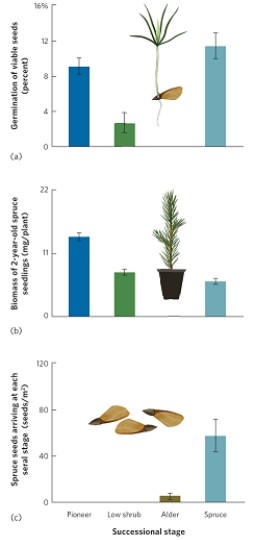 (Figure 19.15) Researchers in Glacier Bay, Alaska, planted Sitka spruce seeds (Picea sitchensis) in four seral stages recovering from deglaciation: pioneer stage (dominated by lichens, mosses, and herbs), low-shrub stage (dominated by Dryas drummondii), alder stage (dominated by Alnus sinuate shrubs), and spruce stage (dominated by P. sitchensis). The researchers originally hypothesized that each seral state facilitates species in the subsequent stage. Do the data shown in the figure support their hypothesis? If so, explain. If not, what would explain the results? What type of successions is this area undergoing?
 (Not Answered)
This question doesn't have any answer yet
How do gaps affect climax communities? Does gap size matter, and why or why not?
(Essay)
4.7/5 (79)
(79) Canopy gaps change local forest composition primarily by increased
(Multiple Choice)
4.8/5 (78)
(78) 
Filters
- Essay(0)
- Multiple Choice(0)
- Short Answer(0)
- True False(0)
- Matching(0)