



 Chat with AI
Exam 7: Evolution and Adaptation


Consider three populations of a plant species, each of which is isolated from other populations of the same species. Population X has had approximately 100 individuals in each generation for the past 200 generations. Population Y has had approximately 10,000 individuals in each generation for the past 200 generations. Population Z has had approximately 1 million individuals in each generation for the past 200 generations. If the environment changed and a new environmental condition exerted the exact same strength of directional selection on all three populations, which population would we expect to evolve most rapidly?

 (74)
 Verified
C
Consider a gene that affects number of seeds in a plant. This gene has two alleles, G and g. If GG plants produce 50 seeds, Gg plants produce 50 seeds, and gg plants produce 25 seeds, how would we describe the effect of these alleles?
(71) VerifiedA
What is the difference between speciation referred to as allopatric in origin and speciation referred to as sympatric in origin?
(70)  Answered by Examlex AI Copilot
Speciation is the evolutionary process by which populations evolve to become distinct species. The primary difference between allopatric and sympatric speciation lies in the geographic relationship and distribution of the populations as they undergo this process.
Allopatric Speciation:
Allopatric speciation, also known as geographic speciation, occurs when a population is divided by a geographic barrier, such as a mountain range, river, or desert, leading to physical separation of groups within the population. Over time, these geographically isolated populations experience different environmental pressures, genetic drift, and mutations, which can lead to divergent evolution. As the populations adapt to their unique environments, they accumulate genetic differences. If these differences become significant enough, they can lead to reproductive isolation, where individuals from the two populations can no longer interbreed successfully. This reproductive isolation solidifies the emergence of two distinct species. Allopatric speciation is considered the most common form of speciation.
Sympatric Speciation:
Sympatric speciation, on the other hand, occurs without geographic separation. Populations that live in the same geographic area diverge into separate species while remaining in close proximity. This can happen through several mechanisms, such as ecological specialization, where different groups within a population exploit different niches or resources within the same environment. Another mechanism is polyploidy, particularly common in plants, where an error in cell division results in a doubling of the chromosome number, creating a reproductive barrier between the polyploid individuals and the rest of the population. Behavioral isolation, such as changes in mating preferences, can also lead to sympatric speciation. Despite living in the same area, these mechanisms can lead to reproductive isolation and the eventual formation of new species.
In summary, the key difference between allopatric and sympatric speciation is the presence or absence of geographic separation. Allopatric speciation involves physical barriers that divide a population, leading to speciation over time due to isolation, while sympatric speciation occurs within a single geographic area, often due to ecological, genetic, or behavioral factors that create reproductive barriers within the population.
Assuming the starting point is the same phenotypic distribution, describe the outcome, in terms of phenotype, of stabilizing, directional, and disruptive selection.
(76) At the Seneca Army Depot in upstate New York, a mutant variety (white coat color) of white-tailed deer composes a much higher percentage of the population than one might consider normal for such a mutation. What is the reason for this?
(87) Chickens with the dominant allele at the frizzle gene produce curly feathers, have very high body temperature, and lay few eggs. This is an example of
(82) When an extreme phenotype has higher fitness than an average phenotype in a population, it is an example of
(79) The drug chloroquine has been widely used to treat the human parasite malaria. Mutations in the malaria gene pfcrt confer resistance to chloroquine. In some countries, more than 90 percent of malaria parasites had the pfcrt resistance alleles. When these countries stopped using chloroquine, the frequency of the pfcrt resistance alleles rapidly declined. Provide an evolutionary explanation for the decline in pfcrt resistance alleles after chloroquine was discontinued.
(87) Based on the phylogeny in the figure, which traits are shared by bony fishes and amphibians? 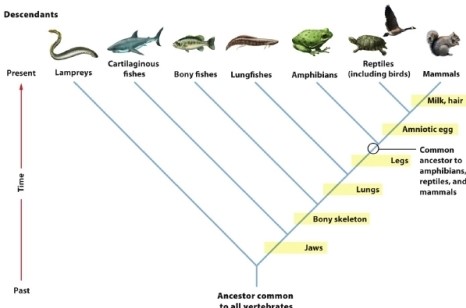
(84) If a population of butterflies is under strong natural selection favoring large wings but there is no genetic variation for wing size, what do we expect to occur in the next generation?
(61) Explain how a diversity of habitats combined with natural selection can lead to sympatric speciation. Provide an example.
(68) The rate at which allele frequencies change because of genetic drift is
(78) Which of the following is/are correct?
I. Allopatric speciation can occur without geographic barriers.
II. Allopatric speciation is the most common form of speciation.
III. Allopatric speciation can be facilitated through genetic drift.
(76) Tremblay's salamander, the result of a diploid egg from a blue-spotted salamander being fertilized by a haploid sperm of a Jefferson's salamander, would be considered
(76) Evolution by artificial selection is similar to evolution by natural selection because
I. both require traits to be heritable.
II. both incorporate founder effects.
III. both favor certain traits over others.
(91) Artificial selection can cause evolutionary change when there is
(81) The shuffling of genes that occurs when DNA is copied during meiosis is known as
(95) Based on the phylogeny of the Galápagos finches, which statement is correct? 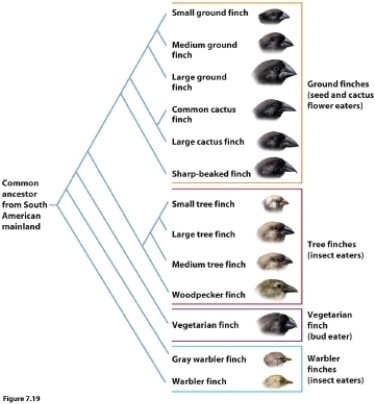
(85) Darwin supported his argument for evolution by natural selection with the observation that artificial selection caused large changes in a short period because
(74) Which of the following three statements is/are correct?
I. Speciation through polyploidy can occur through hybridization.
II. Speciation through polyploidy never occurs in vertebrates; it occurs only in plants.
III. Speciation through polyploidy generates phenotypic differences among the resulting species.
(69) 
Filters
- Essay(0)
- Multiple Choice(0)
- Short Answer(0)
- True False(0)
- Matching(0)