



 Chat with AI
Exam 8: Life Histories


When adults have a high probability of survival from one year to the next and offspring survival is relatively poor, the best strategy for an adult to maximize fitness is to

 (73)
 Verified
C
Which life history type, fast or slow, is more likely to describe an endangered animal species?
(55)  Answered by Examlex AI Copilot
Endangered animal species are more likely to be described by a slow life history type. Slow life history strategies are characterized by traits such as long gestation periods, late sexual maturity, longer lifespans, lower reproductive rates, and higher investment in fewer offspring. These species often produce a small number of offspring but invest significant parental care to ensure their survival.
This strategy can make species more vulnerable to environmental changes, habitat destruction, overexploitation, and other threats because they cannot quickly rebound from population declines. When a species with a slow life history faces such threats, its population may not be able to recover rapidly enough due to its low reproductive output and slow population growth rates.
In contrast, species with a fast life history strategy tend to have short gestation periods, early sexual maturity, shorter lifespans, higher reproductive rates, and less investment in a larger number of offspring. These species can often adapt more quickly to changes in their environment because they reproduce in greater numbers and at a faster rate, which can help their populations recover more quickly from declines.
However, it's important to note that while slow life history traits are more commonly associated with endangered species, there are exceptions, and a variety of factors can contribute to a species becoming endangered. Conservation status is influenced by a complex interplay of biological characteristics, environmental conditions, and human activities.
We might expect natural selection to favor organisms that produce more offspring. Why is this not the case for species with a high degree of parental care?
(85) Answered by Examlex AI CopilotNatural selection does indeed favor organisms that produce more offspring, as this increases the chances of their genes being passed on to the next generation. However, for species with a high degree of parental care, the situation is different. In these species, the parents invest a significant amount of time and resources into raising their offspring. This means that they are not able to produce as many offspring as species that do not provide parental care.
Instead of producing a large number of offspring, these species invest in ensuring the survival and success of a smaller number of offspring. This is because the quality of care and resources provided by the parents can greatly increase the chances of their offspring surviving and reproducing themselves. Therefore, in species with high parental care, natural selection favors the quality of care provided to a smaller number of offspring, rather than the quantity of offspring produced. This ultimately increases the overall fitness of the species by ensuring that the offspring that are produced have a higher chance of survival and reproductive success.
Compare the relative influence of determinate and indeterminate growth patterns on natural selection for adult size.
(77) How would fecundity and age at maturity be influenced by adult and juvenile survival rates?
(67) Explain why life history variables, such as number of offspring, size of offspring, and degree of parental care, are often correlated.
(79) Use the information in the figure to explain whether the fitness of the parent increases with more eggs produced and why. 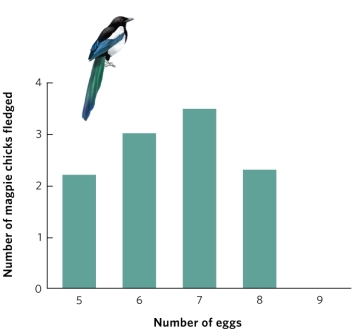
How does having a large number of offspring affect a parent's fitness for subsequent breeding seasons?
(64) Research on the 17-year periodical cicada emergence pattern has shown that this semelparous organism appears to be sensitive to
(88) Grime proposed that combinations of life history traits in plants are mainly determined by three factors. Which is NOT one of these factors?
(85) Reproductive trade-offs that an organism might face include all of the following except
(87) Is senescence inevitable? Please explain your answer, accounting for the great variation in patterns of aging among different species.
(82) In human females the increased prevalence of birth defects in offspring and of infertility after 30 years of age is one indication of
(65) If maintaining high survival and reproduction would increase an individual's fitness at any age, what is the most likely reason these traits decline with age in humans?
(77) Explain the relationship between the two plotted variables in Figure 8.14. How can egg development and laying occur prior to the end of May if there is a relation between the mean date of laying and average temperatures for May? 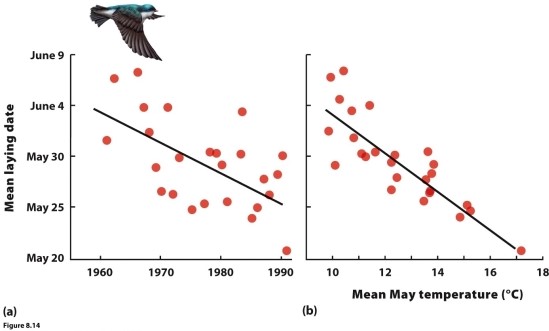
Yucca plants are mostly iteroparous, but some can be semelparous. Based on the information in Figure 8.9, semelparous yuccas have a higher percentage of seed germination, which suggests high fitness. Why, then, are most yucca varieties iteroparous? 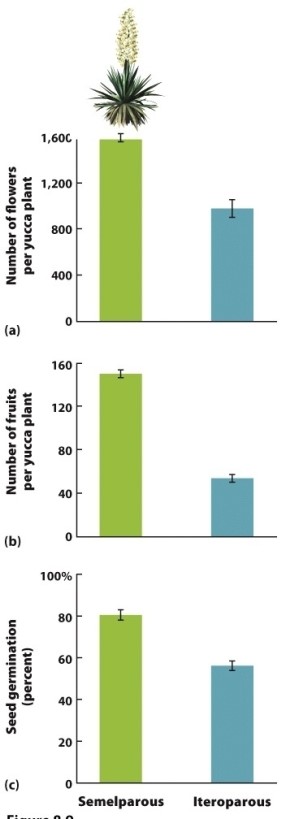
Many life history events are matched to seasonal changes in environmental conditions, such as the onset of winter. Explain why photoperiod is a more reliable seasonal indicator for plants than air temperature.
(73) 
Filters
- Essay(0)
- Multiple Choice(0)
- Short Answer(0)
- True False(0)
- Matching(0)