



 Chat with AI
Exam 19: Community Succession

Exam 1: Introduction: Ecology, Evolution, and the Scientific Method65 Questions
Exam 2: Adaptations to Aquatic Environments 67 Questions
Exam 3: Adaptations to Terrestrial Environments 69 Questions
Exam 4: Adaptations to Variable Environments 65 Questions
Exam 5: Climates and Soils68 Questions
Exam 6: Terrestrial and Aquatic Biomes64 Questions
Exam 7: Evolution and Adaptation 68 Questions
Exam 8: Life Histories66 Questions
Exam 9: Reproductive Strategies65 Questions
Exam 10: Social Behaviors67 Questions
Exam 11: Population Distributions70 Questions
Exam 12: Population Growth and Regulation62 Questions
Exam 13: Population Dynamics Over Space and Time69 Questions
Exam 14: Predation and Herbivory69 Questions
Exam 15: Parasitism and Infectious Diseases68 Questions
Exam 16: Competition67 Questions
Exam 17: Mutualism68 Questions
Exam 18: Community Structure 66 Questions
Exam 19: Community Succession 120 Questions
Exam 20: Movement of Energy in Ecosystems 68 Questions
Exam 21: Movement of Elements in Ecosystems71 Questions
Exam 22: Landscape Ecology and Global Biodiversity 68 Questions
Exam 23: Global Conservation of Biodiversity67 Questions
Select questions type


Inhibition is a mechanism of succession in which

Free
(Multiple Choice)
4.8/5  (74)
(74) Correct Answer: Verified
C
Each stage of community change during succession is called a _____ stage.
Free
(Multiple Choice)
4.7/5 (76)
(76) Correct Answer:Verified
VerifiedB
Why might direct observation of succession be easier in intertidal communities than in terrestrial communities?
Free
(Multiple Choice)
4.9/5 (70)
(70) Correct Answer:Verified
VerifiedD
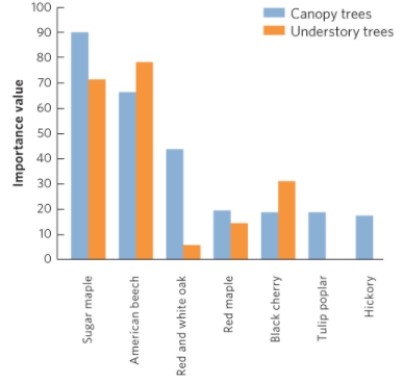 (Figure 19.16) If you excluded deer from the forest represented by the graph, what changes in importance would you likely see?
 (Multiple Choice)
4.9/5 (86)
(86) How could you tell for certain if a plant lived 2,000 years ago in a pond sediment sample?
(Multiple Choice)
4.9/5 (77)
(77) You observe three beech-maple forests in Indiana that began as ponds. How might you determine whether they all started succession with the same community composition?
(Multiple Choice)
4.7/5 (73)
(73) Some of the first species to colonize an area following disturbance have to persevere under inhospitable conditions such as disturbed soils, low soil moisture, and altered nutrient levels. This is an example of
(Multiple Choice)
4.8/5 (84)
(84) Early-succession plant species are often shade intolerant, whereas late-succession plant species are often shade tolerant. Why are differences in shade tolerance important in succession?
(Short Answer)
4.9/5 (69)
(69) Suppose two species of trees are able to colonize an area disturbed by fire. One species typically grows to 5 meters, while the other species tends to stay under 2 meters in height. The two species have seeds of the same shape that are relatively light. Which one is more likely to colonize the disturbed area and why?
(Short Answer)
4.8/5 (86)
(86) _____ is a mechanism of succession in which the probability that a species can establish itself depends on its dispersal ability and its ability to persist under the physical conditions of the environment.
(Multiple Choice)
4.7/5 (84)
(84) Which type of succession would be expected to be the slowest?
(Multiple Choice)
4.8/5 (81)
(81) Succession studied at Glacier Bay, Alaska, and on the island of Krakatau, Indonesia, has been done using
(Multiple Choice)
4.8/5 (80)
(80) A climax community that is not persistent is called a _____ climax community.
(Multiple Choice)
4.8/5 (67)
(67) A mechanism of succession in which the presence of one species increases the probability that a second species can become established is
(Multiple Choice)
4.8/5 (89)
(89) In the Great Basin Desert, many areas are dominated by sagebrush (Artemesia tridentata). Before settlement by Europeans, these areas had a greater diversity of native plants. What might have happened to cause the dominance of sagebrush?
(Essay)
4.9/5 (91)
(91) Chaparral vegetation found in southern California is an example of a climax community maintained by
(Multiple Choice)
4.7/5 (71)
(71) Invasion of cheatgrass (Bromus tectorum) in western North America is maintained by
(Multiple Choice)
4.8/5 (78)
(78) 
Filters
- Essay(0)
- Multiple Choice(0)
- Short Answer(0)
- True False(0)
- Matching(0)