



 Chat with AI
Exam 19: Community Succession

Exam 1: Introduction: Ecology, Evolution, and the Scientific Method65 Questions
Exam 2: Adaptations to Aquatic Environments 67 Questions
Exam 3: Adaptations to Terrestrial Environments 69 Questions
Exam 4: Adaptations to Variable Environments 65 Questions
Exam 5: Climates and Soils68 Questions
Exam 6: Terrestrial and Aquatic Biomes64 Questions
Exam 7: Evolution and Adaptation 68 Questions
Exam 8: Life Histories66 Questions
Exam 9: Reproductive Strategies65 Questions
Exam 10: Social Behaviors67 Questions
Exam 11: Population Distributions70 Questions
Exam 12: Population Growth and Regulation62 Questions
Exam 13: Population Dynamics Over Space and Time69 Questions
Exam 14: Predation and Herbivory69 Questions
Exam 15: Parasitism and Infectious Diseases68 Questions
Exam 16: Competition67 Questions
Exam 17: Mutualism68 Questions
Exam 18: Community Structure 66 Questions
Exam 19: Community Succession 120 Questions
Exam 20: Movement of Energy in Ecosystems 68 Questions
Exam 21: Movement of Elements in Ecosystems71 Questions
Exam 22: Landscape Ecology and Global Biodiversity 68 Questions
Exam 23: Global Conservation of Biodiversity67 Questions
Select questions type


In the Sonoran Desert of Arizona, young saguaro cacti often begin life in the shade of mesquite trees; they usually die if they begin life in out in the open. This is an example of
(Multiple Choice)
4.7/5  (85)
(85) In fire-maintained climax communities in the southeastern United States, periodic fires
(Multiple Choice)
4.9/5 (81)
(81) What are the characteristics of plants found immediately after a drought in a pond?
(Multiple Choice)
4.8/5 (83)
(83) Discuss how the classic explanation of lake/pond succession differs from the new model proposed in 2012.
(Essay)
4.9/5 (95)
(95) Electrical companies have discovered that dense shrub thickets, once established, can prevent growth of trees under power lines. Which mechanism of succession are these companies using by planting shrubs under power lines?
(Multiple Choice)
4.9/5 (87)
(87) Plants _____ should be used for initial seeding of abandoned strip mines.
(Multiple Choice)
4.9/5 (72)
(72) Legumes contain nitrogen-fixing bacteria in their roots that increase soil nitrogen for use by other species. This is an example of
(Multiple Choice)
4.8/5 (77)
(77) Which of the following is NOT an example of a habitat that could undergo primary succession?
(Multiple Choice)
4.7/5 (85)
(85) 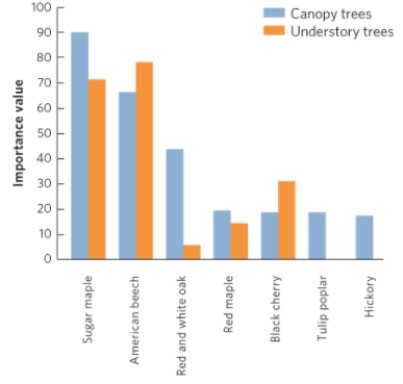 (Figure 19.16) This figure shows the importance of different tree species in the canopy and understory of a forest. Why did the researchers who conducted this study suggest that the future canopy will have fewer oaks and hickories?
 (Not Answered)
This question doesn't have any answer yet
Typical colonizers in primary succession are mosses and lichens that inhabit bare rock. What colonizers in primary succession do not inhabit bare rock?
(Short Answer)
4.7/5 (86)
(86) What characteristic shared by diatoms and cyanobacteria might make them good colonizers of nutrient-poor habitats?
(Multiple Choice)
5.0/5 (79)
(79) Describe the difference in seed strategy between early successional and late successional plants.
(Short Answer)
4.7/5 (77)
(77) Why does secondary succession occur faster than primary succession?
(Multiple Choice)
4.9/5 (63)
(63) Why must oxygen concentrations remain at low levels for pond succession to occur?
(Multiple Choice)
4.7/5 (69)
(69) Experimental removal of a single species in succession would
(Multiple Choice)
4.8/5 (77)
(77) When seeds of early- and late-succession species were raised under low light conditions similar to those found in the understory of a mature forest, researchers found that species with _____ seeds had _____ seedling survivorship in shade.
(Multiple Choice)
4.7/5 (80)
(80) 
Filters
- Essay(0)
- Multiple Choice(0)
- Short Answer(0)
- True False(0)
- Matching(0)