



 Chat with AI
Exam 14: Predation and Herbivory

Exam 1: Introduction: Ecology, Evolution, and the Scientific Method65 Questions
Exam 2: Adaptations to Aquatic Environments 67 Questions
Exam 3: Adaptations to Terrestrial Environments 69 Questions
Exam 4: Adaptations to Variable Environments 65 Questions
Exam 5: Climates and Soils68 Questions
Exam 6: Terrestrial and Aquatic Biomes64 Questions
Exam 7: Evolution and Adaptation 68 Questions
Exam 8: Life Histories66 Questions
Exam 9: Reproductive Strategies65 Questions
Exam 10: Social Behaviors67 Questions
Exam 11: Population Distributions70 Questions
Exam 12: Population Growth and Regulation62 Questions
Exam 13: Population Dynamics Over Space and Time69 Questions
Exam 14: Predation and Herbivory69 Questions
Exam 15: Parasitism and Infectious Diseases68 Questions
Exam 16: Competition67 Questions
Exam 17: Mutualism68 Questions
Exam 18: Community Structure 66 Questions
Exam 19: Community Succession 120 Questions
Exam 20: Movement of Energy in Ecosystems 68 Questions
Exam 21: Movement of Elements in Ecosystems71 Questions
Exam 22: Landscape Ecology and Global Biodiversity 68 Questions
Exam 23: Global Conservation of Biodiversity67 Questions
Select questions type


Lotka-Volterra models of predator-prey interactions show that

Free
(Multiple Choice)
4.8/5  (82)
(82) Correct Answer: Verified
A
Plant alkaloids act as chemical defense against herbivory because they
Free
(Multiple Choice)
4.9/5 (71)
(71) Correct Answer:Verified
VerifiedA
How was the invasive plant the Klamath weed (Hypericum perforatum) controlled in California?
Free
(Multiple Choice)
4.9/5 (67)
(67) Correct Answer:Verified
VerifiedA
In Lotka-Volterra models, a population is stable when its rate of change is
(Multiple Choice)
4.9/5 (74)
(74) Draw the shape of the curves for type I, II, and III functional responses for predator and prey population.
(Essay)
5.0/5 (91)
(91) A species has been transplanted to a region of the world where historically it did not exist. It spreads rapidly and harms native species. This is known as a(n)
(Multiple Choice)
5.0/5 (79)
(79) The introduction of the brown tree snake (Boiga irregularis) to Guam decimated the native fauna because
(Multiple Choice)
4.8/5 (88)
(88) According to Lotka and Voltera what information was required to calculate the change in population size of the predator over time (dP/dt)?
(Multiple Choice)
4.8/5 (92)
(92) The common wasp (Vespula vulgaris), the hover fly (Helophilus pendulus), and the hornet clearwing (Sesia apiformis) all exhibit similar color patterns, but only the wasp is harmful. What benefit, if any, do the hornet and fly gain from having coloring similar to that of the wasp?
(Short Answer)
4.8/5 (78)
(78) Which functional response curve shows a satiation of the predator at high prey densities?
(Multiple Choice)
4.7/5 (71)
(71) Simultaneous examination of predator and prey population trends is called a
(Multiple Choice)
4.8/5 (86)
(86) Describe what is occurring with predator and prey populations in each of the four sections of the figure. 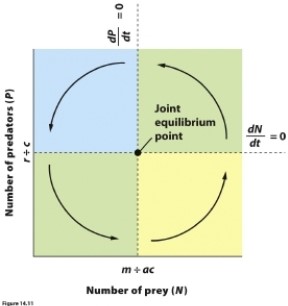
(Not Answered)
This question doesn't have any answer yet
In Lotka-Volterra models of predator-prey interactions, the growth rate of the prey population is represented by
(Multiple Choice)
4.8/5 (77)
(77) Humans have had the largest impact on natural systems as a result of
(Multiple Choice)
4.8/5 (67)
(67) The two basic hunting strategies [active hunting vs. ambush (sit-and-wait hunting)] are both successful strategies under differing conditions. What characteristics of the prey might be associated with these two hunting strategies?
(Essay)
4.9/5 (82)
(82) At the equilibrium isocline for prey, the population of predators
(Multiple Choice)
4.8/5 (87)
(87) The nonpoisonous scarlet king snake (Lampropeltis elapsoides) found in the eastern United States has similar coloration to that of the poisonous eastern coral snake (Micrurus fulvius). This is an example of
(Multiple Choice)
5.0/5 (63)
(63) A type _____ functional response occurs when a predator's rate of prey consumption increases linearly with increasing prey and then satiates.
(Multiple Choice)
4.8/5 (74)
(74) 
Filters
- Essay(0)
- Multiple Choice(0)
- Short Answer(0)
- True False(0)
- Matching(0)