



 Chat with AI
Exam 4: Adaptations to Variable Environments

Exam 1: Introduction: Ecology, Evolution, and the Scientific Method65 Questions
Exam 2: Adaptations to Aquatic Environments 67 Questions
Exam 3: Adaptations to Terrestrial Environments 69 Questions
Exam 4: Adaptations to Variable Environments 65 Questions
Exam 5: Climates and Soils68 Questions
Exam 6: Terrestrial and Aquatic Biomes64 Questions
Exam 7: Evolution and Adaptation 68 Questions
Exam 8: Life Histories66 Questions
Exam 9: Reproductive Strategies65 Questions
Exam 10: Social Behaviors67 Questions
Exam 11: Population Distributions70 Questions
Exam 12: Population Growth and Regulation62 Questions
Exam 13: Population Dynamics Over Space and Time69 Questions
Exam 14: Predation and Herbivory69 Questions
Exam 15: Parasitism and Infectious Diseases68 Questions
Exam 16: Competition67 Questions
Exam 17: Mutualism68 Questions
Exam 18: Community Structure 66 Questions
Exam 19: Community Succession 120 Questions
Exam 20: Movement of Energy in Ecosystems 68 Questions
Exam 21: Movement of Elements in Ecosystems71 Questions
Exam 22: Landscape Ecology and Global Biodiversity 68 Questions
Exam 23: Global Conservation of Biodiversity67 Questions
Select questions type


This figure shows the tail shape developed by three tadpole genotypes (M, N, and O) when raised in an environment with predators and an environment without predators. In the presence of predators, tadpoles with large tails have high fitness and tadpoles with small tails have low fitness. When predators are not present, tadpoles with large tails have low fitness and tadpoles with small tails have high fitness. 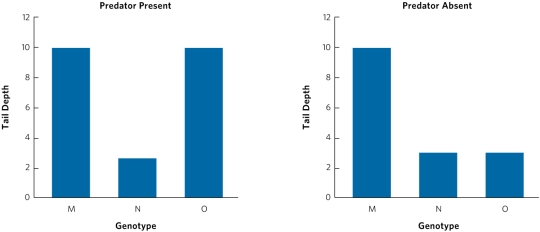 Which genotype(s) exhibit(s) phenotypic plasticity in response to predators?
Free
(Multiple Choice)
4.8/5  (78)
(78) Correct Answer: Verified
C
Over the course of a day, a snake will move from place to place to reach its preferred body temperature. This is an example of
Free
(Multiple Choice)
4.7/5 (73)
(73) Correct Answer:Verified
VerifiedA
Consider the figure, which shows how Virginia pepperweed responds to herbivores. Which of the following conclusions can we make solely using the data shown? 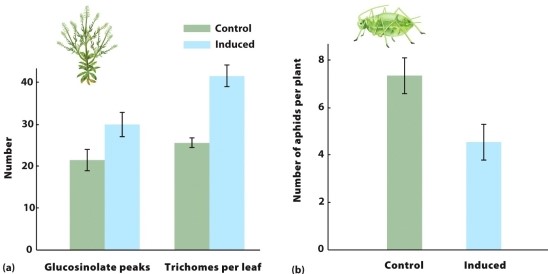 I. Plants increased glucosinolate production when aphids were present.
II) Plants with more glucosinolate and trichomes had fewer aphids.
III) Producing glucosinolate and trichomes reduced plant fitness when aphids were absent.
I. Plants increased glucosinolate production when aphids were present.
II) Plants with more glucosinolate and trichomes had fewer aphids.
III) Producing glucosinolate and trichomes reduced plant fitness when aphids were absent.Free
(Multiple Choice)
4.9/5 (74)
(74) Correct Answer:Verified
VerifiedD
A risk to a migratory species like the monarch butterfly may include all of the following except
(Multiple Choice)
5.0/5 (83)
(83) Which of the following are phenotypically plastic responses of plants to reduced water availability?
I. develop trichomes and produce more glucosinolate
II. close stomata in leaves
III. increase the root/shoot ratio
(Multiple Choice)
4.8/5 (84)
(84) Explain why many prey species reduce activity when they detect predators but have high activity when they do not detect predators.
(Short Answer)
4.8/5 (87)
(87) Plants develop trichomes and produce glucosinolates as adaptive phenotypic plasticity to
(Multiple Choice)
4.9/5 (68)
(68) Based on the central-place foraging theory and the figure, identify the optimal number of prey for a forager to catch. In the figure the straight orange line indicates the optimal rate of prey capture. 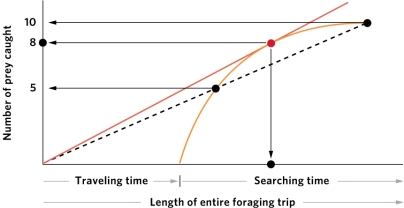
(Multiple Choice)
4.9/5 (70)
(70) Many Arctic animals accumulate fat as an energy reserve that allows them to survive winter when food is difficult to obtain. This strategy is an example of
(Multiple Choice)
4.9/5 (80)
(80) Red-backed salamanders (Plethodon cinereus) occur simultaneously in several different color morphs in nature. Individuals may be red backed (having a red stripe down the back), lead backed (a blackish stripe) and erocrystic (a yellow stripe). If these color morphs conferred differing fitness levels in differing environments, this would be considered an example of
(Multiple Choice)
4.9/5 (81)
(81) Consider a species of squirrel that eats acorns and maple seeds. Define the diet-mixing hypothesis and describe an experiment that would test whether squirrels eat both acorns and seeds because of the diet-mixing hypothesis. As part of your answer, describe the experimental treatments, the response variable that would be measured, and results that would both support and reject the diet-mixing hypothesis.
(Essay)
4.8/5 (76)
(76) When a given phenotype has higher fitness in one environment and different phenotypes have higher fitness in other environments, this is considered to be
(Multiple Choice)
4.7/5 (84)
(84) What types of plants and animals are able to reproduce even if they cannot find a mate?
(Multiple Choice)
4.9/5 (80)
(80) In response to a specific type of environmental variation, the Burmese python can drastically increase the size of its heart and length of its intestines in fewer than 2 days. What environmental variation causes this drastic change?
(Multiple Choice)
4.8/5 (87)
(87) Explain the differences and similarities between storage and dormancy as adaptive strategies, and provide an example.
(Essay)
4.8/5 (83)
(83) Which type of variation refers to the typical atmospheric conditions that occur throughout the year and are measured over multiple years?
(Multiple Choice)
4.7/5 (74)
(74) Why is it beneficial for birds and mammals with high surface-area-to-volume ratios to reduce their body temperature for short periods?
(Multiple Choice)
4.8/5 (75)
(75) A specific location within the area where an animal lives and typically contains more favorable abiotic conditions than other locations in the area is a(n)
(Multiple Choice)
4.8/5 (88)
(88) 
Filters
- Essay(0)
- Multiple Choice(0)
- Short Answer(0)
- True False(0)
- Matching(0)