



 Chat with AI
Exam 4: Adaptations to Variable Environments

Exam 1: Introduction: Ecology, Evolution, and the Scientific Method65 Questions
Exam 2: Adaptations to Aquatic Environments 67 Questions
Exam 3: Adaptations to Terrestrial Environments 69 Questions
Exam 4: Adaptations to Variable Environments 65 Questions
Exam 5: Climates and Soils68 Questions
Exam 6: Terrestrial and Aquatic Biomes64 Questions
Exam 7: Evolution and Adaptation 68 Questions
Exam 8: Life Histories66 Questions
Exam 9: Reproductive Strategies65 Questions
Exam 10: Social Behaviors67 Questions
Exam 11: Population Distributions70 Questions
Exam 12: Population Growth and Regulation62 Questions
Exam 13: Population Dynamics Over Space and Time69 Questions
Exam 14: Predation and Herbivory69 Questions
Exam 15: Parasitism and Infectious Diseases68 Questions
Exam 16: Competition67 Questions
Exam 17: Mutualism68 Questions
Exam 18: Community Structure 66 Questions
Exam 19: Community Succession 120 Questions
Exam 20: Movement of Energy in Ecosystems 68 Questions
Exam 21: Movement of Elements in Ecosystems71 Questions
Exam 22: Landscape Ecology and Global Biodiversity 68 Questions
Exam 23: Global Conservation of Biodiversity67 Questions
Select questions type


If a goldfish is acclimated at 25°C, at which temperature would we expect the fish to swim fastest?
(Multiple Choice)
4.8/5  (84)
(84) The figure shows plant growth responses to variation in availability of water. If this is an example of adaptive phenotypic plasticity, how would we expect the root-to-shoot ratio to be related to fitness? 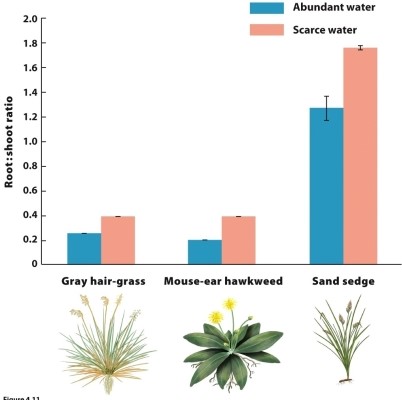
(Multiple Choice)
4.8/5 (82)
(82) Based on the figure, describe the phenotypic trade-offs of a fish being acclimated to 25°C compared to a fish acclimated to 5°C. 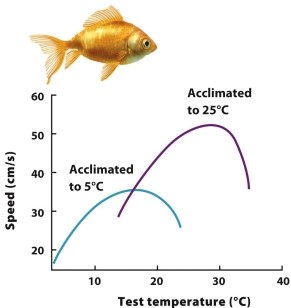
(Not Answered)
This question doesn't have any answer yet
This figure shows the tail shape developed by three tadpole genotypes (M, N, and O) when raised in an environment with predators and an environment without predators. In the presence of predators, tadpoles with large tails have high fitness and tadpoles with small tails have low fitness. When predators are not present, tadpoles with large tails have low fitness and tadpoles with small tails have high fitness. 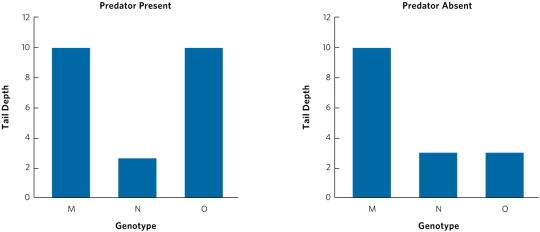 Under which of the following situations would the plastic genotype be favored over other genotypes?
I. if all environments have predators
II. if no environments have predators
III. if environments with predators are as common as environments without predators
Under which of the following situations would the plastic genotype be favored over other genotypes?
I. if all environments have predators
II. if no environments have predators
III. if environments with predators are as common as environments without predators (Multiple Choice)
4.9/5 (88)
(88) 
Filters
- Essay(0)
- Multiple Choice(0)
- Short Answer(0)
- True False(0)
- Matching(0)