



 Chat with AI
Exam 16: Competition

Exam 1: Introduction: Ecology, Evolution, and the Scientific Method65 Questions
Exam 2: Adaptations to Aquatic Environments 67 Questions
Exam 3: Adaptations to Terrestrial Environments 69 Questions
Exam 4: Adaptations to Variable Environments 65 Questions
Exam 5: Climates and Soils68 Questions
Exam 6: Terrestrial and Aquatic Biomes64 Questions
Exam 7: Evolution and Adaptation 68 Questions
Exam 8: Life Histories66 Questions
Exam 9: Reproductive Strategies65 Questions
Exam 10: Social Behaviors67 Questions
Exam 11: Population Distributions70 Questions
Exam 12: Population Growth and Regulation62 Questions
Exam 13: Population Dynamics Over Space and Time69 Questions
Exam 14: Predation and Herbivory69 Questions
Exam 15: Parasitism and Infectious Diseases68 Questions
Exam 16: Competition67 Questions
Exam 17: Mutualism68 Questions
Exam 18: Community Structure 66 Questions
Exam 19: Community Succession 120 Questions
Exam 20: Movement of Energy in Ecosystems 68 Questions
Exam 21: Movement of Elements in Ecosystems71 Questions
Exam 22: Landscape Ecology and Global Biodiversity 68 Questions
Exam 23: Global Conservation of Biodiversity67 Questions
Select questions type


When wolves and coyotes compete, reductions in numbers of coyotes are attributed to a virus the wolves carry that is more harmful in coyotes. This is an example of

Free
(Multiple Choice)
4.9/5  (83)
(83) Correct Answer: Verified
A
Which of the following is NOT an example of a resource?
Free
(Multiple Choice)
4.7/5 (80)
(80) Correct Answer:Verified
VerifiedA
In Morin's competition experiment, ponds contained tadpoles of three species and a species of newt. Newts in increasing numbers were added to ponds containing the tadpoles. How did the number of newts affect competition among tadpoles?
Free
(Multiple Choice)
4.8/5 (93)
(93) Correct Answer:Verified
VerifiedA
The research on competition between sage and grasses in California demonstrated that the bare zone surrounding purple sage shrubs (Salvia leucophylla) was due to
(Multiple Choice)
4.9/5 (60)
(60) Species that produce chemicals for whatever reason pay a price. Whether the chemical allows them to be a more effective prey (i.e., less likely to be taken by a predator) or a better competitor, the chemical produced by the organism has a cost that must be accounted for and could have been used for other purposes (i.e., reproduction). Discuss the costs associated with garlic mustard's production of the chemical sinigrin. How should the production of the chemical change as the species residency time in a particular forested area increases? Why would this change in production make sense?
(Essay)
4.9/5 (62)
(62) 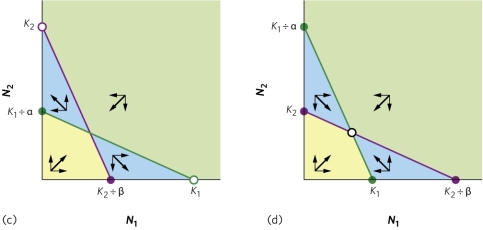 (Figure 16.8c and d) Compare the outcomes of competition between species 1 and 2 in the figure. Justify your answers.
 (Not Answered)
This question doesn't have any answer yet
Tansley's experiments with bedstraw (Galium) showed that closely related species reduce competition by
(Multiple Choice)
4.8/5 (76)
(76) In the study of the diatoms Synedra and Asterionella, Synedra was a better competitor than Asterionella because Synedra
(Multiple Choice)
4.8/5 (82)
(82) Researchers studying sex ratios among field mice expect to find a 50:50 ratio of males to females. Instead they find 1,120 females and 975 males at their site. Use a chi-square analysis to determine whether the field mouse population at their site significantly differs from a 50:50 sex ratio. Assume a critical chi-square value of 3.841 for = 0.05 and 1 degree of freedom.
(Short Answer)
4.8/5 (76)
(76) Researchers perform an experiment on a long-lived perennial shrub in a semiarid site where the soil is low in nitrogen. They fertilize the plants with nitrogen, but the treated plants do not increase their growth compared to control plants. What is a reasonable hypothesis for this result?
(Essay)
4.9/5 (77)
(77) When looking at a competitive interaction between chipmunks and gray squirrels, you determine the competition coefficient for chipmunks is 0.25. How many chipmunks would need to be added to the chipmunk population to have the same effect as adding one gray squirrel to the gray squirrel population (relative to resource use and carrying capacity)?
(Multiple Choice)
5.0/5 (74)
(74) Organisms often have specific environmental requirements. For example, many organisms can live only within a narrow range of temperatures, nutrient levels, pH, humidity, soil moisture, and soil type. They require specific nesting sites, mates, and prey. Which (if any) of these factors are considered resources? What distinguishes resources from the other environmental factors?
(Essay)
4.9/5 (87)
(87) Imagine a population of 600 mice and 350 chipmunks. The chipmunks and mice eat some of the same food, but the food to support 1,000 mice would support only 300 chipmunks. What would and be for this population in which mice are species 1 and chipmunks are species 2?
(Multiple Choice)
4.8/5 (73)
(73) 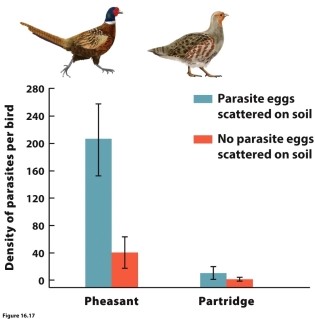 In the study of the gray partridge and ring-necked pheasant in the United Kingdom, researchers found that gray partridges were declining. A parasitic nematode seemed to negatively affect partridges. The pheasants that carried the parasites were not negatively affected. Researchers performed an experiment in which they allowed both species to feed in one of two enclosures: enclosures with parasite eggs scattered on the floor or enclosures without parasite eggs. The results are shown in the nearby figure. What did the researchers conclude? Was competition occurring, and if so what type?
 (Not Answered)
This question doesn't have any answer yet
The result of a chi-square test gives 2 = 35.95, 2 critical = 14.98. What is the conclusion of the analysis?
(Multiple Choice)
4.8/5 (82)
(82) In David Tilman's experiments with the diatoms Cyclotella and Asterionella, when the diatoms were grown at silicon/phosphorus ratios between 6 and 90, why did the two species coexist?
(Multiple Choice)
4.8/5 (75)
(75) 
Filters
- Essay(0)
- Multiple Choice(0)
- Short Answer(0)
- True False(0)
- Matching(0)