



 Chat with AI
Exam 14: Predation and Herbivory

Exam 1: Introduction: Ecology, Evolution, and the Scientific Method65 Questions
Exam 2: Adaptations to Aquatic Environments 67 Questions
Exam 3: Adaptations to Terrestrial Environments 69 Questions
Exam 4: Adaptations to Variable Environments 65 Questions
Exam 5: Climates and Soils68 Questions
Exam 6: Terrestrial and Aquatic Biomes64 Questions
Exam 7: Evolution and Adaptation 68 Questions
Exam 8: Life Histories66 Questions
Exam 9: Reproductive Strategies65 Questions
Exam 10: Social Behaviors67 Questions
Exam 11: Population Distributions70 Questions
Exam 12: Population Growth and Regulation62 Questions
Exam 13: Population Dynamics Over Space and Time69 Questions
Exam 14: Predation and Herbivory69 Questions
Exam 15: Parasitism and Infectious Diseases68 Questions
Exam 16: Competition67 Questions
Exam 17: Mutualism68 Questions
Exam 18: Community Structure 66 Questions
Exam 19: Community Succession 120 Questions
Exam 20: Movement of Energy in Ecosystems 68 Questions
Exam 21: Movement of Elements in Ecosystems71 Questions
Exam 22: Landscape Ecology and Global Biodiversity 68 Questions
Exam 23: Global Conservation of Biodiversity67 Questions
Select questions type


What does it mean when scientists set the alpha at .05 for a statistical test?
(Short Answer)
4.8/5  (82)
(82) The biocontrol species cactus moth (Cactoblastis cactorum) has not been able to eradicate the invasive prickly pear cactus from Australia because
(Multiple Choice)
4.9/5 (70)
(70) The Indian gray mongoose (Herpestes edwardsii) is a small mammal that is known for its ability to kill venomous king cobras (Ophiophagus hannah). Mongooses have evolved acetylcholine receptors that make them resistant or immune to the cobra's venom. What is likely responsible for this?
(Multiple Choice)
4.9/5 (86)
(86) Ladybugs (Coccinella septempunctata) produce bad-tasting alkaloids as a chemical defense against predators. Researchers wanted to determine the costs of this chemical defense. They fed ladybugs either small or large amounts of food and measured alkaloid production and concentrations of carotenoids in the ladybug bodies. Carotenoids are the chemicals responsible for the red color of the ladybug, which advertises its unpalatability to predators. What do the results of this experiment, shown in the figure, indicate about costs of chemical defenses? 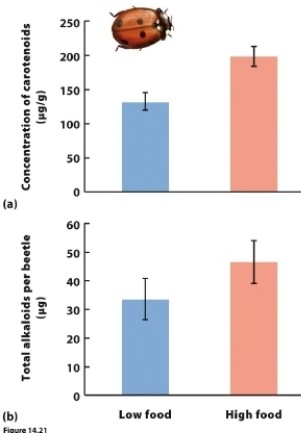
(Not Answered)
This question doesn't have any answer yet
The resemblance of poison dart frog species of the genus Ranitomeya to one another in Peru is an example of
(Multiple Choice)
4.7/5 (95)
(95) Describe the difference between Batesian Mimicry and Müllerian Mimicry.
(Essay)
4.8/5 (81)
(81) For some predators, as prey density increases, the rate of consumption slows and eventually levels off with satiation. This is a type _____ functional response.
(Multiple Choice)
4.9/5 (76)
(76) Which of the following chemical defenses makes plants difficult for herbivores to digest?
(Multiple Choice)
5.0/5 (81)
(81) Which functional response curve shows a slower rate of consumption of prey at low prey density levels due to the predator learning a search image for the prey?
(Multiple Choice)
4.9/5 (90)
(90) A functional response in predatory-prey cycles is the relation between the density of
(Multiple Choice)
4.7/5 (76)
(76) Which term best describes the brown tree snake based on its impact on the island of Guam?
(Multiple Choice)
4.9/5 (75)
(75) Which of the following is NOT a behavioral defense against predation?
(Multiple Choice)
4.9/5 (87)
(87) A numerical response is a change in the number of predators due to all of the following EXCEPT
(Multiple Choice)
4.8/5 (74)
(74) Researchers studying production of nicotine in tobacco plants (Nicotiana sylvestris) treated some of the plants with a hormone that prevents the chemical defenses from responding to herbivory. What did they find to be the cost of nicotine production?
(Multiple Choice)
4.8/5 (78)
(78) How does the removal of top predators affect mesopredator populations?
(Multiple Choice)
4.7/5 (92)
(92) Reductions in bay scallops in the Atlantic Ocean were caused by a(n)
(Multiple Choice)
4.9/5 (85)
(85) The crucian carp (Carassius carassius) develops a muscular hump on its back that increases its acceleration in response to predators. This is an example of
(Multiple Choice)
4.9/5 (81)
(81) According to Lotka and Volterra, what information was required to calculate the change in population size of the prey over time (dN/dt)?
(Multiple Choice)
4.8/5 (71)
(71) 
Filters
- Essay(0)
- Multiple Choice(0)
- Short Answer(0)
- True False(0)
- Matching(0)