



 Chat with AI
Exam 14: Predation and Herbivory

Exam 1: Introduction: Ecology, Evolution, and the Scientific Method65 Questions
Exam 2: Adaptations to Aquatic Environments 67 Questions
Exam 3: Adaptations to Terrestrial Environments 69 Questions
Exam 4: Adaptations to Variable Environments 65 Questions
Exam 5: Climates and Soils68 Questions
Exam 6: Terrestrial and Aquatic Biomes64 Questions
Exam 7: Evolution and Adaptation 68 Questions
Exam 8: Life Histories66 Questions
Exam 9: Reproductive Strategies65 Questions
Exam 10: Social Behaviors67 Questions
Exam 11: Population Distributions70 Questions
Exam 12: Population Growth and Regulation62 Questions
Exam 13: Population Dynamics Over Space and Time69 Questions
Exam 14: Predation and Herbivory69 Questions
Exam 15: Parasitism and Infectious Diseases68 Questions
Exam 16: Competition67 Questions
Exam 17: Mutualism68 Questions
Exam 18: Community Structure 66 Questions
Exam 19: Community Succession 120 Questions
Exam 20: Movement of Energy in Ecosystems 68 Questions
Exam 21: Movement of Elements in Ecosystems71 Questions
Exam 22: Landscape Ecology and Global Biodiversity 68 Questions
Exam 23: Global Conservation of Biodiversity67 Questions
Select questions type


On Macquarie Island invasive rabbits were causing declines in palatable vegetation, and feral cats were preying on native birds. What was the primary result when a flea carrying a virus that killed the rabbits decreased rabbits' numbers on the island?
(Multiple Choice)
4.9/5  (86)
(86) In Lotka-Volterra predator-prey models, prey populations decrease when
(Multiple Choice)
4.8/5 (94)
(94) In Lotka-Volterra models of predator-prey interactions, c represents the
(Multiple Choice)
4.8/5 (89)
(89) What is true about the Lotka-Volterra model for predator and prey?
(Multiple Choice)
4.8/5 (91)
(91) In Lotka-Volterra models of predator-prey interactions, the growth rate of the predator population is represented by
(Multiple Choice)
4.8/5 (66)
(66) Experiments with fences that exclude deer and other plant herbivores from grazing showed greater plant biomass in fenced areas than in unfenced control areas. The few plant species that remain in unfenced areas are those that
(Multiple Choice)
4.8/5 (89)
(89) Reduced growth and development due to reduced feeding and foraging activity is a cost of
(Multiple Choice)
4.9/5 (76)
(76) What is the driving force in the 10-year cycle of lynx and hare abundance?
(Multiple Choice)
4.8/5 (83)
(83) In Lotka-Volterra predator-prey models, the equilibrium isocline for prey is represented as
(Multiple Choice)
4.9/5 (87)
(87) In rocky shore communities in which sea urchins lived among populations of brown algae and other species of algae, sea urchins were experimentally removed. What happened in response to sea urchin removal?
(Short Answer)
4.8/5 (62)
(62) In experiments with the backswimmer (Notonecta glauca), a predatory insect, and two types of prey species, isopods (Asellus aquaticus) and mayflies (Coeon dipterum), predator preference seemed to be affected by the percentage of mayflies. What explains the results presented in the figure? What type of functional response is being demonstrated? 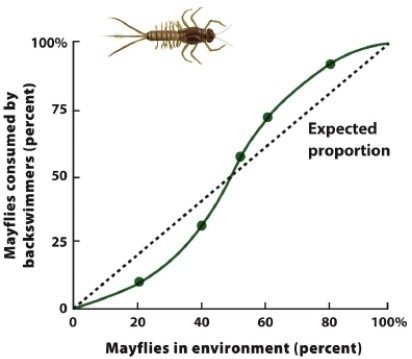
(Not Answered)
This question doesn't have any answer yet
Milkweeds use _____ as a chemical defense against herbivory.
(Multiple Choice)
4.9/5 (69)
(69) The figure shows results of a study in which scientists observed the responses of tadpoles to a caged predator and an empty control cage in tubs of water. The caged predator emitted a chemical that alerted the tadpoles to its presence but was not able to kill tadpoles. Based on the figure, how did tadpoles respond to the experiment, and what type of defense did they exhibit? 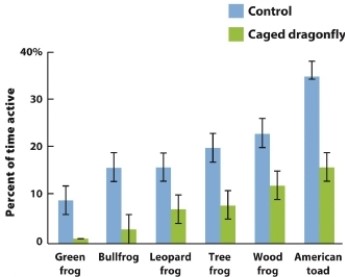
(Not Answered)
This question doesn't have any answer yet
Wolves hunt in packs that chase down their prey. This is an example of
(Multiple Choice)
4.9/5 (70)
(70) In Lotka-Volterra predator-prey models, predator populations decrease when
(Multiple Choice)
4.8/5 (80)
(80) Predators that live in the Canadian tundra and feed on larger herbivores tend to have _____ population cycles, and predators that feed on smaller herbivores tend to have _____ population cycles.
(Multiple Choice)
4.8/5 (70)
(70) 
Filters
- Essay(0)
- Multiple Choice(0)
- Short Answer(0)
- True False(0)
- Matching(0)