



 Chat with AI
Exam 19: Community Succession

Exam 1: Introduction: Ecology, Evolution, and the Scientific Method65 Questions
Exam 2: Adaptations to Aquatic Environments 67 Questions
Exam 3: Adaptations to Terrestrial Environments 69 Questions
Exam 4: Adaptations to Variable Environments 65 Questions
Exam 5: Climates and Soils68 Questions
Exam 6: Terrestrial and Aquatic Biomes64 Questions
Exam 7: Evolution and Adaptation 68 Questions
Exam 8: Life Histories66 Questions
Exam 9: Reproductive Strategies65 Questions
Exam 10: Social Behaviors67 Questions
Exam 11: Population Distributions70 Questions
Exam 12: Population Growth and Regulation62 Questions
Exam 13: Population Dynamics Over Space and Time69 Questions
Exam 14: Predation and Herbivory69 Questions
Exam 15: Parasitism and Infectious Diseases68 Questions
Exam 16: Competition67 Questions
Exam 17: Mutualism68 Questions
Exam 18: Community Structure 66 Questions
Exam 19: Community Succession 120 Questions
Exam 20: Movement of Energy in Ecosystems 68 Questions
Exam 21: Movement of Elements in Ecosystems71 Questions
Exam 22: Landscape Ecology and Global Biodiversity 68 Questions
Exam 23: Global Conservation of Biodiversity67 Questions
Select questions type


What information about species is needed to calculate Jaccard's index?
(Multiple Choice)
4.9/5  (82)
(82) In the study of Oregon intertidal communities, little brown barnacles (Chthamalus dalii) are first to colonize disturbed areas. Over time, the acorn barnacle (Balanus glandula) dominates the community. Which mechanism of succession explains the relationship between the two species of barnacles?
(Multiple Choice)
4.9/5 (83)
(83) Suppose that seeds from large canopy trees land in an area where facilitators made the soil fertile for their germination. What are two factors that might prevent these trees from growing to maturity?
(Short Answer)
4.8/5 (90)
(90) A sequence of communities that exist over time at a given location is
(Multiple Choice)
4.7/5 (81)
(81) The assumptions behind the valid use of chronosequences are usually not all met. How, then, do researchers establish the most likely scenario of terrestrial succession in a given area?
(Short Answer)
4.8/5 (82)
(82) 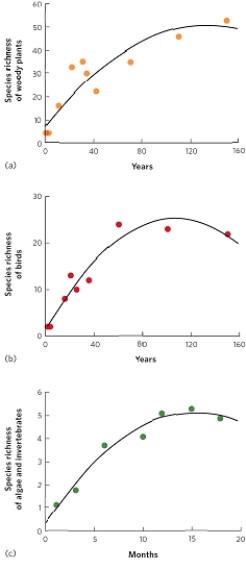 (Figure 19.11) These graphs show that succession is associated with a rapid increase in species richness that slows and levels off over time. How might you explain a graph showing succession with an initial increase in species richness followed by a decline in species richness over time?
 (Multiple Choice)
4.9/5 (70)
(70) When succession was initially observed on the island of Krakatau, plants with _____ seeds dominated.
(Multiple Choice)
4.9/5 (70)
(70) In some areas of the western United States, pines are an important part of the climax community. Fires occur at regular intervals in these areas. How could fire maintain these pine populations?
(Multiple Choice)
4.8/5 (86)
(86) It is known that as succession progresses from an early seral stage to a later seral stage, not only do the plants change but so too do the animals. A possible reason for this change in animals present may be
(Multiple Choice)
4.7/5 (94)
(94) Describe the difference in seedling strategy between early successional and late successional plants and explain why such a strategy makes sense.
(Essay)
4.9/5 (82)
(82) How do herbivores affect the outcome of succession in intertidal zones?
(Multiple Choice)
4.9/5 (83)
(83) Early seral stages of terrestrial succession are dependent upon rates of
(Multiple Choice)
5.0/5 (82)
(82) Why were wind- and sea-dispersed seeds the first to colonize and survive on Krakatau?
(Multiple Choice)
4.7/5 (85)
(85) The receding glacier at Glacier Bay in Alaska has been used to study
(Multiple Choice)
4.8/5 (76)
(76) Which of the following habitats could NOT undergo secondary succession?
(Multiple Choice)
4.7/5 (74)
(74) 
Filters
- Essay(0)
- Multiple Choice(0)
- Short Answer(0)
- True False(0)
- Matching(0)