



 Chat with AI
Exam 8: Life Histories

Exam 1: Introduction: Ecology, Evolution, and the Scientific Method65 Questions
Exam 2: Adaptations to Aquatic Environments 67 Questions
Exam 3: Adaptations to Terrestrial Environments 69 Questions
Exam 4: Adaptations to Variable Environments 65 Questions
Exam 5: Climates and Soils68 Questions
Exam 6: Terrestrial and Aquatic Biomes64 Questions
Exam 7: Evolution and Adaptation 68 Questions
Exam 8: Life Histories66 Questions
Exam 9: Reproductive Strategies65 Questions
Exam 10: Social Behaviors67 Questions
Exam 11: Population Distributions70 Questions
Exam 12: Population Growth and Regulation62 Questions
Exam 13: Population Dynamics Over Space and Time69 Questions
Exam 14: Predation and Herbivory69 Questions
Exam 15: Parasitism and Infectious Diseases68 Questions
Exam 16: Competition67 Questions
Exam 17: Mutualism68 Questions
Exam 18: Community Structure 66 Questions
Exam 19: Community Succession 120 Questions
Exam 20: Movement of Energy in Ecosystems 68 Questions
Exam 21: Movement of Elements in Ecosystems71 Questions
Exam 22: Landscape Ecology and Global Biodiversity 68 Questions
Exam 23: Global Conservation of Biodiversity67 Questions
Select questions type


Explain how human fishing for larger individuals from a population of fish can reduce the average maturation time in the population.
(Essay)
5.0/5  (77)
(77) Which panel best illustrates the most direct effect of predation? 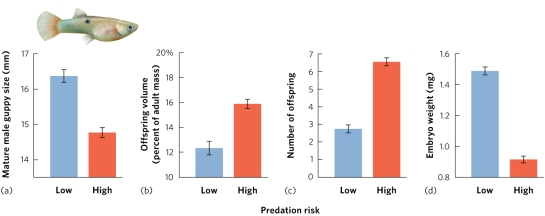
(Multiple Choice)
4.8/5 (89)
(89) What type of reproduction will be favored if adult plant survival is low because of a disturbance such as fire?
(Multiple Choice)
4.8/5 (79)
(79) Many animals undergo a dramatic metamorphosis from larval to adult form. Poorly nourished animals cannot grow as fast as well-nourished animals and therefore do not reach a given mass as quickly as their well-nourished counterparts. If metamorphosis occurs when a specific minimum body mass is reached, which of the following costs is most likely incurred by a poorly nourished animal?
(Multiple Choice)
4.8/5 (78)
(78) Some marine snails (species L) produce large numbers of small eggs that are shed into the sea, hatch at an early stage of development, and feed on microscopic plants. Other marine snails (species S) produce few eggs that are retained for a long time within the body of the mother snail in a brood pouch, hatch at an advanced stage of development, and immediately begin to feed on the surfaces of large plants like the adults. A biologist discovers approximately equal numbers of adults of species L and S in the same area over many generations. While studying the two species of snails, the biologist hypothesizes that the two species expend approximately the same amount of energy producing young. What assumption is the biologist making?
(Multiple Choice)
4.9/5 (64)
(64) The principle of allocation states that life history traits are adapted to maximize
(Multiple Choice)
4.9/5 (79)
(79) A mature female sockeye salmon swims up to 5,000 km from her Pacific Ocean feeding ground to the mouth of a coastal river in British Columbia and then another 1,000 km upstream to her spawning ground. Once there, she lays thousands of eggs in her single reproductive event and promptly dies. The salmon's reproductive life history is
(Multiple Choice)
4.7/5 (88)
(88) Birds and mammals tend to have shorter times to sexual maturity as compared to reptiles and fish. Why?
(Multiple Choice)
4.9/5 (77)
(77) Which plant life history type, fast or slow, would best describe a weed species that is a good invader of new habitats?
(Short Answer)
5.0/5 (89)
(89) Describe the difference between an organism that displays determinate growth and an organism that displays indeterminate growth. Provide examples of organisms that display each growth type.
(Essay)
4.8/5 (94)
(94) Which of the following does NOT apply to indeterminate growth?
(Multiple Choice)
4.9/5 (82)
(82) A gradual decrease in fecundity and increase in the probability of mortality is known as
(Multiple Choice)
4.8/5 (79)
(79) What environmental factor would likely lead to later maturation with an iteroparous reproductive strategy?
(Multiple Choice)
4.8/5 (77)
(77) What is meant by the principle of allocation and how is this concept related to fitness?
(Essay)
4.9/5 (78)
(78) The number of chicks fledged in a brood may not be independent of the number of eggs produced. How might researchers test these variables independently to determine whether there is a relationship between them?
(Essay)
4.9/5 (79)
(79) The amount of light that occurs each day and changes as the seasons progress is termed
(Multiple Choice)
4.8/5 (67)
(67) 
Filters
- Essay(0)
- Multiple Choice(0)
- Short Answer(0)
- True False(0)
- Matching(0)