



 Chat with AI
Exam 8: Life Histories

Exam 1: Introduction: Ecology, Evolution, and the Scientific Method65 Questions
Exam 2: Adaptations to Aquatic Environments 67 Questions
Exam 3: Adaptations to Terrestrial Environments 69 Questions
Exam 4: Adaptations to Variable Environments 65 Questions
Exam 5: Climates and Soils68 Questions
Exam 6: Terrestrial and Aquatic Biomes64 Questions
Exam 7: Evolution and Adaptation 68 Questions
Exam 8: Life Histories66 Questions
Exam 9: Reproductive Strategies65 Questions
Exam 10: Social Behaviors67 Questions
Exam 11: Population Distributions70 Questions
Exam 12: Population Growth and Regulation62 Questions
Exam 13: Population Dynamics Over Space and Time69 Questions
Exam 14: Predation and Herbivory69 Questions
Exam 15: Parasitism and Infectious Diseases68 Questions
Exam 16: Competition67 Questions
Exam 17: Mutualism68 Questions
Exam 18: Community Structure 66 Questions
Exam 19: Community Succession 120 Questions
Exam 20: Movement of Energy in Ecosystems 68 Questions
Exam 21: Movement of Elements in Ecosystems71 Questions
Exam 22: Landscape Ecology and Global Biodiversity 68 Questions
Exam 23: Global Conservation of Biodiversity67 Questions
Select questions type


Would human removal of large fish from a population influence both the age of maturation in the population and the proportion of energy dedicated to reproduction? Explain your answer.
(Essay)
4.9/5  (77)
(77) Size limits for fish catches typically refer to the minimum size of individuals that can be harvested and retained. How might size limits affect the spawning strategy of a fish population compared to no size limits, assuming the fish captured are representative of the size distribution of the population?
(Essay)
4.8/5 (73)
(73) Consider a species with a slow potential growth rate, reproduction at a relatively late age, allocation of a small proportion of net production to seeds, and reliance on vegetative spread. According to Grime's classification of life history traits, this species fits the profile of a
(Multiple Choice)
4.8/5 (86)
(86) Which life history trait is most likely to be fixed for a species?
(Multiple Choice)
4.9/5 (93)
(93) Tropical songbirds tend to lay fewer eggs in each clutch than birds nesting at higher latitudes. David Lack of Oxford University first placed this observation in a life history context. To what relation did Lack attribute this pattern?
(Short Answer)
4.9/5 (77)
(77) According to the figure, what are the implications of producing five versus eight eggs? Which option should be favored by natural selection? 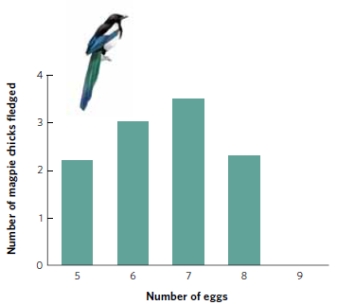
(Not Answered)
This question doesn't have any answer yet
The number of reproductive episodes that an organism experiences is called
(Multiple Choice)
4.8/5 (80)
(80) Consider a species with a fast potential growth rate, reproduction at a relatively early age, allocation of a small proportion of net production to seeds, and reliance on vegetative spread. According to Grime's classification of life history traits, this species fits the profile of a
(Multiple Choice)
4.8/5 (79)
(79) One might suppose that an earlier, longer summer would be beneficial for most species, because it offers a longer growing season for offspring. How might earlier offspring births in a predator species be detrimental to it?
(Essay)
4.7/5 (77)
(77) Research on frogs has shown that compared to well-nourished counterparts, poorly nourished frogs mature at
(Multiple Choice)
4.8/5 (73)
(73) Which of the following statements regarding semelparous and iteroparous organisms is true?
(Multiple Choice)
4.9/5 (73)
(73) For seed-producing trees, what conditions might favor production of few relatively large seeds? What conditions might favor production of many relatively small seeds?
(Essay)
4.9/5 (100)
(100) Migratory birds are likely responding to what environmental cue to initiate the behavior leading to migration from the northern breeding grounds to their more southern overwintering areas?
(Multiple Choice)
4.9/5 (76)
(76) Which of the following does NOT apply to determinate growth?
(Multiple Choice)
4.9/5 (70)
(70) Explain two significant ways in which environmental productivity and stability can influence the number of offspring produced and their probability of survival.
(Essay)
4.8/5 (69)
(69) Some marine snails (species L) produce large numbers of small eggs that are shed into the sea, hatch at an early stage of development, and feed on microscopic plants. Other marine snails (species S) produce few eggs that are retained for a long time within the body of the mother snail in a brood pouch, hatch at an advanced stage of development, and immediately begin to feed on the surfaces of large plants like the adults. If a biologist discovers approximately equal numbers of adults of species L and S in the same area over many generations, which of the following is most likely?
(Multiple Choice)
4.9/5 (84)
(84) Explain the main life history trait that differentiates ruderals and stress-tolerators.
(Short Answer)
4.8/5 (81)
(81) 
Filters
- Essay(0)
- Multiple Choice(0)
- Short Answer(0)
- True False(0)
- Matching(0)