



 Chat with AI
Exam 7: Evolution and Adaptation

Exam 1: Introduction: Ecology, Evolution, and the Scientific Method65 Questions
Exam 2: Adaptations to Aquatic Environments 67 Questions
Exam 3: Adaptations to Terrestrial Environments 69 Questions
Exam 4: Adaptations to Variable Environments 65 Questions
Exam 5: Climates and Soils68 Questions
Exam 6: Terrestrial and Aquatic Biomes64 Questions
Exam 7: Evolution and Adaptation 68 Questions
Exam 8: Life Histories66 Questions
Exam 9: Reproductive Strategies65 Questions
Exam 10: Social Behaviors67 Questions
Exam 11: Population Distributions70 Questions
Exam 12: Population Growth and Regulation62 Questions
Exam 13: Population Dynamics Over Space and Time69 Questions
Exam 14: Predation and Herbivory69 Questions
Exam 15: Parasitism and Infectious Diseases68 Questions
Exam 16: Competition67 Questions
Exam 17: Mutualism68 Questions
Exam 18: Community Structure 66 Questions
Exam 19: Community Succession 120 Questions
Exam 20: Movement of Energy in Ecosystems 68 Questions
Exam 21: Movement of Elements in Ecosystems71 Questions
Exam 22: Landscape Ecology and Global Biodiversity 68 Questions
Exam 23: Global Conservation of Biodiversity67 Questions
Select questions type


A process that occurs when genetic variation is lost because of random variation in mating, mortality, fecundity, and inheritance is known as
(Multiple Choice)
4.9/5  (62)
(62) Which is/are correct about founder effect?
I. Founder effect occurs when individuals are transplanted to a new location.
II. Founder effect produces new alleles.
III. Founder effect may see further reduction in genetic variation.
(Multiple Choice)
4.9/5 (79)
(79) Many genetic diseases have severe or lethal effects in the homozygous form, yet alleles for these diseases are not entirely removed by natural selection. Explain how dominance relationships among alleles allow deleterious mutations to remain in a population.
(Essay)
5.0/5 (78)
(78) Based on the phylogeny in the figure, which group is most closely related to the reptiles? 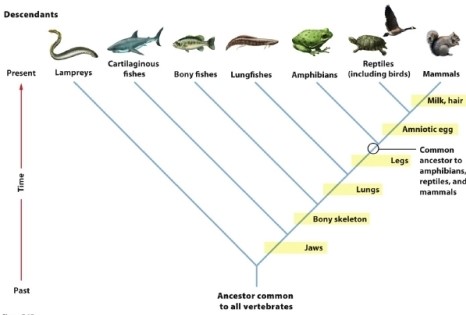
(Multiple Choice)
4.9/5 (81)
(81) Which of the following types of allele would we expect to have the lowest frequency in a population?
(Multiple Choice)
4.9/5 (81)
(81) What is the term for evolution acting at the level of populations?
(Multiple Choice)
5.0/5 (85)
(85) The example of the peppered moth in nineteenth-century England showed
(Multiple Choice)
4.9/5 (76)
(76) Which of the following insights about microevolution is demonstrated by industrial melanism?
(Multiple Choice)
4.8/5 (88)
(88) Consider a situation in which overharvesting causes the number of fish in a population to become drastically smaller, which causes genetic variation in that fish to decrease over a few generations. This is an example of
(Multiple Choice)
4.8/5 (72)
(72) When a parental generation undergoes stabilizing selection, how will the distribution of phenotypes in the population change between the parental generation and their progeny?
(Multiple Choice)
4.7/5 (79)
(79) How is the process known as genetic drift different from the process known as the bottleneck effect?
(Short Answer)
4.8/5 (69)
(69) Which is a prediction of the hypothesis that predation caused industrial melanism?
(Multiple Choice)
4.9/5 (80)
(80) Clonal animals do not reshuffle their genes through genetic recombination, whereas sexually reproducing animals do. Explain how this difference could affect how pathogens interact with clonal animals and how they interact with sexually reproducing animals.
(Essay)
4.8/5 (57)
(57) You conduct an experiment in which you raise six replicated lines of fruit flies for eight generations. You keep population size constant at 20 adults per generation. You are interested in a gene, bw, that affects eye color. This gene has two alleles, bw-1 and bw-2. You start each replicated line with the frequency of the bw-1 allele at 50 percent. Do the data in the graph better match the prediction for the bw alleles evolving by genetic drift or by directional selection? Be sure to define directional selection and genetic drift and describe the prediction of both hypotheses. 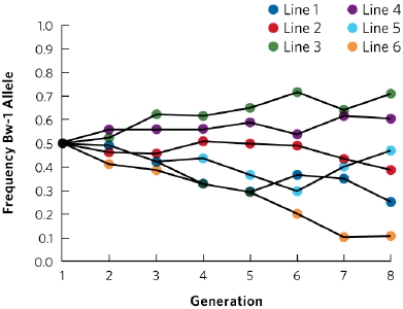
(Not Answered)
This question doesn't have any answer yet
Describe how genetic drift and natural selection can play a role in allopatric speciation.
(Essay)
5.0/5 (93)
(93) An example of the bottleneck effect having a detrimental impact on a species and its inability to evolve against new pathogen strains has been documented in the
(Multiple Choice)
4.7/5 (93)
(93) Recombination and polyploidy both occur during the process known as
(Multiple Choice)
4.8/5 (78)
(78) 
Filters
- Essay(0)
- Multiple Choice(0)
- Short Answer(0)
- True False(0)
- Matching(0)