



 Chat with AI
Exam 10: Externalities

Exam 1: Ten Principles of Economics439 Questions
Exam 2: Thinking Like an Economist617 Questions
Exam 3: Interdependence and the Gains From Trade527 Questions
Exam 4: The Market Forces of Supply and Demand697 Questions
Exam 5: Elasticity and Its Application594 Questions
Exam 6: Supply, Demand, and Government Policies645 Questions
Exam 7: Consumers, Producers, and the Efficiency of Markets549 Questions
Exam 8: Application: the Costs of Taxation513 Questions
Exam 9: Application: International Trade492 Questions
Exam 10: Externalities524 Questions
Exam 11: Public Goods and Common Resources433 Questions
Exam 12: The Design of the Tax System549 Questions
Exam 13: The Costs of Production420 Questions
Exam 14: Firms in Competitive Markets543 Questions
Exam 15: Monopoly637 Questions
Exam 16: Monopolistic Competition580 Questions
Exam 17: Oligopoly488 Questions
Exam 18: The Markets for the Factors of Production564 Questions
Exam 19: Earnings and Discrimination490 Questions
Exam 20: Income Inequality and Poverty455 Questions
Exam 21: The Theory of Consumer Choice431 Questions
Exam 22: Frontiers of Microeconomics440 Questions
Exam 23: Measuring a Nations Income520 Questions
Exam 24: Measuring the Cost of Living529 Questions
Exam 25: Production and Growth505 Questions
Exam 26: Saving, Investment, and the Financial System564 Questions
Exam 27: The Basic Tools of Finance500 Questions
Exam 28: Unemployment678 Questions
Exam 29: The Monetary System515 Questions
Exam 30: Money Growth and Inflation481 Questions
Exam 31: Open-Economy Macroeconomics: Basic Concepts522 Questions
Exam 32: A Macroeconomic Theory of the Open Economy475 Questions
Exam 33: Aggregate Demand and Aggregate Supply562 Questions
Exam 34: The Influence of Monetary and Fiscal Policy on Aggregate Demand508 Questions
Exam 35: The Short-Run Trade-Off Between Inflation and Unemployment491 Questions
Exam 36: Six Debates Over Macroeconomic Policy372 Questions
Select questions type


With pollution permits, the supply curve for pollution rights is
(Multiple Choice)
4.9/5  (80)
(80) Scenario 10-3  Suppose the equation for the demand curve in a market is
where is the quantity demanded and is the price.


 Also, suppose the equation for the supply curve in the same market is ,
where is the quantity supplied.
 -Refer to Scenario 10-3. Suppose there is an external cost of $12 associated with the production of each unit of the good. What is the equation of the social-cost curve?
Suppose the equation for the demand curve in a market is
where is the quantity demanded and is the price. Also, suppose the equation for the supply curve in the same market is ,
where is the quantity supplied.
-Refer to Scenario 10-3. Suppose there is an external cost of $12 associated with the production of each unit of the good. What is the equation of the social-cost curve? (Essay)
4.9/5 (82)
(82) Suppose the government imposes a tax in a certain market in order to internalize an externality. This type of policy is based on which of the Ten Principles of Economics?
(Multiple Choice)
4.8/5 (84)
(84) Figure 10-12  -Refer to Figure 10-12. An alternative label for the line labeled "Supply" would be
 (Multiple Choice)
4.8/5 (72)
(72) Table 10-3  -Refer to Table 10-3. What amount of subsidy per unit of output would move the market from the equilibrium level of output to the socially optimal level of output?
 (Multiple Choice)
4.8/5 (69)
(69) Figure 10-11  -Refer to Figure 10-11. The socially optimal quantity of output is
 (Multiple Choice)
4.7/5 (82)
(82) Figure 10-4 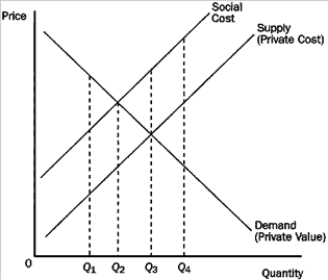 -Refer to Figure 10-4. The socially optimal quantity would be
 (Multiple Choice)
4.9/5 (82)
(82) Honey producers provide a positive externality to orchards because
(Multiple Choice)
4.9/5 (77)
(77) Karen's cat causes Danny to sneeze. Karen values her cat's companionship at $300 per year. The cost to Danny of tissues and her allergy medication is $350 per year. Based on the Coase theorem,
(Multiple Choice)
4.8/5 (87)
(87) Suppose the Environmental Protection Agency uses a corrective tax to set a price for pollution. Under this policy, is the supply curve for pollution rights vertical or is it horizontal?
(Short Answer)
4.7/5 (84)
(84) Figure 10-9  -Refer to Figure 10-9. Which graph represents a market with a positive externality?
 (Multiple Choice)
4.9/5 (69)
(69) Figure 10-12
-Refer to Figure 10-12. Which of the following is an appropriate label for Line 1?
-Refer to Figure 10-12. Which of the following is an appropriate label for Line 1? (Multiple Choice)
4.7/5 (86)
(86) Scenario 10-4
The demand curve for fire extinguishers slopes downward and the supply curve for fire extinguishers slopes upward. The production of the 500th fire extinguisher entails the following:
-a private cost of $10;
-an external cost of $0;
-a private value of $9;
-an external benefit of $3.
-
-Refer to Scenario 10-4. What is the social value of the 500th fire extinguisher?
(Essay)
4.8/5 (96)
(96) In terms of their economic effects, which of the following policies toward pollution are most similar to one another?
(Multiple Choice)
4.9/5 (77)
(77) Tyler owns a dog and receives a $300 benefit from owning it. Tyler's neighbor, Liz, incurs a cost of $450 from the dog's barking. Suggest a deal between Tyler and Liz that would result in both individuals becoming better off.
(Essay)
4.8/5 (82)
(82) 
Filters
- Essay(0)
- Multiple Choice(0)
- Short Answer(0)
- True False(0)
- Matching(0)