



 Chat with AI
Exam 10: Externalities

Exam 1: Ten Principles of Economics439 Questions
Exam 2: Thinking Like an Economist617 Questions
Exam 3: Interdependence and the Gains From Trade527 Questions
Exam 4: The Market Forces of Supply and Demand697 Questions
Exam 5: Elasticity and Its Application594 Questions
Exam 6: Supply, Demand, and Government Policies645 Questions
Exam 7: Consumers, Producers, and the Efficiency of Markets549 Questions
Exam 8: Application: the Costs of Taxation513 Questions
Exam 9: Application: International Trade492 Questions
Exam 10: Externalities524 Questions
Exam 11: Public Goods and Common Resources433 Questions
Exam 12: The Design of the Tax System549 Questions
Exam 13: The Costs of Production420 Questions
Exam 14: Firms in Competitive Markets543 Questions
Exam 15: Monopoly637 Questions
Exam 16: Monopolistic Competition580 Questions
Exam 17: Oligopoly488 Questions
Exam 18: The Markets for the Factors of Production564 Questions
Exam 19: Earnings and Discrimination490 Questions
Exam 20: Income Inequality and Poverty455 Questions
Exam 21: The Theory of Consumer Choice431 Questions
Exam 22: Frontiers of Microeconomics440 Questions
Exam 23: Measuring a Nations Income520 Questions
Exam 24: Measuring the Cost of Living529 Questions
Exam 25: Production and Growth505 Questions
Exam 26: Saving, Investment, and the Financial System564 Questions
Exam 27: The Basic Tools of Finance500 Questions
Exam 28: Unemployment678 Questions
Exam 29: The Monetary System515 Questions
Exam 30: Money Growth and Inflation481 Questions
Exam 31: Open-Economy Macroeconomics: Basic Concepts522 Questions
Exam 32: A Macroeconomic Theory of the Open Economy475 Questions
Exam 33: Aggregate Demand and Aggregate Supply562 Questions
Exam 34: The Influence of Monetary and Fiscal Policy on Aggregate Demand508 Questions
Exam 35: The Short-Run Trade-Off Between Inflation and Unemployment491 Questions
Exam 36: Six Debates Over Macroeconomic Policy372 Questions
Select questions type


Table 10-3  -Refer to Table 10-3. Taking into account private and external costs, the maximum total surplus that can be achieved in this market is
 (Multiple Choice)
4.9/5  (81)
(81) Suppose that smoking creates a negative externality. If the government does not interfere in the cigarette market, then
(Multiple Choice)
4.8/5 (79)
(79) When firms internalize a negative externality, the market supply curve shifts to the left.
(True/False)
4.8/5 (81)
(81) Figure 10-3 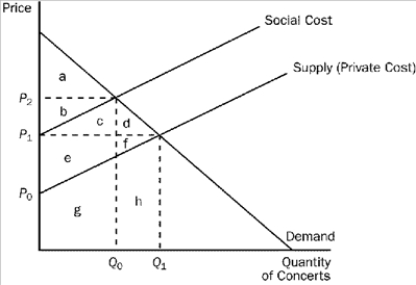 -Refer to Figure 10-3. The social cost curve is above the supply curve because
 (Multiple Choice)
4.8/5 (88)
(88) Figure 10-13. On the graph, Q represents the quantity of plastics and P represents the price of plastics.  Multiple Choice - Section 02: Public Policies toward Externalities
-Refer to Figure 10-13. If the government imposed a corrective tax that successfully moved the market from the market equilibrium to the social optimum, then tax revenue for the government would amount to
Multiple Choice - Section 02: Public Policies toward Externalities
-Refer to Figure 10-13. If the government imposed a corrective tax that successfully moved the market from the market equilibrium to the social optimum, then tax revenue for the government would amount to (Multiple Choice)
4.9/5 (76)
(76) Abe owns a dog; the dog's barking annoys Abe's neighbor, Jenny. Suppose that the benefit of owning the dog is worth $200 to Abe and that Jenny bears a cost of $400 from the barking. Assuming Abe has the legal right to keep the dog, a possible private solution to this problem is that
(Multiple Choice)
4.9/5 (73)
(73) As a means of dealing with pollution, do economists generally prefer corrective taxes or do they prefer regulations?
(Essay)
4.8/5 (81)
(81) Why are Pigovian taxes preferred to regulatory policies as methods to remedy negative externalities?
(Essay)
4.9/5 (73)
(73) Even if possible, it would be inefficient to prohibit all polluting activity.
(True/False)
4.9/5 (79)
(79) Suppose that Company A's railroad cars pass through Farmer B's corn fields. The railroad causes an externality to the farmer because the railroad cars emit sparks that cause $1,500 in damage to the farmer's crops. There is a special soy-based grease that the railroad could purchase that would eliminate the damaging sparks. The grease costs $1,200. Suppose that the farmer has the right to compensation for any damage that his crops suffer. Assume that there are no transaction costs. Which of the following characterizes the efficient outcome?
(Multiple Choice)
4.9/5 (84)
(84) Figure 10-4 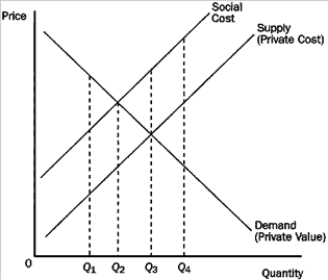 -Refer to Figure 10-4. If this market is currently producing at Q4, then total economic well-being would be maximized if output
 (Multiple Choice)
4.8/5 (74)
(74) Suppose a certain good provides an external benefit. If the private cost of the last unit of the good that was produced is equal to the social value of that unit, then the sum of producer and consumer surplus is maximized.
(True/False)
4.8/5 (87)
(87) The impact of one person's actions on the well-being of a bystander is called
(Multiple Choice)
4.9/5 (70)
(70) Scenario 10-1
The demand curve for gasoline slopes downward and the supply curve for gasoline slopes upward. The production of the 1,000th gallon of gasoline entails the following:
-a private cost of $3.10;
-a social cost of $3.55;
-a value to consumers of $3.70.
-Refer to Scenario 10-1. The production of the 1,000th gallon of gasoline entails an
(Multiple Choice)
4.8/5 (90)
(90) Dee loves to landscape her yard, but her neighbor Marvin places a low value on his landscaping. When Marvin's grass is neglected and gets long, Dee will mow it for Marvin. This is an example of
(Multiple Choice)
4.9/5 (85)
(85) Private parties may choose not to solve an externality problem if the transaction costs are large enough.
(True/False)
4.9/5 (79)
(79) Figure 10-12  -Refer to Figure 10-12. Suppose, on the figure,
 represents the quantity of education and
 represents the price of education. Then the quantity
 represents
-Refer to Figure 10-12. Suppose, on the figure, represents the quantity of education and represents the price of education. Then the quantity represents (Multiple Choice)
4.8/5 (75)
(75) 
Filters
- Essay(0)
- Multiple Choice(0)
- Short Answer(0)
- True False(0)
- Matching(0)