



 Chat with AI
Exam 10: Externalities

Exam 1: Ten Principles of Economics439 Questions
Exam 2: Thinking Like an Economist617 Questions
Exam 3: Interdependence and the Gains From Trade527 Questions
Exam 4: The Market Forces of Supply and Demand697 Questions
Exam 5: Elasticity and Its Application594 Questions
Exam 6: Supply, Demand, and Government Policies645 Questions
Exam 7: Consumers, Producers, and the Efficiency of Markets549 Questions
Exam 8: Application: the Costs of Taxation513 Questions
Exam 9: Application: International Trade492 Questions
Exam 10: Externalities524 Questions
Exam 11: Public Goods and Common Resources433 Questions
Exam 12: The Design of the Tax System549 Questions
Exam 13: The Costs of Production420 Questions
Exam 14: Firms in Competitive Markets543 Questions
Exam 15: Monopoly637 Questions
Exam 16: Monopolistic Competition580 Questions
Exam 17: Oligopoly488 Questions
Exam 18: The Markets for the Factors of Production564 Questions
Exam 19: Earnings and Discrimination490 Questions
Exam 20: Income Inequality and Poverty455 Questions
Exam 21: The Theory of Consumer Choice431 Questions
Exam 22: Frontiers of Microeconomics440 Questions
Exam 23: Measuring a Nations Income520 Questions
Exam 24: Measuring the Cost of Living529 Questions
Exam 25: Production and Growth505 Questions
Exam 26: Saving, Investment, and the Financial System564 Questions
Exam 27: The Basic Tools of Finance500 Questions
Exam 28: Unemployment678 Questions
Exam 29: The Monetary System515 Questions
Exam 30: Money Growth and Inflation481 Questions
Exam 31: Open-Economy Macroeconomics: Basic Concepts522 Questions
Exam 32: A Macroeconomic Theory of the Open Economy475 Questions
Exam 33: Aggregate Demand and Aggregate Supply562 Questions
Exam 34: The Influence of Monetary and Fiscal Policy on Aggregate Demand508 Questions
Exam 35: The Short-Run Trade-Off Between Inflation and Unemployment491 Questions
Exam 36: Six Debates Over Macroeconomic Policy372 Questions
Select questions type


Figure 10-9  -Refer to Figure 10-9, Panel (b) and Panel (c). Which of the following is correct?
 (Multiple Choice)
4.9/5  (60)
(60) Which of the following is true of markets characterized by positive externalities?
(Multiple Choice)
4.8/5 (69)
(69) Private solutions may not be possible due to the costs of negotiating and enforcing these solutions. Such costs are called
(Multiple Choice)
4.8/5 (85)
(85) Internalizing a positive externality will cause the demand curve to
(Multiple Choice)
4.8/5 (79)
(79) When a policy succeeds in giving buyers and sellers in a market an incentive to take into account the external effects of their actions, the policy is said to
(Multiple Choice)
4.8/5 (72)
(72) According to the Coase theorem, private markets will solve externality problems and allocate resources efficiently as long as
(Multiple Choice)
4.7/5 (87)
(87) Scenario 10-2
The demand curve for restored historic buildings slopes downward and the supply curve for restored historic buildings slopes upward. The production of the 50th restored historic building entails the following:
-a private cost of $800,000;
-a private value of $650,000;
-a social value of $800,000.
-Refer to Scenario 10-2. Is there an external cost associated with the restoration of the 50th historic building, or is there an external benefit? What is the amount of that external cost or external benefit?
(Essay)
4.8/5 (64)
(64) Figure 10-2. The graph depicts the market for plastic.  -Refer to Figure 10-2. Suppose that the production of plastic creates a social cost which is depicted in the graph above. What is the socially optimal quantity of plastic?
 (Multiple Choice)
4.8/5 (74)
(74) Table 10-5
The following table shows the marginal costs for each of four firms (A, B, C, and D) to eliminate units of pollution from their production processes. For example, for Firm A to eliminate one unit of pollution, it would cost $54, and for Firm A to eliminate a second unit of pollution it would cost an additional $67.  -Refer to Table 10-5. If the government charged a fee of $84 per unit of pollution, how many units of pollution would the firms eliminate altogether?
 (Multiple Choice)
4.9/5 (79)
(79) Suppose that electricity producers create a negative externality equal to $6 per unit. Further suppose that the government imposes a $8 per-unit tax on the producers. What is the relationship between the after-tax equilibrium quantity and the socially optimal quantity of electricity to be produced?
(Multiple Choice)
4.9/5 (86)
(86) Figure 10-10  -Refer to Figure 10-10. The socially optimal quantity of output is
 (Multiple Choice)
4.7/5 (76)
(76) The Coase theorem asserts that, if externalities are present and if private parties can bargain over the allocation of resources at no cost, then
(Multiple Choice)
4.8/5 (87)
(87) Government subsidized scholarships are an example of a government policy aimed at correcting negative externalities associated with education.
(True/False)
4.9/5 (80)
(80) Suppose a tax is imposed on producers of aluminum as a means of internalizing the externality associated with aluminum production. If the tax accurately reflects the external costs of pollutants released into the atmosphere, then the new supply curve for aluminum coincides with which other curve?
(Essay)
4.8/5 (86)
(86) Figure 10-7 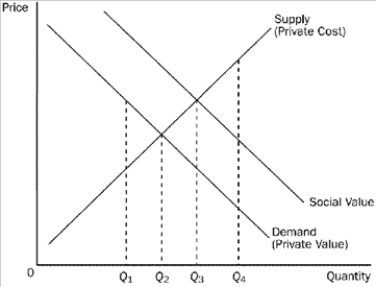 -Refer to Figure 10-7. Which quantity represents the social optimum for this market?
 (Multiple Choice)
4.8/5 (84)
(84) Once tradable pollution permits have been allocated to firms,
(Multiple Choice)
4.8/5 (79)
(79) Table 10-6
The following table shows the total costs for each of four firms (A, B, C, and D) to eliminate units of pollution from their production processes. For example, for Firm A to eliminate one unit of pollution, it would cost $46, and for Firm A to eliminate two units of pollution, it would cost a total of $103.  -Refer to Table 10-6. If the government charged a fee of $93 per unit of pollution, how many units of pollution would the firms eliminate altogether?
 (Multiple Choice)
4.7/5 (80)
(80) 
Filters
- Essay(0)
- Multiple Choice(0)
- Short Answer(0)
- True False(0)
- Matching(0)