



 Chat with AI
Exam 10: Externalities

Exam 1: Ten Principles of Economics439 Questions
Exam 2: Thinking Like an Economist617 Questions
Exam 3: Interdependence and the Gains From Trade527 Questions
Exam 4: The Market Forces of Supply and Demand697 Questions
Exam 5: Elasticity and Its Application594 Questions
Exam 6: Supply, Demand, and Government Policies645 Questions
Exam 7: Consumers, Producers, and the Efficiency of Markets549 Questions
Exam 8: Application: the Costs of Taxation513 Questions
Exam 9: Application: International Trade492 Questions
Exam 10: Externalities524 Questions
Exam 11: Public Goods and Common Resources433 Questions
Exam 12: The Design of the Tax System549 Questions
Exam 13: The Costs of Production420 Questions
Exam 14: Firms in Competitive Markets543 Questions
Exam 15: Monopoly637 Questions
Exam 16: Monopolistic Competition580 Questions
Exam 17: Oligopoly488 Questions
Exam 18: The Markets for the Factors of Production564 Questions
Exam 19: Earnings and Discrimination490 Questions
Exam 20: Income Inequality and Poverty455 Questions
Exam 21: The Theory of Consumer Choice431 Questions
Exam 22: Frontiers of Microeconomics440 Questions
Exam 23: Measuring a Nations Income520 Questions
Exam 24: Measuring the Cost of Living529 Questions
Exam 25: Production and Growth505 Questions
Exam 26: Saving, Investment, and the Financial System564 Questions
Exam 27: The Basic Tools of Finance500 Questions
Exam 28: Unemployment678 Questions
Exam 29: The Monetary System515 Questions
Exam 30: Money Growth and Inflation481 Questions
Exam 31: Open-Economy Macroeconomics: Basic Concepts522 Questions
Exam 32: A Macroeconomic Theory of the Open Economy475 Questions
Exam 33: Aggregate Demand and Aggregate Supply562 Questions
Exam 34: The Influence of Monetary and Fiscal Policy on Aggregate Demand508 Questions
Exam 35: The Short-Run Trade-Off Between Inflation and Unemployment491 Questions
Exam 36: Six Debates Over Macroeconomic Policy372 Questions
Select questions type


Before the flu season begins, Jeremy gets a flu shot. As a result, Jeremy and several of his friends and relatives avoid the flu for the entire flu season. It would make sense to argue that
(Multiple Choice)
4.8/5  (83)
(83) The Environmental Protection Agency (EPA) requires that firms in a certain industry adopt a particular technology to reduce the emission of pollutants. Is this requirement a command- and-control policy or is it a market-based policy?
(Essay)
4.8/5 (74)
(74) The Coase theorem asserts that, in the presence of externalities,
(Multiple Choice)
4.8/5 (83)
(83) Because there are positive externalities from higher education,
(Multiple Choice)
4.8/5 (74)
(74) Figure 10-9  -Refer to Figure 10-9, Panel (b) and Panel (c). The installation of a scrubber in a smokestack reduces the emission of harmful chemicals from the smokestack. Therefore, the socially optimal quantity of smokestack scrubbers is represented by point
 (Multiple Choice)
4.8/5 (84)
(84) Table 10-1
The following table shows the private value, private cost, and external cost for various quantities of output in a market. 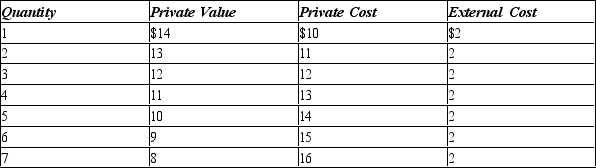 -Refer to Table 10-1. Which of the following statements is correct?
 (Multiple Choice)
4.8/5 (71)
(71) In the case of a technology spillover, internalizing a positive externality will cause the supply curve of an industry to
(Multiple Choice)
4.8/5 (78)
(78) Suppose the market-equilibrium quantity of good x is 5,000 units and the socially-optimal quantity of good x is 4,000 units. Then
(Multiple Choice)
4.9/5 (86)
(86) Which of the following is not an advantage of corrective taxes?
(Multiple Choice)
4.7/5 (72)
(72) Which of the following statements is correct about a market in which pollution is emitted?
(Multiple Choice)
4.8/5 (76)
(76) Figure 10-10  -Refer to Figure 10-10. A decrease in output from 160 units to 120 units would
 (Multiple Choice)
4.7/5 (81)
(81) Which of the following is not a necessary condition for the Coase theorem?
(Multiple Choice)
5.0/5 (80)
(80) Figure 10-2. The graph depicts the market for plastic. 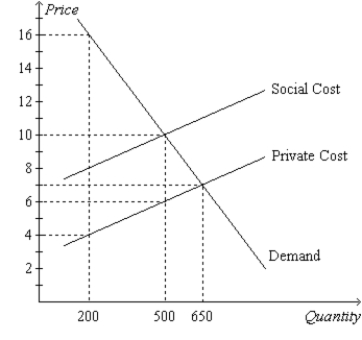 -Refer to Figure 10-2. Suppose that the production of plastic creates a social cost which is depicted in the graph above. Without any government regulation, what price will the firm charge per unit of plastic?
 (Multiple Choice)
4.7/5 (83)
(83) Social welfare can be enhanced by allowing firms to trade their rights to pollute.
(True/False)
4.8/5 (92)
(92) Assume that your roommate is very messy. Suppose she gets a $25 benefit from being messy but imposes a $50 cost on you. The Coase theorem would suggest that an efficient solution would be for you to
(Multiple Choice)
4.8/5 (92)
(92) According to the Coase theorem, in the presence of externalities
(Multiple Choice)
4.8/5 (81)
(81) That some firms are engaged in more than one type of business is explained, in some cases, by
(Multiple Choice)
4.8/5 (77)
(77) In class action lawsuits interested parties to the lawsuit are not required to pay attorney fees directly. This is an example of an attempt to
(Multiple Choice)
4.9/5 (82)
(82) 
Filters
- Essay(0)
- Multiple Choice(0)
- Short Answer(0)
- True False(0)
- Matching(0)