



 Chat with AI
Exam 10: Externalities

Exam 1: Ten Principles of Economics439 Questions
Exam 2: Thinking Like an Economist617 Questions
Exam 3: Interdependence and the Gains From Trade527 Questions
Exam 4: The Market Forces of Supply and Demand697 Questions
Exam 5: Elasticity and Its Application594 Questions
Exam 6: Supply, Demand, and Government Policies645 Questions
Exam 7: Consumers, Producers, and the Efficiency of Markets549 Questions
Exam 8: Application: the Costs of Taxation513 Questions
Exam 9: Application: International Trade492 Questions
Exam 10: Externalities524 Questions
Exam 11: Public Goods and Common Resources433 Questions
Exam 12: The Design of the Tax System549 Questions
Exam 13: The Costs of Production420 Questions
Exam 14: Firms in Competitive Markets543 Questions
Exam 15: Monopoly637 Questions
Exam 16: Monopolistic Competition580 Questions
Exam 17: Oligopoly488 Questions
Exam 18: The Markets for the Factors of Production564 Questions
Exam 19: Earnings and Discrimination490 Questions
Exam 20: Income Inequality and Poverty455 Questions
Exam 21: The Theory of Consumer Choice431 Questions
Exam 22: Frontiers of Microeconomics440 Questions
Exam 23: Measuring a Nations Income520 Questions
Exam 24: Measuring the Cost of Living529 Questions
Exam 25: Production and Growth505 Questions
Exam 26: Saving, Investment, and the Financial System564 Questions
Exam 27: The Basic Tools of Finance500 Questions
Exam 28: Unemployment678 Questions
Exam 29: The Monetary System515 Questions
Exam 30: Money Growth and Inflation481 Questions
Exam 31: Open-Economy Macroeconomics: Basic Concepts522 Questions
Exam 32: A Macroeconomic Theory of the Open Economy475 Questions
Exam 33: Aggregate Demand and Aggregate Supply562 Questions
Exam 34: The Influence of Monetary and Fiscal Policy on Aggregate Demand508 Questions
Exam 35: The Short-Run Trade-Off Between Inflation and Unemployment491 Questions
Exam 36: Six Debates Over Macroeconomic Policy372 Questions
Select questions type


University researchers create a positive externality because what they discover in their research labs can easily be learned by others who haven't contributed to the research costs. What could the federal government do to equate the equilibrium quantity of university research and the socially optimal quantity of university research produced?
(Multiple Choice)
4.9/5  (90)
(90) To enhance the well-being of society, a social planner will encourage firms to increase production when
(Multiple Choice)
4.8/5 (76)
(76) Which of the following problems can not be alleviated by a gasoline tax?
(Multiple Choice)
4.8/5 (79)
(79) Many charities like the Sierra Club are established to deal with externalities.
(True/False)
4.8/5 (66)
(66) If an aluminum manufacturer does not bear the entire cost of the smoke it emits, it will
(Multiple Choice)
4.9/5 (79)
(79) Suppose that an MBA degree creates no externality because the benefits of an MBA are internalized by the student in the form of higher wages. If the government offers subsidies for MBAs, then which of the following statements is correct?
(Multiple Choice)
4.8/5 (74)
(74) Figure 10-18. The graph represents a corrective tax to reduce pollution. On the axes, Q denotes the quantity of pollution and P represents the price of pollution. 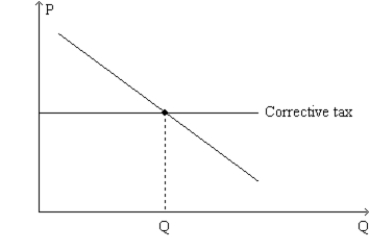 -Refer to Figure 10-18. What is the appropriate label for the downward-sloping line on the graph?
 (Multiple Choice)
4.7/5 (98)
(98) The concept of external benefit is associated with a negative externality, but not with a positive externality.
(True/False)
5.0/5 (60)
(60) To determine the optimal level of output in a market with negative externalities, a benevolent social planner would look for the level of output at which private cost equals private value.
(True/False)
4.8/5 (81)
(81) Which of the following is not an effective method of reducing negative externalities?
(Multiple Choice)
4.8/5 (74)
(74) Scenario 10-3  Suppose the equation for the demand curve in a market is
where is the quantity demanded and is the price.


 Also, suppose the equation for the supply curve in the same market is ,
where is the quantity supplied.
 -Refer to Scenario 10-3. Suppose there is an external cost of $12 associated with the production of each unit of the good. What are the socially optimal quantity and price?
Suppose the equation for the demand curve in a market is
where is the quantity demanded and is the price. Also, suppose the equation for the supply curve in the same market is ,
where is the quantity supplied.
-Refer to Scenario 10-3. Suppose there is an external cost of $12 associated with the production of each unit of the good. What are the socially optimal quantity and price? (Essay)
4.8/5 (61)
(61) Most taxes distort incentives and move the allocation of resources away from the social optimum. Why do corrective taxes avoid the disadvantages of most other taxes?
(Multiple Choice)
4.9/5 (90)
(90) Table 10-1
The following table shows the private value, private cost, and external cost for various quantities of output in a market.  -Refer to Table 10-1. How large would a corrective tax need to be to move this market from the equilibrium outcome to the socially-optimal outcome?
 (Multiple Choice)
4.7/5 (82)
(82) Does the restoration of historic buildings create a positive externality or does it create a negative externality?
(Essay)
4.8/5 (79)
(79) A cost imposed on someone who is neither the consumer nor the producer is called a
(Multiple Choice)
4.8/5 (83)
(83) 
Filters
- Essay(0)
- Multiple Choice(0)
- Short Answer(0)
- True False(0)
- Matching(0)