



 Chat with AI
Exam 10: Externalities

Exam 1: Ten Principles of Economics439 Questions
Exam 2: Thinking Like an Economist617 Questions
Exam 3: Interdependence and the Gains From Trade527 Questions
Exam 4: The Market Forces of Supply and Demand697 Questions
Exam 5: Elasticity and Its Application594 Questions
Exam 6: Supply, Demand, and Government Policies645 Questions
Exam 7: Consumers, Producers, and the Efficiency of Markets549 Questions
Exam 8: Application: the Costs of Taxation513 Questions
Exam 9: Application: International Trade492 Questions
Exam 10: Externalities524 Questions
Exam 11: Public Goods and Common Resources433 Questions
Exam 12: The Design of the Tax System549 Questions
Exam 13: The Costs of Production420 Questions
Exam 14: Firms in Competitive Markets543 Questions
Exam 15: Monopoly637 Questions
Exam 16: Monopolistic Competition580 Questions
Exam 17: Oligopoly488 Questions
Exam 18: The Markets for the Factors of Production564 Questions
Exam 19: Earnings and Discrimination490 Questions
Exam 20: Income Inequality and Poverty455 Questions
Exam 21: The Theory of Consumer Choice431 Questions
Exam 22: Frontiers of Microeconomics440 Questions
Exam 23: Measuring a Nations Income520 Questions
Exam 24: Measuring the Cost of Living529 Questions
Exam 25: Production and Growth505 Questions
Exam 26: Saving, Investment, and the Financial System564 Questions
Exam 27: The Basic Tools of Finance500 Questions
Exam 28: Unemployment678 Questions
Exam 29: The Monetary System515 Questions
Exam 30: Money Growth and Inflation481 Questions
Exam 31: Open-Economy Macroeconomics: Basic Concepts522 Questions
Exam 32: A Macroeconomic Theory of the Open Economy475 Questions
Exam 33: Aggregate Demand and Aggregate Supply562 Questions
Exam 34: The Influence of Monetary and Fiscal Policy on Aggregate Demand508 Questions
Exam 35: The Short-Run Trade-Off Between Inflation and Unemployment491 Questions
Exam 36: Six Debates Over Macroeconomic Policy372 Questions
Select questions type


Suppose that Bill wants to dine at a fancy restaurant, but the only available table is in the smoking section. Bill dislikes the smell of cigarette smoke. He notices that only one person, Peter, is smoking in the smoking section. Bill values the absence of smoke at $15. Peter values the ability to smoke in the restaurant at $10. In order for Bill to pay Peter not to smoke, he will need to tip the waiter $10 to facilitate the transaction. Which of the following represents an efficient solution?
(Multiple Choice)
4.9/5  (86)
(86) Suppose that flu shots create a positive externality equal to $8 per shot. Further suppose that the government offers a $6-per-shot subsidy to producers. What is the relationship between the equilibrium quantity and the socially optimal quantity of flu shots produced?
(Multiple Choice)
4.8/5 (73)
(73) Figure 10-9  -Refer to Figure 10-9. The installation of a scrubber in a smokestack reduces the emission of harmful chemicals from the smokestack. Therefore, the market for smokestack scrubbers is shown in
 (Multiple Choice)
4.8/5 (79)
(79) In markets, the invisible hand allocates resources efficiently
(Multiple Choice)
4.8/5 (84)
(84) Barking dogs cannot be considered an externality because externalities must be associated with some form of market exchange.
(True/False)
4.8/5 (94)
(94) Figure 10-4 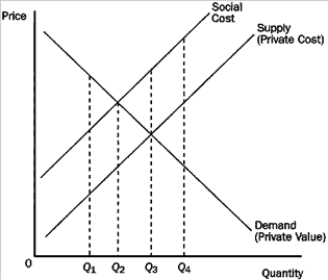 -Refer to Figure 10-4. If all external costs were internalized, then the market's equilibrium output would be
 (Multiple Choice)
4.8/5 (72)
(72) Gretchen is a writer who works from her home. Gretchen lives next door to Randall, the trumpet player for a local band. Randall needs lots of practice to earn his share of the band's profit, which will amount to $350. Gretchen gets distracted by Randall's trumpet playing but she needs to get her writing done to earn $570 for her current article. If Gretchen needs to hire a lawyer to help her reach an agreement with Randall, then what price is Gretchen willing to pay the lawyer?
(Multiple Choice)
4.8/5 (84)
(84) If only a few people are affected by an externality, then it is likely that
(Multiple Choice)
4.8/5 (82)
(82) The difference between social cost and private cost is a measure of the
(Multiple Choice)
4.8/5 (85)
(85) Figure 10-1 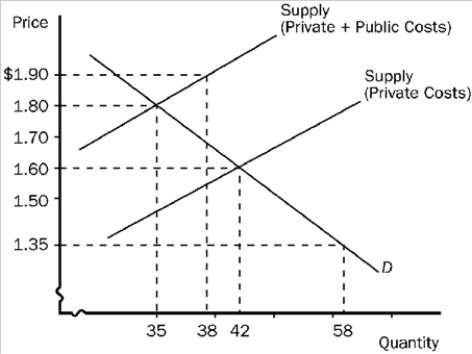 -Refer to Figure 10-1. This graph represents the tobacco industry. Without any government intervention, the equilibrium price and quantity are
 (Multiple Choice)
4.9/5 (69)
(69) Which of the following policies is the government most inclined to use when faced with a positive externality?
(Multiple Choice)
4.9/5 (80)
(80) The likelihood of successful private solutions to problems caused by externalities depends, in part, upon the number of interested parties. Briefly explain.
(Essay)
4.8/5 (78)
(78) Scenario 10-3  Suppose the equation for the demand curve in a market is
where is the quantity demanded and is the price.


 Also, suppose the equation for the supply curve in the same market is ,
where is the quantity supplied.
 -Refer to Scenario 10-3. What are the market equilibrium quantity and price?
Suppose the equation for the demand curve in a market is
where is the quantity demanded and is the price. Also, suppose the equation for the supply curve in the same market is ,
where is the quantity supplied.
-Refer to Scenario 10-3. What are the market equilibrium quantity and price? (Essay)
4.9/5 (76)
(76) If the government were to limit the release of air pollution produced by a glue factory to 75 parts per million, the policy would be considered a
(Multiple Choice)
4.8/5 (95)
(95) 
Filters
- Essay(0)
- Multiple Choice(0)
- Short Answer(0)
- True False(0)
- Matching(0)