



 Chat with AI
Exam 10: Externalities

Exam 1: Ten Principles of Economics439 Questions
Exam 2: Thinking Like an Economist617 Questions
Exam 3: Interdependence and the Gains From Trade527 Questions
Exam 4: The Market Forces of Supply and Demand697 Questions
Exam 5: Elasticity and Its Application594 Questions
Exam 6: Supply, Demand, and Government Policies645 Questions
Exam 7: Consumers, Producers, and the Efficiency of Markets549 Questions
Exam 8: Application: the Costs of Taxation513 Questions
Exam 9: Application: International Trade492 Questions
Exam 10: Externalities524 Questions
Exam 11: Public Goods and Common Resources433 Questions
Exam 12: The Design of the Tax System549 Questions
Exam 13: The Costs of Production420 Questions
Exam 14: Firms in Competitive Markets543 Questions
Exam 15: Monopoly637 Questions
Exam 16: Monopolistic Competition580 Questions
Exam 17: Oligopoly488 Questions
Exam 18: The Markets for the Factors of Production564 Questions
Exam 19: Earnings and Discrimination490 Questions
Exam 20: Income Inequality and Poverty455 Questions
Exam 21: The Theory of Consumer Choice431 Questions
Exam 22: Frontiers of Microeconomics440 Questions
Exam 23: Measuring a Nations Income520 Questions
Exam 24: Measuring the Cost of Living529 Questions
Exam 25: Production and Growth505 Questions
Exam 26: Saving, Investment, and the Financial System564 Questions
Exam 27: The Basic Tools of Finance500 Questions
Exam 28: Unemployment678 Questions
Exam 29: The Monetary System515 Questions
Exam 30: Money Growth and Inflation481 Questions
Exam 31: Open-Economy Macroeconomics: Basic Concepts522 Questions
Exam 32: A Macroeconomic Theory of the Open Economy475 Questions
Exam 33: Aggregate Demand and Aggregate Supply562 Questions
Exam 34: The Influence of Monetary and Fiscal Policy on Aggregate Demand508 Questions
Exam 35: The Short-Run Trade-Off Between Inflation and Unemployment491 Questions
Exam 36: Six Debates Over Macroeconomic Policy372 Questions
Select questions type


Suppose the government issues a limited number of pollution permits in order to limit the quantity of pollution. Under this policy, does the demand curve for pollution rights determine the quantity of pollution, or does it determine the price of pollution?
(Essay)
4.9/5  (77)
(77) When producers operate in a market characterized by negative externalities, a tax that forces them to internalize the externality will
(Multiple Choice)
4.9/5 (80)
(80) In some parts of the United States, sugar beets are grown and harvested. The process of producing usable sugar from the beets generates foul-smelling smoke. A government policy that limits the emission of smoke by sugar- beet-processing firms is an example of
(Multiple Choice)
4.7/5 (63)
(63) Which of the following is a problem that keeps people from privately solving externality problems?
(Multiple Choice)
4.8/5 (69)
(69) The government can internalize externalities by taxing goods that have negative externalities and subsidizing goods that have positive externalities.
(True/False)
4.8/5 (85)
(85) Figure 10-19  -Refer to Figure 10-19. How many units of the good are produced in a market equilibrium?
 (Multiple Choice)
4.7/5 (92)
(92) Which of the following illustrates the concept of a negative externality?
(Multiple Choice)
4.8/5 (72)
(72) If we know that the supply curve for good x fails to reflect the total cost to society of producing that good, then we know that
(Multiple Choice)
4.9/5 (94)
(94) Thurman is a writer who works from his home. Thurman lives next door to Phil, the drummer for a local band. Phil needs a lot of practice to earn $250, which is his share of the band's profit. Thurman gets distracted by Phil's drumming but he needs to get his writing done to earn $500 for his current article. Which of the following is an efficient solution?
(Multiple Choice)
4.9/5 (67)
(67) Figure 10-2. The graph depicts the market for plastic.  -Refer to Figure 10-2. The private value of the 200th unit of plastic exceeds the social cost of the 200th unit of plastic by
 (Multiple Choice)
4.8/5 (81)
(81) Suppose the government levies a corrective tax on firms that pollute in order to limit the quantity of pollution. Under this policy, does the demand curve for pollution rights determine the quantity of pollution, or does it determine the price of pollution?
(Essay)
4.8/5 (65)
(65) Figure 10-14 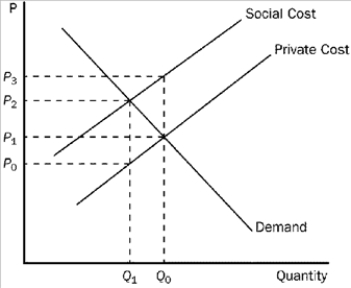 -Refer to Figure 10-14. Which of the following statements is correct?
 (Multiple Choice)
4.7/5 (71)
(71) Laws that are passed that either require or forbid certain behaviors are examples of command-and-control policies.
(True/False)
4.8/5 (83)
(83) Figure 10-10  -Refer to Figure 10-10. Which of the following statements is correct?
 (Multiple Choice)
4.8/5 (78)
(78) Figure 10-12  -Refer to Figure 10-12. The graph, as drawn, could apply to the market for
 (Multiple Choice)
4.9/5 (87)
(87) Ty lives in an apartment building and gets a benefit from playing his stereo. Olivia, who lives next door to Ty and often loses sleep due to the loud music coming from Ty's stereo, bears a cost from the noise. Olivia is threatening to call the police to force Ty to turn down his stereo. Under which of the following conditions would Ty be able to offer Olivia some amount of money to keep her from calling the police and to allow him to continue to play his stereo loudly?
(Multiple Choice)
4.9/5 (85)
(85) 
Filters
- Essay(0)
- Multiple Choice(0)
- Short Answer(0)
- True False(0)
- Matching(0)