



 Chat with AI
Exam 10: Externalities

Exam 1: Ten Principles of Economics439 Questions
Exam 2: Thinking Like an Economist617 Questions
Exam 3: Interdependence and the Gains From Trade527 Questions
Exam 4: The Market Forces of Supply and Demand697 Questions
Exam 5: Elasticity and Its Application594 Questions
Exam 6: Supply, Demand, and Government Policies645 Questions
Exam 7: Consumers, Producers, and the Efficiency of Markets549 Questions
Exam 8: Application: the Costs of Taxation513 Questions
Exam 9: Application: International Trade492 Questions
Exam 10: Externalities524 Questions
Exam 11: Public Goods and Common Resources433 Questions
Exam 12: The Design of the Tax System549 Questions
Exam 13: The Costs of Production420 Questions
Exam 14: Firms in Competitive Markets543 Questions
Exam 15: Monopoly637 Questions
Exam 16: Monopolistic Competition580 Questions
Exam 17: Oligopoly488 Questions
Exam 18: The Markets for the Factors of Production564 Questions
Exam 19: Earnings and Discrimination490 Questions
Exam 20: Income Inequality and Poverty455 Questions
Exam 21: The Theory of Consumer Choice431 Questions
Exam 22: Frontiers of Microeconomics440 Questions
Exam 23: Measuring a Nations Income520 Questions
Exam 24: Measuring the Cost of Living529 Questions
Exam 25: Production and Growth505 Questions
Exam 26: Saving, Investment, and the Financial System564 Questions
Exam 27: The Basic Tools of Finance500 Questions
Exam 28: Unemployment678 Questions
Exam 29: The Monetary System515 Questions
Exam 30: Money Growth and Inflation481 Questions
Exam 31: Open-Economy Macroeconomics: Basic Concepts522 Questions
Exam 32: A Macroeconomic Theory of the Open Economy475 Questions
Exam 33: Aggregate Demand and Aggregate Supply562 Questions
Exam 34: The Influence of Monetary and Fiscal Policy on Aggregate Demand508 Questions
Exam 35: The Short-Run Trade-Off Between Inflation and Unemployment491 Questions
Exam 36: Six Debates Over Macroeconomic Policy372 Questions
Select questions type


Figure 10-19  -Refer to Figure 10-19. The socially optimal quantity of output is
 (Multiple Choice)
4.9/5  (83)
(83) Figure 10-19
-Refer to Figure 10-19. Note that the lines labeled "Demand" and "Social Value"are parallel. Also, the slopes of the lines on the graph reflect the following facts: (1) Private value and social value decrease by $1.00 with each additional unit of the good that is consumed, and (2) private cost increases by $1.40 with each additional unit of the good that is produced. Thus, when the 59th unit of the good is produced and consumed, social well-being increases by
-Refer to Figure 10-19. Note that the lines labeled "Demand" and "Social Value"are parallel. Also, the slopes of the lines on the graph reflect the following facts: (1) Private value and social value decrease by $1.00 with each additional unit of the good that is consumed, and (2) private cost increases by $1.40 with each additional unit of the good that is produced. Thus, when the 59th unit of the good is produced and consumed, social well-being increases by (Multiple Choice)
4.8/5 (82)
(82) Table 10-3  -Refer to Table 10-3. The social value of the 4th unit of output that is produced is
 (Multiple Choice)
4.8/5 (93)
(93) Employing a lawyer to draft and enforce a private contract between parties wishing to solve an externality problem is an example of
(Multiple Choice)
4.9/5 (74)
(74) According to the Coase theorem, the private market will need government intervention in order to reach an efficient outcome.
(True/False)
4.9/5 (86)
(86) Assume each college degree that is granted conveys an external benefit of $3,500. The granting of the 500th college degree entails a private cost of $15,000 and a private value of $25,000. What is the social value of the 500th college degree?
(Essay)
4.9/5 (63)
(63) The Coase theorem suggests that taxes should be enacted to alleviate the effects of negative externalities.
(True/False)
4.8/5 (88)
(88) Figure 10-12  -Refer to Figure 10-12. An alternative label for the quantity
 WOULD BE
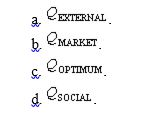
-Refer to Figure 10-12. An alternative label for the quantity WOULD BE
(Short Answer)
5.0/5 (90)
(90) Figure 10-16  -Refer to Figure 10-16. This graph shows the market for pollution when permits are issued to firms and traded in the marketplace. In the absence of a pollution permit system, the quantity of pollution would be
 (Multiple Choice)
4.8/5 (72)
(72) A negative externality arises when a person engages in an activity that has
(Multiple Choice)
4.9/5 (86)
(86) The social cost of pollution includes the private costs of the producers plus the costs to those bystanders adversely affected by the pollution.
(True/False)
4.7/5 (92)
(92) According to the Coase theorem, whatever the initial distribution of rights, the interested parties can bargain to an efficient outcome.
(True/False)
4.9/5 (82)
(82) In Singapore, littering fines are strictly enforced. This is an example of a policy that
(Multiple Choice)
4.9/5 (89)
(89) Figure 10-9  -Refer to Figure 10-9, Panel (b) and Panel (c). The installation of a scrubber in a smokestack reduces the emission of harmful chemicals from the smokestack. Therefore, the external benefit of smokestack scrubber installation is represented by
 (Multiple Choice)
4.8/5 (89)
(89) What is the difference between command-and-control policies and market-based policies toward externalities?
(Multiple Choice)
4.8/5 (79)
(79) 
Filters
- Essay(0)
- Multiple Choice(0)
- Short Answer(0)
- True False(0)
- Matching(0)