



 Chat with AI
Exam 10: Externalities

Exam 1: Ten Principles of Economics439 Questions
Exam 2: Thinking Like an Economist617 Questions
Exam 3: Interdependence and the Gains From Trade527 Questions
Exam 4: The Market Forces of Supply and Demand697 Questions
Exam 5: Elasticity and Its Application594 Questions
Exam 6: Supply, Demand, and Government Policies645 Questions
Exam 7: Consumers, Producers, and the Efficiency of Markets549 Questions
Exam 8: Application: the Costs of Taxation513 Questions
Exam 9: Application: International Trade492 Questions
Exam 10: Externalities524 Questions
Exam 11: Public Goods and Common Resources433 Questions
Exam 12: The Design of the Tax System549 Questions
Exam 13: The Costs of Production420 Questions
Exam 14: Firms in Competitive Markets543 Questions
Exam 15: Monopoly637 Questions
Exam 16: Monopolistic Competition580 Questions
Exam 17: Oligopoly488 Questions
Exam 18: The Markets for the Factors of Production564 Questions
Exam 19: Earnings and Discrimination490 Questions
Exam 20: Income Inequality and Poverty455 Questions
Exam 21: The Theory of Consumer Choice431 Questions
Exam 22: Frontiers of Microeconomics440 Questions
Exam 23: Measuring a Nations Income520 Questions
Exam 24: Measuring the Cost of Living529 Questions
Exam 25: Production and Growth505 Questions
Exam 26: Saving, Investment, and the Financial System564 Questions
Exam 27: The Basic Tools of Finance500 Questions
Exam 28: Unemployment678 Questions
Exam 29: The Monetary System515 Questions
Exam 30: Money Growth and Inflation481 Questions
Exam 31: Open-Economy Macroeconomics: Basic Concepts522 Questions
Exam 32: A Macroeconomic Theory of the Open Economy475 Questions
Exam 33: Aggregate Demand and Aggregate Supply562 Questions
Exam 34: The Influence of Monetary and Fiscal Policy on Aggregate Demand508 Questions
Exam 35: The Short-Run Trade-Off Between Inflation and Unemployment491 Questions
Exam 36: Six Debates Over Macroeconomic Policy372 Questions
Select questions type


A benevolent social planner would prefer that the output of good x be decreased from its current level if, at the current level of output of good x,
(Multiple Choice)
4.9/5  (72)
(72) In a market with positive externalities, the market equilibrium quantity maximizes the welfare of society as a whole.
(True/False)
4.9/5 (78)
(78) The Coase theorem suggests that efficient solutions to externalities can be determined through bargaining. Under what circumstances will private bargaining fail to produce a solution?
(Essay)
4.7/5 (80)
(80) Some policies toward externalities provide incentives so that private decision makers will choose to solve the problem on their own. What name do we use for these types of policies?
(Essay)
4.7/5 (79)
(79) A market for pollution permits can efficiently allocate the right to pollute by using the forces of supply and demand.
(True/False)
4.9/5 (83)
(83) Figure 10-8  -Refer to Figure 10-8. If the government wanted to tax or subsidize this good to achieve the socially-optimal level of output, it would
 (Multiple Choice)
5.0/5 (77)
(77) Does the phenomenon of externalities strengthen the argument that we should rely upon the "invisible hand" of the marketplace, or does it weaken that argument?
(Essay)
4.9/5 (89)
(89) Figure 10-3 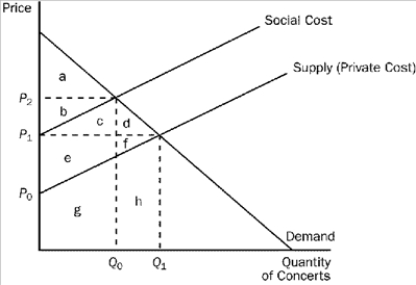 -Refer to Figure 10-3. The difference between the social cost curve and the supply curve reflects the
 (Multiple Choice)
4.7/5 (79)
(79) Flu shots provide a positive externality. Suppose that the market for vaccinations is perfectly competitive. Without government intervention in the vaccination market, which of the following statements is correct?
(Multiple Choice)
4.9/5 (80)
(80) 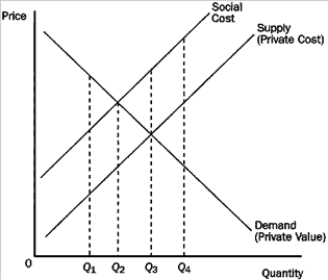 -Refer to Figure 10-4. At Q3
When the social cost curve is above a product's supply curve,
(Multiple Choice)
4.9/5 (82)
(82) Which of the following represents a way that a government can help the private market to internalize an externality?
(Multiple Choice)
4.7/5 (73)
(73) Suppose that elementary education creates a positive externality. If the government does not subsidize education, then
(Multiple Choice)
4.9/5 (74)
(74) When correcting for an externality, command-and-control policies are always preferable to market-based policies.
(True/False)
4.9/5 (72)
(72) Suppose the socially-optimal quantity of good x is larger than the market-equilibrium quantity of good x. Does the production of good x convey a positive externality or does it convey a negative externality?
(Essay)
4.7/5 (89)
(89) When externalities are present, reaching an efficient outcome is especially difficult when the number of interested parties is large.
(True/False)
4.7/5 (73)
(73) 
Filters
- Essay(0)
- Multiple Choice(0)
- Short Answer(0)
- True False(0)
- Matching(0)