



 Chat with AI
Exam 10: Externalities

Exam 1: Ten Principles of Economics439 Questions
Exam 2: Thinking Like an Economist617 Questions
Exam 3: Interdependence and the Gains From Trade527 Questions
Exam 4: The Market Forces of Supply and Demand697 Questions
Exam 5: Elasticity and Its Application594 Questions
Exam 6: Supply, Demand, and Government Policies645 Questions
Exam 7: Consumers, Producers, and the Efficiency of Markets549 Questions
Exam 8: Application: the Costs of Taxation513 Questions
Exam 9: Application: International Trade492 Questions
Exam 10: Externalities524 Questions
Exam 11: Public Goods and Common Resources433 Questions
Exam 12: The Design of the Tax System549 Questions
Exam 13: The Costs of Production420 Questions
Exam 14: Firms in Competitive Markets543 Questions
Exam 15: Monopoly637 Questions
Exam 16: Monopolistic Competition580 Questions
Exam 17: Oligopoly488 Questions
Exam 18: The Markets for the Factors of Production564 Questions
Exam 19: Earnings and Discrimination490 Questions
Exam 20: Income Inequality and Poverty455 Questions
Exam 21: The Theory of Consumer Choice431 Questions
Exam 22: Frontiers of Microeconomics440 Questions
Exam 23: Measuring a Nations Income520 Questions
Exam 24: Measuring the Cost of Living529 Questions
Exam 25: Production and Growth505 Questions
Exam 26: Saving, Investment, and the Financial System564 Questions
Exam 27: The Basic Tools of Finance500 Questions
Exam 28: Unemployment678 Questions
Exam 29: The Monetary System515 Questions
Exam 30: Money Growth and Inflation481 Questions
Exam 31: Open-Economy Macroeconomics: Basic Concepts522 Questions
Exam 32: A Macroeconomic Theory of the Open Economy475 Questions
Exam 33: Aggregate Demand and Aggregate Supply562 Questions
Exam 34: The Influence of Monetary and Fiscal Policy on Aggregate Demand508 Questions
Exam 35: The Short-Run Trade-Off Between Inflation and Unemployment491 Questions
Exam 36: Six Debates Over Macroeconomic Policy372 Questions
Select questions type


Figure 10-5 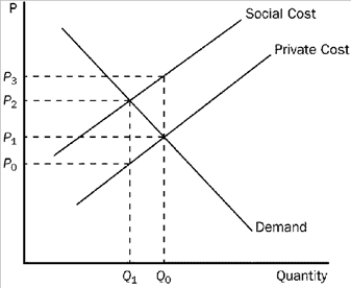 -Refer to Figure 10-5. Which price and quantity combination represents the social optimum?
 (Multiple Choice)
4.9/5  (80)
(80) Suppose that smoking creates a negative externality. If the government imposes a per-cigarette tax equal to the per-cigarette externality, then
(Multiple Choice)
4.8/5 (65)
(65) Table 10-4  -Refer to Table 10-4. Which of the following policies would move the market from the market equilibrium to the socially optimal equilibrium?
 (Multiple Choice)
4.9/5 (88)
(88) Figure 10-11  -Refer to Figure 10-11. Taking only private value and private cost into account, total surplus at the market equilibrium amounts to
 (Multiple Choice)
5.0/5 (72)
(72) Suppose that Company A's railroad cars pass through Farmer B's corn fields. The railroad causes an externality to the farmer because the railroad cars emit sparks that cause $1,500 in damage to the farmer's crops. There is a special soy-based grease that the railroad could purchase that would eliminate the damaging sparks. The grease costs $1,200. Suppose that the railroad is not liable for any damage caused to the crops. Assume that there are no transaction costs. Which of the following characterizes the efficient outcome?
(Multiple Choice)
4.7/5 (69)
(69) The Coase theorem asserts that the private market will always solve the problem of externalities and allocate resources efficiently
(Multiple Choice)
4.8/5 (91)
(91) Figure 10-8  -Refer to Figure 10-8. What is the socially-optimal quantity of output in this market?
 (Multiple Choice)
5.0/5 (92)
(92) Figure 10-12  -Refer to Figure 10-12. Which of the following is an appropriate label for Line 2?
 (Multiple Choice)
4.8/5 (79)
(79) Figure 10-10  -Refer to Figure 10-10. Taking into account private and external costs, the maximum total surplus that can be achieved in this market is
 (Multiple Choice)
4.8/5 (82)
(82) Corrective taxes cause deadweight losses, reducing economic efficiency.
(True/False)
4.8/5 (79)
(79) Patent protection is one way to deal with technology spillovers.
(True/False)
4.8/5 (74)
(74) When a negative externality exists in a market, the cost to producers
(Multiple Choice)
4.7/5 (85)
(85) Figure 10-15  -Refer to Figure 10-15. The supply of pollution permits is
 (Multiple Choice)
4.9/5 (87)
(87) Figure 10-9  -Refer to Figure 10-9, Panel (b) and Panel (c). The overuse of antibiotics leads to the development of antibiotic- resistant diseases. Therefore, the external cost of antibiotic overuse is represented by
 (Multiple Choice)
4.8/5 (82)
(82) When the government uses a command-and-control policy to solve an externality, it
(Multiple Choice)
4.9/5 (69)
(69) If the government wanted to ensure that the market reaches the socially optimal equilibrium in the presence of a technology spillover, it should
(Multiple Choice)
4.9/5 (88)
(88) The difference between a corrective tax and a tradable pollution permit is that
(Multiple Choice)
4.8/5 (77)
(77) 
Filters
- Essay(0)
- Multiple Choice(0)
- Short Answer(0)
- True False(0)
- Matching(0)