



 Chat with AI
Exam 15: Money Creation

Exam 1: Limits, Alternatives, and Choices212 Questions
Exam 2: The Market System and the Circular Flow141 Questions
Exam 3: Demand, Supply, and Market Equilibrium202 Questions
Exam 4: Market Failures: Public Goods and Externalities155 Questions
Exam 5: Governments Role and Government Failure148 Questions
Exam 6: An Introduction to Macroeconomics123 Questions
Exam 7: Measuring Domestic Output and National Income157 Questions
Exam 8: Economic Growth114 Questions
Exam 9: Business Cycles, Unemployment, and Inflation143 Questions
Exam 10: Basic Macroeconomic Relationships142 Questions
Exam 11: The Aggregate Expenditures Model143 Questions
Exam 12: Aggregate Demand and Aggregate Supply152 Questions
Exam 13: Fiscal Policy, Deficits, and Debt164 Questions
Exam 14: Money, Banking, and Financial Institutions130 Questions
Exam 15: Money Creation127 Questions
Exam 16: Interest Rates and Monetary Policy174 Questions
Exam 17: Financial Economics136 Questions
Exam 18: Extending the Analysis of Aggregate Supply135 Questions
Exam 19: Current Issues in Macro Theory and Policy134 Questions
Exam 20: International Trade151 Questions
Exam 21: The Balance of Payments, Exchange Rates, and Trade Deficits152 Questions
Exam 22: The Economics of Developing Countries135 Questions
Select questions type


The balance sheet below is for the First Federal Bank. Assume the required reserve ratio is 20 percent. 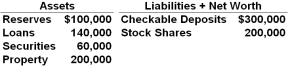 Refer to the above information. This bank can safely expand its loans by a maximum of:
 (Multiple Choice)
4.7/5  (78)
(78) The Federal funds rate is the rate that banks pay for loans from:
(Multiple Choice)
4.9/5 (85)
(85) When cash is deposited at a bank, the composition of the money supply is changed but the total supply of money is not.
(True/False)
5.0/5 (74)
(74) A single commercial bank must meet a 25 percent reserve requirement. If it initially has no excess reserves and then $2,000 in cash is deposited in the bank, it can increase its loans by a maximum of:
(Multiple Choice)
4.8/5 (78)
(78) Banks can lend their excess reserves to other banks in the:
(Multiple Choice)
4.9/5 (71)
(71) While the withdrawal of cash from banks does not affect money supply immediately, it will affect the banking system's lending capacity which will eventually lead to a contraction in money supply.
(True/False)
4.8/5 (84)
(84) 
Filters
- Essay(0)
- Multiple Choice(0)
- Short Answer(0)
- True False(0)
- Matching(0)