



 Chat with AI
Exam 15: Money Creation

Exam 1: Limits, Alternatives, and Choices212 Questions
Exam 2: The Market System and the Circular Flow141 Questions
Exam 3: Demand, Supply, and Market Equilibrium202 Questions
Exam 4: Market Failures: Public Goods and Externalities155 Questions
Exam 5: Governments Role and Government Failure148 Questions
Exam 6: An Introduction to Macroeconomics123 Questions
Exam 7: Measuring Domestic Output and National Income157 Questions
Exam 8: Economic Growth114 Questions
Exam 9: Business Cycles, Unemployment, and Inflation143 Questions
Exam 10: Basic Macroeconomic Relationships142 Questions
Exam 11: The Aggregate Expenditures Model143 Questions
Exam 12: Aggregate Demand and Aggregate Supply152 Questions
Exam 13: Fiscal Policy, Deficits, and Debt164 Questions
Exam 14: Money, Banking, and Financial Institutions130 Questions
Exam 15: Money Creation127 Questions
Exam 16: Interest Rates and Monetary Policy174 Questions
Exam 17: Financial Economics136 Questions
Exam 18: Extending the Analysis of Aggregate Supply135 Questions
Exam 19: Current Issues in Macro Theory and Policy134 Questions
Exam 20: International Trade151 Questions
Exam 21: The Balance of Payments, Exchange Rates, and Trade Deficits152 Questions
Exam 22: The Economics of Developing Countries135 Questions
Select questions type


Sharon sells a government security worth $4,600,000 to the Federal Reserve Bank of Kansas City. She then deposits the funds in her checking account at First Commerce Bank. Her checking account had a $150,000 balance before this deposit. The reserves of First Commerce Bank would:
(Multiple Choice)
4.9/5  (75)
(75) Assume that the required reserve ratio is 5 percent. If a commercial bank has $2 million cash in its vault, $1 million in government securities, $3 million on deposit at the Fed, and $60 million in checkable deposits, then its excess reserves equal:
(Multiple Choice)
4.9/5 (71)
(71) When you deposit money at a bank, the bank will normally turn around and lend most of it to a borrower.
(True/False)
4.7/5 (89)
(89)  Refer to the table above. If a bank has checkable deposits of $45 million and reserves of $2 million, then its excess reserves are:
 (Multiple Choice)
4.9/5 (81)
(81) When a bank accepts a checkable deposit from a customer, its deposits will increase and its excess reserves will:
(Multiple Choice)
4.8/5 (75)
(75) When a bank sells capital stock (equity shares) in return for cash:
(Multiple Choice)
4.9/5 (89)
(89) Suppose that the reserve ratio is 6%, and applies only to checkable deposits. A bank has non-checkable time deposits of $300 million, checkable deposits of $100 million, and reserves of $8 million. What are the excess reserves of this bank?
(Multiple Choice)
4.9/5 (80)
(80) Fractional reserve banking refers to a system where banks:
(Multiple Choice)
4.9/5 (74)
(74) The commercial banking system can lend by a multiple of its excess reserves primarily because:
(Multiple Choice)
4.9/5 (65)
(65) A bank has excess reserves of $5,000 and demand deposits of $50,000; the required reserve ratio is 20 percent. If the reserve ratio is raised to 25 percent, then this bank can lend a maximum of:
(Multiple Choice)
4.9/5 (86)
(86) If a commercial banking system has $200,000 in checkable deposits and actual reserves of $70,000, then with a reserve ratio of 20 percent the banking system can expand the supply of money by a maximum of $180,000.
(True/False)
4.9/5 (83)
(83) Answer the question based on the following balance sheet for the First National Bank. Assume the reserve ratio is 15 percent: 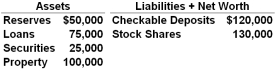 Refer to the data above. If a check for $20,000 is drawn and cleared against this bank, it will then have excess reserves of:
 (Multiple Choice)
4.8/5 (78)
(78) When required reserves exceed actual reserves, commercial banks will be forced to have borrowers:
(Multiple Choice)
4.8/5 (80)
(80) One major component of money supply M1 is part of a bank's:
(Multiple Choice)
4.8/5 (72)
(72) When cash is deposited in a checkable-deposit account at a bank, there is:
(Multiple Choice)
4.9/5 (72)
(72)  Refer to the table above. If a bank has $60 million in savings deposits and $40 million in checkable deposits, then its required reserves are:
 (Multiple Choice)
4.9/5 (76)
(76) 
Filters
- Essay(0)
- Multiple Choice(0)
- Short Answer(0)
- True False(0)
- Matching(0)