



 Chat with AI
Exam 20: International Trade

Exam 1: Limits, Alternatives, and Choices212 Questions
Exam 2: The Market System and the Circular Flow141 Questions
Exam 3: Demand, Supply, and Market Equilibrium202 Questions
Exam 4: Market Failures: Public Goods and Externalities155 Questions
Exam 5: Governments Role and Government Failure148 Questions
Exam 6: An Introduction to Macroeconomics123 Questions
Exam 7: Measuring Domestic Output and National Income157 Questions
Exam 8: Economic Growth114 Questions
Exam 9: Business Cycles, Unemployment, and Inflation143 Questions
Exam 10: Basic Macroeconomic Relationships142 Questions
Exam 11: The Aggregate Expenditures Model143 Questions
Exam 12: Aggregate Demand and Aggregate Supply152 Questions
Exam 13: Fiscal Policy, Deficits, and Debt164 Questions
Exam 14: Money, Banking, and Financial Institutions130 Questions
Exam 15: Money Creation127 Questions
Exam 16: Interest Rates and Monetary Policy174 Questions
Exam 17: Financial Economics136 Questions
Exam 18: Extending the Analysis of Aggregate Supply135 Questions
Exam 19: Current Issues in Macro Theory and Policy134 Questions
Exam 20: International Trade151 Questions
Exam 21: The Balance of Payments, Exchange Rates, and Trade Deficits152 Questions
Exam 22: The Economics of Developing Countries135 Questions
Select questions type


Which of the following products is a leading import of the United States?

Free
(Multiple Choice)
4.9/5  (84)
(84) Correct Answer: Verified
C
Whenever a foreign producer is selling a product like steel at a lower price than domestic producers, then dumping is being practiced and must be corrected.
Free
(True/False)
4.8/5 (95)
(95) Correct Answer:Verified
VerifiedFalse
The imposition of a tariff on a product is least likely to result in a(n):
Free
(Multiple Choice)
4.9/5 (83)
(83) Correct Answer:Verified
VerifiedA
Import quotas on products will reduce the quantity of the imported products and:
(Multiple Choice)
4.8/5 (69)
(69) Globalization of resource markets has resulted in the business practice of offshoring, which involves:
(Multiple Choice)
5.0/5 (85)
(85) The World Trade Organization was established by the United States to force other nations to open their markets to U.S. goods.
(True/False)
4.7/5 (82)
(82) Among the principal exports of the United States are agricultural products.
(True/False)
4.8/5 (88)
(88) Autos and chemicals are in million of units in the following production possibilities tables: 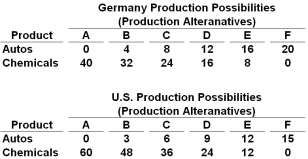 Refer to the tables above. If Germany and the United States engage in trade, the mutually-beneficial terms of trade will be between:
 (Multiple Choice)
4.9/5 (79)
(79) In a two-nation two-good world, it is possible for one nation to have the comparative advantage in both goods.
(True/False)
4.9/5 (81)
(81) The world price for a traded product will be between the domestic no-trade prices of the trading nations.
(True/False)
4.8/5 (71)
(71) 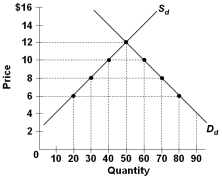 Refer to the graph above, where Sd and Dd are the domestic supply and demand curves for a product. The world price of the product is $6. If the market is open to international trade but there is a tariff of $2 per unit imposed, the total government revenue generated by the tariff would be:
 (Multiple Choice)
4.9/5 (89)
(89) A nation will import a particular product if the world price is less than the domestic price.
(True/False)
4.8/5 (86)
(86) 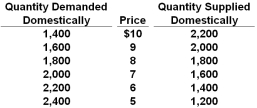 Refer to the table above for a certain product's market in Econland. If the world price of the product were $6 and a tariff of $1 per unit imported is imposed, then the quantity of output that would be supplied domestically would be:
 (Multiple Choice)
4.9/5 (89)
(89) 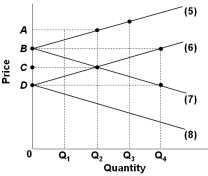 Refer to the graph above which shows the import demand and export supply curves for two nations that produce a certain product. In this two-nation model, the equilibrium world price and quantity will be:
 (Multiple Choice)
4.9/5 (70)
(70) Which of the following statements best describes a protective tariff?
(Multiple Choice)
4.8/5 (83)
(83) 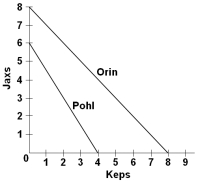 The graph above shows the production possibilities curves for two hypothetical nations, Orin and Pohl, which each make two hypothetical products, jaxs and keps. Which of the following statements is correct?
 (Multiple Choice)
4.8/5 (63)
(63) 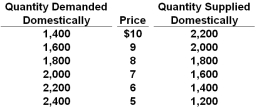 Refer to the table above for a certain product's market in Econland. If the world price for this product were $6, then Econland would import:
 (Multiple Choice)
4.7/5 (79)
(79) If Nation A requires more resources to produce each bale of cloth than Nation B does, then we say that:
(Multiple Choice)
4.8/5 (82)
(82) 
Filters
- Essay(0)
- Multiple Choice(0)
- Short Answer(0)
- True False(0)
- Matching(0)