



 Chat with AI
Exam 20: International Trade

Exam 1: Limits, Alternatives, and Choices212 Questions
Exam 2: The Market System and the Circular Flow141 Questions
Exam 3: Demand, Supply, and Market Equilibrium202 Questions
Exam 4: Market Failures: Public Goods and Externalities155 Questions
Exam 5: Governments Role and Government Failure148 Questions
Exam 6: An Introduction to Macroeconomics123 Questions
Exam 7: Measuring Domestic Output and National Income157 Questions
Exam 8: Economic Growth114 Questions
Exam 9: Business Cycles, Unemployment, and Inflation143 Questions
Exam 10: Basic Macroeconomic Relationships142 Questions
Exam 11: The Aggregate Expenditures Model143 Questions
Exam 12: Aggregate Demand and Aggregate Supply152 Questions
Exam 13: Fiscal Policy, Deficits, and Debt164 Questions
Exam 14: Money, Banking, and Financial Institutions130 Questions
Exam 15: Money Creation127 Questions
Exam 16: Interest Rates and Monetary Policy174 Questions
Exam 17: Financial Economics136 Questions
Exam 18: Extending the Analysis of Aggregate Supply135 Questions
Exam 19: Current Issues in Macro Theory and Policy134 Questions
Exam 20: International Trade151 Questions
Exam 21: The Balance of Payments, Exchange Rates, and Trade Deficits152 Questions
Exam 22: The Economics of Developing Countries135 Questions
Select questions type


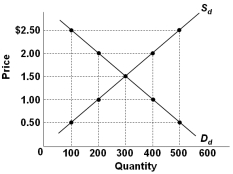 Refer to the graph above showing the domestic demand and supply curves for a specific product in a hypothetical nation called Econland. At what price will Econland be neither importing nor exporting the product?
 (Multiple Choice)
4.9/5  (72)
(72) The table below shows the output (either machines or wine) that each unit of input in France and Germany can produce: 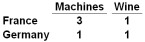 Refer to the table above. Based on the given information, we see that:
 (Multiple Choice)
4.9/5 (83)
(83) Answer the following question based on the data provided in the tables below for two hypothetical nations, Wat and Xat. The nations have the production possibilities for rice and corn given in the following table: 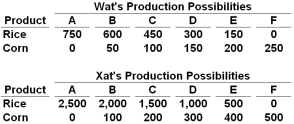 Refer to the data above. The mutually-beneficial terms of trade will be:
 (Multiple Choice)
4.9/5 (74)
(74) Assume that a tariff is imposed on an imported product. The difference between the domestic price and the world price is captured by:
(Multiple Choice)
4.8/5 (76)
(76) 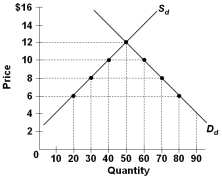 Refer to the graph above, where Sd and Dd are the domestic supply and demand curves for a product. The world price of the product is $6. If the economy is open to international trade but a per unit tariff of $4 is imposed, then the total revenue going to domestic producers would be:
 (Multiple Choice)
4.8/5 (77)
(77) In 2011, the United States was the largest exporter in the world.
(True/False)
4.8/5 (80)
(80) If two nations specialize in their respective comparative advantage and then trade with each other, both nations can consume output-combinations that are beyond their production possibilities curves.
(True/False)
4.7/5 (78)
(78) If a nation's labor can produce more of a good compared to labor in another nation, then we say that the first nation has a comparative advantage in producing that good.
(True/False)
4.9/5 (84)
(84) 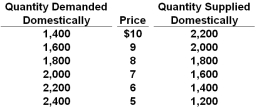 Refer to the table above for a certain product's market in Econland. If Econland were entirely closed to international trade, the equilibrium price and quantity would be:
 (Multiple Choice)
4.8/5 (85)
(85) 
Filters
- Essay(0)
- Multiple Choice(0)
- Short Answer(0)
- True False(0)
- Matching(0)