



 Chat with AI
Exam 13: Fiscal Policy, Deficits, and Debt

Exam 1: Limits, Alternatives, and Choices212 Questions
Exam 2: The Market System and the Circular Flow141 Questions
Exam 3: Demand, Supply, and Market Equilibrium202 Questions
Exam 4: Market Failures: Public Goods and Externalities155 Questions
Exam 5: Governments Role and Government Failure148 Questions
Exam 6: An Introduction to Macroeconomics123 Questions
Exam 7: Measuring Domestic Output and National Income157 Questions
Exam 8: Economic Growth114 Questions
Exam 9: Business Cycles, Unemployment, and Inflation143 Questions
Exam 10: Basic Macroeconomic Relationships142 Questions
Exam 11: The Aggregate Expenditures Model143 Questions
Exam 12: Aggregate Demand and Aggregate Supply152 Questions
Exam 13: Fiscal Policy, Deficits, and Debt164 Questions
Exam 14: Money, Banking, and Financial Institutions130 Questions
Exam 15: Money Creation127 Questions
Exam 16: Interest Rates and Monetary Policy174 Questions
Exam 17: Financial Economics136 Questions
Exam 18: Extending the Analysis of Aggregate Supply135 Questions
Exam 19: Current Issues in Macro Theory and Policy134 Questions
Exam 20: International Trade151 Questions
Exam 21: The Balance of Payments, Exchange Rates, and Trade Deficits152 Questions
Exam 22: The Economics of Developing Countries135 Questions
Select questions type


In an economy, the government wants to increase aggregate demand by $50 billion at each price level to increase real GDP and reduce unemployment. If the MPS is 0.4, then it could increase government spending by:

Free
(Multiple Choice)
4.8/5  (77)
(77) Correct Answer: Verified
B
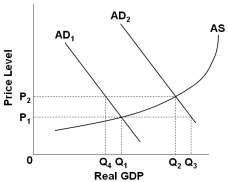 Refer to the graph above. Assume that the economy is in a recession with a price level of P1 and output level Q1. The government then adopts an appropriate discretionary fiscal policy. What will be the most likely new equilibrium price level and output?
Free
(Multiple Choice)
4.7/5 (84)
(84) Correct Answer:Verified
VerifiedC
A major reason that the public debt cannot bankrupt the Federal government is because:
Free
(Multiple Choice)
4.8/5 (82)
(82) Correct Answer:Verified
VerifiedC
The following are important problems associated with the public debt, except:
(Multiple Choice)
4.8/5 (93)
(93) In 2012, the general public (excluding Federal agencies) held about what percentage of U.S. Federal debt?
(Multiple Choice)
4.8/5 (91)
(91) The cyclically-adjusted surplus in the U.S. went from +1.2% of GDP in 2000 to +0.6% of GDP in 2002. This suggests that the government during that period:
(Multiple Choice)
4.8/5 (81)
(81) The effect of an increase in the government budget deficit on the equilibrium level of GDP is essentially the same as a(n):
(Multiple Choice)
4.9/5 (83)
(83) 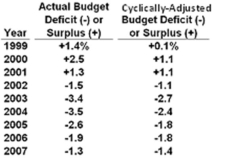 Refer to the data in the table above. The direction of fiscal policy became more contractionary from:
 (Multiple Choice)
4.8/5 (78)
(78) When Social Security contributions have exceeded payouts in the past, the excess amounts were used to help finance the Federal government's budget deficits.
(True/False)
4.8/5 (74)
(74) Due to automatic stabilizers, when the nation's total income rises, government transfer spending:
(Multiple Choice)
4.8/5 (57)
(57) To track the public debt over time and understand its significance to the economy, it is best:
(Multiple Choice)
4.9/5 (74)
(74) The economy is in a recession. The government enacts a policy to increase spending by $2 billion. The MPS is 0.2. What would be the full increase in real GDP from the change in government spending assuming that the aggregate supply curve is horizontal across the range of GDP being considered?
(Multiple Choice)
4.8/5 (82)
(82) 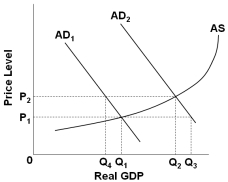 Refer to the graph above. Assume that the economy initially has a price level of P1 and output level Q1. If the government implements expansionary fiscal policy, and the full multiplier effect was felt, it would bring the economy to:
 (Multiple Choice)
4.8/5 (86)
(86) The Medicare trust fund is expected, if current flows continue, to be depleted within a couple of decades.
(True/False)
4.9/5 (84)
(84) If the U.S. Congress passes legislation to raise taxes to control demand-pull inflation, then this would be an example of a(n):
(Multiple Choice)
5.0/5 (83)
(83) When the Federal government cuts taxes and increases spending to stimulate the economy during a period of recession, such actions are design to be:
(Multiple Choice)
4.8/5 (79)
(79) In the later part of 2009, something historic happened relative to Social Security, in that for the first time:
(Multiple Choice)
4.7/5 (82)
(82) Which of the following expansionary fiscal policy changes would be most favored by those economists who think that the government is too large and inefficient?
(Multiple Choice)
4.9/5 (86)
(86) As the economy declines into recession, the collection of personal income tax revenues automatically falls. This phenomenon best illustrates how a progressive income-tax system:
(Multiple Choice)
4.7/5 (88)
(88) 
Filters
- Essay(0)
- Multiple Choice(0)
- Short Answer(0)
- True False(0)
- Matching(0)