



 Chat with AI
Exam 13: Fiscal Policy, Deficits, and Debt

Exam 1: Limits, Alternatives, and Choices212 Questions
Exam 2: The Market System and the Circular Flow141 Questions
Exam 3: Demand, Supply, and Market Equilibrium202 Questions
Exam 4: Market Failures: Public Goods and Externalities155 Questions
Exam 5: Governments Role and Government Failure148 Questions
Exam 6: An Introduction to Macroeconomics123 Questions
Exam 7: Measuring Domestic Output and National Income157 Questions
Exam 8: Economic Growth114 Questions
Exam 9: Business Cycles, Unemployment, and Inflation143 Questions
Exam 10: Basic Macroeconomic Relationships142 Questions
Exam 11: The Aggregate Expenditures Model143 Questions
Exam 12: Aggregate Demand and Aggregate Supply152 Questions
Exam 13: Fiscal Policy, Deficits, and Debt164 Questions
Exam 14: Money, Banking, and Financial Institutions130 Questions
Exam 15: Money Creation127 Questions
Exam 16: Interest Rates and Monetary Policy174 Questions
Exam 17: Financial Economics136 Questions
Exam 18: Extending the Analysis of Aggregate Supply135 Questions
Exam 19: Current Issues in Macro Theory and Policy134 Questions
Exam 20: International Trade151 Questions
Exam 21: The Balance of Payments, Exchange Rates, and Trade Deficits152 Questions
Exam 22: The Economics of Developing Countries135 Questions
Select questions type


The two reasons why bankruptcy is a false concern about the public debt are:
(Multiple Choice)
4.9/5  (79)
(79) The table gives data on interest rates and investment demand (in billions of dollars) in a hypothetical economy. 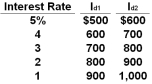 Refer to the above table. Using the Id1 schedule, assume that the government needs to finance the public debt and this public borrowing increases the interest rate from 3% to 4%. How much crowding out of private investment will occur?
 (Multiple Choice)
4.8/5 (95)
(95) Which of the following is an example of built-in stability? As real GDP decreases, income tax revenues:
(Multiple Choice)
4.9/5 (88)
(88) Without a change in discretionary fiscal policy, we would expect that if the economy goes into recession, then the:
(Multiple Choice)
4.8/5 (81)
(81)  Refer to the figure above. The economy is at equilibrium at point C which is below potential output. What fiscal policy would increase real GDP?
 (Multiple Choice)
4.9/5 (78)
(78) If the government wishes to increase the level of real GDP, it might reduce:
(Multiple Choice)
4.7/5 (67)
(67) The table gives data on interest rates and investment demand (in billions of dollars) in a hypothetical economy. 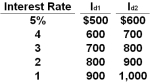 Refer to the above table. Assume that the public debt is used to expand the capital stock of the economy and that, as a consequence, the investment-demand schedule changes from Id1 to Id2. At the same time, the interest rate rises from 3% to 4% as the government borrows money to finance the public debt. How much crowding out of private investment will occur in this case?
 (Multiple Choice)
4.9/5 (80)
(80) The following is budget information for a hypothetical economy. All data are in billions of dollars. 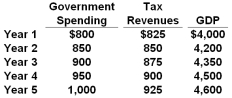 Refer to the above table. In which year is there a balanced budget?
 (Multiple Choice)
4.9/5 (83)
(83) The so-called crowding-out effect refers to government spending crowding out private investment spending.
(True/False)
4.8/5 (76)
(76) State and local governments are limited in their ability to respond to recessions because of:
(Multiple Choice)
4.9/5 (76)
(76) The time which elapses between the beginning of a recession or an inflationary episode and the identification of the macroeconomic problem is referred to as a(n):
(Multiple Choice)
4.8/5 (77)
(77) The payment of interest on the public debt in the U.S. mildly increases income inequality.
(True/False)
4.7/5 (82)
(82) A budget deficit causes the government to issue or sell Treasury bonds.
(True/False)
4.8/5 (95)
(95) The economy starts out with a balanced Federal budget. If the government then implements expansionary fiscal policy, then there will be a:
(Multiple Choice)
4.8/5 (81)
(81)  Refer to the graph above. Automatic stability in this economy could be enhanced by:
 (Multiple Choice)
4.8/5 (80)
(80) Proponents of the notion of a "political business cycle" suggest that:
(Multiple Choice)
4.7/5 (90)
(90) Discretionary fiscal policy is often initiated on the advice of the:
(Multiple Choice)
4.8/5 (76)
(76)  In the graph above, tax revenues vary:

Filters
- Essay(0)
- Multiple Choice(0)
- Short Answer(0)
- True False(0)
- Matching(0)