



 Chat with AI
Exam 13: Fiscal Policy, Deficits, and Debt

Exam 1: Limits, Alternatives, and Choices212 Questions
Exam 2: The Market System and the Circular Flow141 Questions
Exam 3: Demand, Supply, and Market Equilibrium202 Questions
Exam 4: Market Failures: Public Goods and Externalities155 Questions
Exam 5: Governments Role and Government Failure148 Questions
Exam 6: An Introduction to Macroeconomics123 Questions
Exam 7: Measuring Domestic Output and National Income157 Questions
Exam 8: Economic Growth114 Questions
Exam 9: Business Cycles, Unemployment, and Inflation143 Questions
Exam 10: Basic Macroeconomic Relationships142 Questions
Exam 11: The Aggregate Expenditures Model143 Questions
Exam 12: Aggregate Demand and Aggregate Supply152 Questions
Exam 13: Fiscal Policy, Deficits, and Debt164 Questions
Exam 14: Money, Banking, and Financial Institutions130 Questions
Exam 15: Money Creation127 Questions
Exam 16: Interest Rates and Monetary Policy174 Questions
Exam 17: Financial Economics136 Questions
Exam 18: Extending the Analysis of Aggregate Supply135 Questions
Exam 19: Current Issues in Macro Theory and Policy134 Questions
Exam 20: International Trade151 Questions
Exam 21: The Balance of Payments, Exchange Rates, and Trade Deficits152 Questions
Exam 22: The Economics of Developing Countries135 Questions
Select questions type


If a government wants to pursue an expansionary fiscal policy, then a tax cut of a certain size will be more expansionary when the:
(Multiple Choice)
4.7/5  (85)
(85) In Year 1, the actual budget deficit was $200 billion and the cyclically-adjusted deficit was $150 billion. In Year 2, the actual budget deficit was $225 billion and the cyclically-adjusted deficit was $175 billion. It can be concluded that fiscal policy from Year 1 to Year 2 became more:
(Multiple Choice)
4.8/5 (78)
(78) If the economy is to have significant built-in stability, then when real GDP increases, the tax revenues should:
(Multiple Choice)
4.9/5 (87)
(87)  Refer to the above graph. What combination would most likely cause a shift from AD1 to AD2?
 (Multiple Choice)
4.8/5 (89)
(89) Medicare and Social Security are similar in the following respects, except:
(Multiple Choice)
4.9/5 (85)
(85) Contractionary fiscal policy would tend to make a budget deficit become:
(Multiple Choice)
4.7/5 (75)
(75) The following is an investment schedule. Investment spending is in billions of dollars. 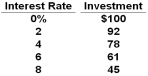 Refer to the data in the table above. When the government runs a budget deficit and issues more Treasury securities, crowding out would occur if:
 (Multiple Choice)
4.9/5 (77)
(77) Crowding out is a decrease in private investment caused by:
(Multiple Choice)
4.7/5 (82)
(82) The key to assessing whether fiscal policy is expansionary or not is to observe the change in the cyclically-adjusted budget balance.
(True/False)
4.8/5 (81)
(81) You are given the following information about aggregate demand at the existing price level for an economy: (1) consumption = $400 billion; (2) investment = $40 billion; (3) government purchases = $90 billion; and (4) net export = $25 billion. If the full-employment level of GDP for this economy is $600 billion, then what combination of actions would be most consistent with closing the GDP-gap here?
(Multiple Choice)
4.8/5 (74)
(74) There is general agreement among economists that a proposed fiscal policy should be evaluated for its:
(Multiple Choice)
4.9/5 (77)
(77) Which combination of fiscal policy actions would most likely offset each other?
(Multiple Choice)
4.8/5 (81)
(81) The lag between the time that the need for fiscal action is recognized and the time action is actually taken is referred to as the:
(Multiple Choice)
4.9/5 (80)
(80) When the Federal government uses taxation and spending actions to stimulate the economy it is conducting:
(Multiple Choice)
4.8/5 (74)
(74) The economic burden of World War II for the United States was primarily:
(Multiple Choice)
4.8/5 (86)
(86) The crowding-out effect works through interest rates and it tends to:
(Multiple Choice)
4.9/5 (84)
(84) 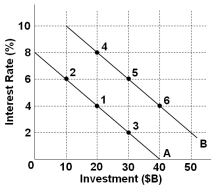 Refer to the above graph. The economy is initially at point 1. Which of the following events would cause a shift that would help offset the crowding-out effect? An increase in:
 (Multiple Choice)
4.7/5 (75)
(75) If the cyclically-adjusted budget shows a deficit zero and the actual budget shows a deficit of about $150 billion, it can be concluded that there is:
(Multiple Choice)
4.9/5 (80)
(80) 
Filters
- Essay(0)
- Multiple Choice(0)
- Short Answer(0)
- True False(0)
- Matching(0)