



 Chat with AI
Exam 1: Limits, Alternatives, and Choices

Exam 1: Limits, Alternatives, and Choices212 Questions
Exam 2: The Market System and the Circular Flow141 Questions
Exam 3: Demand, Supply, and Market Equilibrium202 Questions
Exam 4: Market Failures: Public Goods and Externalities155 Questions
Exam 5: Governments Role and Government Failure148 Questions
Exam 6: An Introduction to Macroeconomics123 Questions
Exam 7: Measuring Domestic Output and National Income157 Questions
Exam 8: Economic Growth114 Questions
Exam 9: Business Cycles, Unemployment, and Inflation143 Questions
Exam 10: Basic Macroeconomic Relationships142 Questions
Exam 11: The Aggregate Expenditures Model143 Questions
Exam 12: Aggregate Demand and Aggregate Supply152 Questions
Exam 13: Fiscal Policy, Deficits, and Debt164 Questions
Exam 14: Money, Banking, and Financial Institutions130 Questions
Exam 15: Money Creation127 Questions
Exam 16: Interest Rates and Monetary Policy174 Questions
Exam 17: Financial Economics136 Questions
Exam 18: Extending the Analysis of Aggregate Supply135 Questions
Exam 19: Current Issues in Macro Theory and Policy134 Questions
Exam 20: International Trade151 Questions
Exam 21: The Balance of Payments, Exchange Rates, and Trade Deficits152 Questions
Exam 22: The Economics of Developing Countries135 Questions
Select questions type


If you knew that the vertical intercept for a straight line was 150 and that the slope of the line was 4, then the dependent variable would be 250 when the value of the independent variable is:

Free
(Multiple Choice)
4.8/5  (84)
(84) Correct Answer: Verified
C
Which of the following is considered to be an entrepreneur?
Free
(Multiple Choice)
4.8/5 (76)
(76) Correct Answer:Verified
VerifiedA
In a relationship between two variables, the "independent variable" refers to the:
Free
(Multiple Choice)
4.9/5 (86)
(86) Correct Answer:Verified
VerifiedD
Because of increasing opportunity costs, the production possibility curve:
(Multiple Choice)
4.9/5 (86)
(86) The comment that "taxes must be reduced for the good of the economy" is an example of a normative economic statement.
(True/False)
4.9/5 (80)
(80) A nation can produce two products: tanks and autos. The table below is the nation's production possibilities: 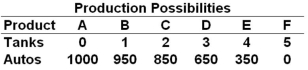 Given the production possibilities schedule above, a combination of 3 tanks and 350 autos:
 (Multiple Choice)
4.8/5 (91)
(91) The following graph is the production possibilities curve of a nation: 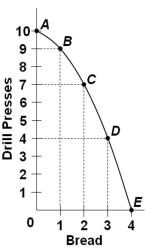 Refer to the above graph. The combination "5 drill presses and 2 bread" indicates:
 (Multiple Choice)
4.9/5 (78)
(78) 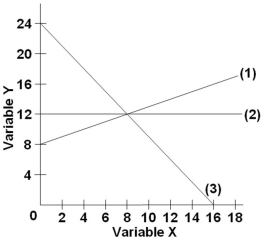 The linear equation for line (1) on the above graph is:
Mia wants to buy a book. The economic perspective suggests that Mia will buy the book if:
(Multiple Choice)
4.9/5 (76)
(76) The economic perspective focuses largely on marginal analysis, which means analyzing:
(Multiple Choice)
4.8/5 (95)
(95) Economic analysis assumes "purposeful behavior", which means that people will pursue decisions or actions:
(Multiple Choice)
4.9/5 (82)
(82) If you knew that the intercept for a straight line was 12, and that if the value of the independent variable was 3 the value of the dependent variable would be 18, then the slope of the line would be:
(Multiple Choice)
4.8/5 (86)
(86) Economics is the social science concerned with the best use of scarce resources to achieve maximum satisfaction of economic wants.
(True/False)
5.0/5 (84)
(84) If economic resources are perfectly interchangeable between the two products shown on a production possibilities graph:
(Multiple Choice)
4.8/5 (88)
(88) The slope of a graph with "income" on the horizontal axis and "saving" on the horizontal axis is +0.2. This means that if: (BOTH SAY HORIZONTAL)
(Multiple Choice)
4.7/5 (95)
(95) When a nation is under-allocating resources to the production of a good, then the:
(Multiple Choice)
4.9/5 (84)
(84) What is a major opportunity cost of going to college on a full-time basis?
(Multiple Choice)
4.7/5 (82)
(82) 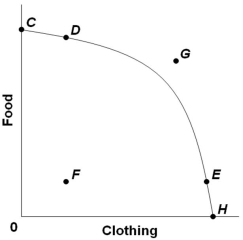 Which point or output-combination in the above graph could the nation produce only if it experienced economic growth?
 (Multiple Choice)
4.9/5 (84)
(84) 
Filters
- Essay(0)
- Multiple Choice(0)
- Short Answer(0)
- True False(0)
- Matching(0)