



 Chat with AI
Exam 14: Money, Banking, and Financial Institutions

Exam 1: Limits, Alternatives, and Choices212 Questions
Exam 2: The Market System and the Circular Flow141 Questions
Exam 3: Demand, Supply, and Market Equilibrium202 Questions
Exam 4: Market Failures: Public Goods and Externalities155 Questions
Exam 5: Governments Role and Government Failure148 Questions
Exam 6: An Introduction to Macroeconomics123 Questions
Exam 7: Measuring Domestic Output and National Income157 Questions
Exam 8: Economic Growth114 Questions
Exam 9: Business Cycles, Unemployment, and Inflation143 Questions
Exam 10: Basic Macroeconomic Relationships142 Questions
Exam 11: The Aggregate Expenditures Model143 Questions
Exam 12: Aggregate Demand and Aggregate Supply152 Questions
Exam 13: Fiscal Policy, Deficits, and Debt164 Questions
Exam 14: Money, Banking, and Financial Institutions130 Questions
Exam 15: Money Creation127 Questions
Exam 16: Interest Rates and Monetary Policy174 Questions
Exam 17: Financial Economics136 Questions
Exam 18: Extending the Analysis of Aggregate Supply135 Questions
Exam 19: Current Issues in Macro Theory and Policy134 Questions
Exam 20: International Trade151 Questions
Exam 21: The Balance of Payments, Exchange Rates, and Trade Deficits152 Questions
Exam 22: The Economics of Developing Countries135 Questions
Select questions type


The "bail-out" money that went to giant financial institutions like Citibank and Goldman Sachs, along with General Motors and Chrysler during the Financial Crisis and the Great Recession, came from the:

Free
(Multiple Choice)
4.8/5  (75)
(75) Correct Answer: Verified
B
Use the following table to answer the question about the money supply given the following hypothetical data for an economy. 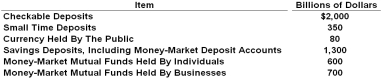 Refer to the table above. The size of the M2 money supply is:
Free
(Multiple Choice)
4.9/5 (78)
(78) Correct Answer:Verified
VerifiedC
To keep high inflation from eroding the value of money, monetary authorities in the United States:
Free
(Multiple Choice)
4.8/5 (84)
(84) Correct Answer:Verified
VerifiedD
The government bail-out of large institutions creates the problem of moral hazard, which means that these large firms will:
(Multiple Choice)
4.9/5 (80)
(80) Which of the following bank-related policies of the Fed fosters huge moral hazard problems:
(Multiple Choice)
4.7/5 (89)
(89) Holding the money deposits of businesses and households and making loans to the public are the basic functions of:
(Multiple Choice)
4.7/5 (92)
(92) One major advantage of money serving as a medium of exchange is that it allows society to:
(Multiple Choice)
4.8/5 (89)
(89) Which of the following functions of money enables society to gain the benefits of geographic and labor specialization?
(Multiple Choice)
5.0/5 (79)
(79) Joe deposits $200 in currency into his checking account at a bank. This deposit is treated as:
(Multiple Choice)
4.8/5 (84)
(84) Which of the following trends had been happening in the banking industry even before the Financial Crisis of 2007-2008?
(Multiple Choice)
4.8/5 (69)
(69) Using a debit card is like writing a check; the amount will be deducted from one's checking account.
(True/False)
4.8/5 (71)
(71) If product prices were stated in terms of tobacco leaves, then tobacco leaves would be functioning primarily as:
(Multiple Choice)
4.9/5 (75)
(75) The consolidation in the financial industry into fewer and larger firms:
(Multiple Choice)
4.8/5 (85)
(85) The TARP loans and the Fed's lender-of-last-resort actions that bailed out large, failing financial institutions helped reduce the moral-hazard problem in financial management.
(True/False)
4.9/5 (70)
(70) The Financial Crisis of 2007-2008 halted the consolidation in the U.S. financial industry that had caused a declining number but increasing size of firms in the industry prior to the crisis.
(True/False)
4.7/5 (74)
(74) With token money, the face value is greater than the intrinsic value.
(True/False)
4.8/5 (83)
(83) 
Filters
- Essay(0)
- Multiple Choice(0)
- Short Answer(0)
- True False(0)
- Matching(0)