



 Chat with AI
Exam 14: Money, Banking, and Financial Institutions

Exam 1: Limits, Alternatives, and Choices212 Questions
Exam 2: The Market System and the Circular Flow141 Questions
Exam 3: Demand, Supply, and Market Equilibrium202 Questions
Exam 4: Market Failures: Public Goods and Externalities155 Questions
Exam 5: Governments Role and Government Failure148 Questions
Exam 6: An Introduction to Macroeconomics123 Questions
Exam 7: Measuring Domestic Output and National Income157 Questions
Exam 8: Economic Growth114 Questions
Exam 9: Business Cycles, Unemployment, and Inflation143 Questions
Exam 10: Basic Macroeconomic Relationships142 Questions
Exam 11: The Aggregate Expenditures Model143 Questions
Exam 12: Aggregate Demand and Aggregate Supply152 Questions
Exam 13: Fiscal Policy, Deficits, and Debt164 Questions
Exam 14: Money, Banking, and Financial Institutions130 Questions
Exam 15: Money Creation127 Questions
Exam 16: Interest Rates and Monetary Policy174 Questions
Exam 17: Financial Economics136 Questions
Exam 18: Extending the Analysis of Aggregate Supply135 Questions
Exam 19: Current Issues in Macro Theory and Policy134 Questions
Exam 20: International Trade151 Questions
Exam 21: The Balance of Payments, Exchange Rates, and Trade Deficits152 Questions
Exam 22: The Economics of Developing Countries135 Questions
Select questions type


When a bank's loans are written off, it means that the bank's:
(Multiple Choice)
4.9/5  (66)
(66) Use the following table to answer the question about the money supply given the following hypothetical data for an economy. 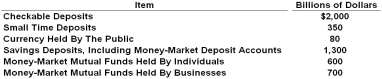 Refer to the table above. The size of the M1 money supply is:
 (Multiple Choice)
4.9/5 (78)
(78) The Fed traditionally can grant loans to commercial banks, but not to investments banks and securities firms.
(True/False)
4.9/5 (68)
(68) When a banker records how many dollars each of his borrowers owes the bank, money is serving as a:
(Multiple Choice)
4.8/5 (89)
(89) Which one of the following is considered to be a "stock" rather than a "flow" variable?
(Multiple Choice)
4.9/5 (71)
(71) The so-called too-big-to-fail policy has two conflicting sides: on one hand there's the moral hazard problem that it creates, but in the other hand the Fed must:
(Multiple Choice)
4.8/5 (80)
(80) The value (or purchasing power) of money increases when the price level increases.
(True/False)
4.9/5 (78)
(78) The basic requirement for an item to function as money is that it be:
(Multiple Choice)
4.8/5 (68)
(68) In 2012 and 2013, the U.S. Attorney General's office illustrated, in several major cases, a bias in favor of the goal of maintaining the stability of the financial system over:
(Multiple Choice)
4.9/5 (79)
(79) Traditionally, the Federal Reserve can give emergency loans only to:
(Multiple Choice)
4.9/5 (67)
(67) During the Financial Crisis of 2007-2008, Goldman Sachs, Morgan Stanley, and other financial firms with heavy exposure to the mortgage-related problems rushed to become bank holding companies in order to:
(Multiple Choice)
4.9/5 (77)
(77) Which of the following financial institutions pool deposits of customers and use the money to buy a portfolio of stocks or bonds or both?
(Multiple Choice)
4.7/5 (73)
(73) Use the following list to answer the question about the money supply. Items
1) Money market mutual funds held by individuals
2) Savings deposits, including money market deposit accounts
3) Money market mutual funds held by businesses
4) Currency held by the public
5) Small time deposits
6) Checkable deposits
Refer to the list above. The M1 money supply is composed of items:
(Multiple Choice)
4.8/5 (89)
(89) The Federal Reserve System consists of which of the following?
(Multiple Choice)
4.9/5 (75)
(75) The Wall Street Reform & Consumer Protection Act of 2010 has the following provisions, except:
(Multiple Choice)
4.9/5 (89)
(89) 
Filters
- Essay(0)
- Multiple Choice(0)
- Short Answer(0)
- True False(0)
- Matching(0)