



 Chat with AI
Exam 14: Money, Banking, and Financial Institutions

Exam 1: Limits, Alternatives, and Choices212 Questions
Exam 2: The Market System and the Circular Flow141 Questions
Exam 3: Demand, Supply, and Market Equilibrium202 Questions
Exam 4: Market Failures: Public Goods and Externalities155 Questions
Exam 5: Governments Role and Government Failure148 Questions
Exam 6: An Introduction to Macroeconomics123 Questions
Exam 7: Measuring Domestic Output and National Income157 Questions
Exam 8: Economic Growth114 Questions
Exam 9: Business Cycles, Unemployment, and Inflation143 Questions
Exam 10: Basic Macroeconomic Relationships142 Questions
Exam 11: The Aggregate Expenditures Model143 Questions
Exam 12: Aggregate Demand and Aggregate Supply152 Questions
Exam 13: Fiscal Policy, Deficits, and Debt164 Questions
Exam 14: Money, Banking, and Financial Institutions130 Questions
Exam 15: Money Creation127 Questions
Exam 16: Interest Rates and Monetary Policy174 Questions
Exam 17: Financial Economics136 Questions
Exam 18: Extending the Analysis of Aggregate Supply135 Questions
Exam 19: Current Issues in Macro Theory and Policy134 Questions
Exam 20: International Trade151 Questions
Exam 21: The Balance of Payments, Exchange Rates, and Trade Deficits152 Questions
Exam 22: The Economics of Developing Countries135 Questions
Select questions type


Which definition(s) of the money supply include(s) only items which are directly and immediately usable as a medium of exchange?
(Multiple Choice)
4.8/5  (84)
(84) The Federal Open Market Committee (FOMC) regulates markets and enforces antitrust laws to keep markets open and competitive.
(True/False)
4.9/5 (78)
(78) When paper money is designated as legal tender, it means that:
(Multiple Choice)
4.8/5 (82)
(82) The twelve Federal Reserve Banks can best be characterized as:
(Multiple Choice)
4.9/5 (93)
(93) The blurring of the lines separating the subsets of the financial industry started in the:
(Multiple Choice)
4.8/5 (82)
(82) The Federal Open Market Committee (FOMC) of the Federal Reserve System is primarily for:
(Multiple Choice)
4.9/5 (84)
(84) As of February 2013, more than half of the money supply (M1) was in the form of:
(Multiple Choice)
4.9/5 (87)
(87) The Financial Crisis of 2007-2008 was triggered by problems in the dot.com sector of the economy.
(True/False)
4.8/5 (87)
(87) The currency or money of the United States, like those of other countries, is:
(Multiple Choice)
4.9/5 (84)
(84) The bail-out money given to the car companies GM and Chrysler came from the Fed acting in its role as "lender of last resort".
(True/False)
4.9/5 (89)
(89) Economic studies conducted in industrially advanced countries suggest there is:
(Multiple Choice)
4.8/5 (94)
(94) The so-called moral-hazard problem in financial management refers to the fact that managers will tend to take on more risk if they know that they are somehow insured against some or all of their losses.
(True/False)
4.8/5 (78)
(78) The Federal Reserve System performs the following functions, except:
(Multiple Choice)
4.8/5 (91)
(91) The Federal Reserve System is the institution that issues the U.S. paper currency or dollar bills.
(True/False)
4.9/5 (81)
(81) 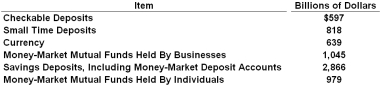 Refer to the table above. The value of the money included in M2 but not counted in M1 is:
 (Multiple Choice)
4.8/5 (77)
(77) Which of the following items are included in money supply M2 but not M1?
(Multiple Choice)
4.9/5 (71)
(71) 
Filters
- Essay(0)
- Multiple Choice(0)
- Short Answer(0)
- True False(0)
- Matching(0)