



 Chat with AI
Exam 14: Money, Banking, and Financial Institutions

Exam 1: Limits, Alternatives, and Choices212 Questions
Exam 2: The Market System and the Circular Flow141 Questions
Exam 3: Demand, Supply, and Market Equilibrium202 Questions
Exam 4: Market Failures: Public Goods and Externalities155 Questions
Exam 5: Governments Role and Government Failure148 Questions
Exam 6: An Introduction to Macroeconomics123 Questions
Exam 7: Measuring Domestic Output and National Income157 Questions
Exam 8: Economic Growth114 Questions
Exam 9: Business Cycles, Unemployment, and Inflation143 Questions
Exam 10: Basic Macroeconomic Relationships142 Questions
Exam 11: The Aggregate Expenditures Model143 Questions
Exam 12: Aggregate Demand and Aggregate Supply152 Questions
Exam 13: Fiscal Policy, Deficits, and Debt164 Questions
Exam 14: Money, Banking, and Financial Institutions130 Questions
Exam 15: Money Creation127 Questions
Exam 16: Interest Rates and Monetary Policy174 Questions
Exam 17: Financial Economics136 Questions
Exam 18: Extending the Analysis of Aggregate Supply135 Questions
Exam 19: Current Issues in Macro Theory and Policy134 Questions
Exam 20: International Trade151 Questions
Exam 21: The Balance of Payments, Exchange Rates, and Trade Deficits152 Questions
Exam 22: The Economics of Developing Countries135 Questions
Select questions type


The so-called near-monies have the following characteristics, except:
(Multiple Choice)
4.8/5  (83)
(83) People can generally get the following items at their commercial banks, except:
(Multiple Choice)
4.8/5 (75)
(75) If the price index rises from 100 to 130, then the purchasing power of the dollar will fall by about:
(Multiple Choice)
4.9/5 (76)
(76) Given the fact that "too big to fail" could translate into "too big to jail", many economists are calling for a return to the separation of high-risk from the low-risk activities in the financial sector. This separation is embodied in the Wall Street Reform and Consumer Protection Act of 2010 in the so-called:
(Multiple Choice)
4.9/5 (70)
(70) When there is inflation in the economy, it implies that the:
(Multiple Choice)
4.9/5 (71)
(71) A few years prior to the Financial Crisis of 2007-2008, many people were getting approved for mortgage loans even without proper documentation or credit checks.
(True/False)
4.8/5 (76)
(76) Which of the following is not true about the Federal Reserve banks?
(Multiple Choice)
4.9/5 (59)
(59) Which group is responsible for the policy decision of changing the money supply?
(Multiple Choice)
4.9/5 (76)
(76) The currency held in the vaults of commercial banks is included in the money supply M1.
(True/False)
4.7/5 (72)
(72) How many members can serve on the Board of Governors of the Federal Reserve System?
(Multiple Choice)
4.7/5 (80)
(80) The general public can open deposit accounts at their district's Federal Reserve Bank.
(True/False)
4.9/5 (85)
(85) The Federal Reserve System performs many functions but its most important one is:
(Multiple Choice)
5.0/5 (74)
(74) 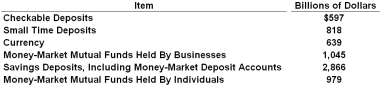 Refer to the table above. The size of the M1 money supply is:
 (Multiple Choice)
4.8/5 (78)
(78) Use the following list to answer the question about the money supply. Items
1) Money market mutual funds held by individuals
2) Savings deposits, including money market deposit accounts
3) Money market mutual funds held by businesses
4) Currency held by the public
5) Small time deposits
6) Checkable deposits
Refer to the list above. The M2 money supply is composed of items:
(Multiple Choice)
4.8/5 (76)
(76) Subprime mortgages, which played a central role in the Financial Crisis of 2007-2008, had been strongly encouraged and supported by the government before the crisis.
(True/False)
4.8/5 (70)
(70) Money eliminates the need for a coincidence of wants in trading primarily through its role as a:
(Multiple Choice)
4.8/5 (81)
(81) Securitization, the process of forming new securities by bundling or slicing up groups of securities like mortgages and bonds, is:
(Multiple Choice)
4.8/5 (93)
(93) 
Filters
- Essay(0)
- Multiple Choice(0)
- Short Answer(0)
- True False(0)
- Matching(0)