



 Chat with AI
Exam 9: Business Cycles, Unemployment, and Inflation

Exam 1: Limits, Alternatives, and Choices212 Questions
Exam 2: The Market System and the Circular Flow141 Questions
Exam 3: Demand, Supply, and Market Equilibrium202 Questions
Exam 4: Market Failures: Public Goods and Externalities155 Questions
Exam 5: Governments Role and Government Failure148 Questions
Exam 6: An Introduction to Macroeconomics123 Questions
Exam 7: Measuring Domestic Output and National Income157 Questions
Exam 8: Economic Growth114 Questions
Exam 9: Business Cycles, Unemployment, and Inflation143 Questions
Exam 10: Basic Macroeconomic Relationships142 Questions
Exam 11: The Aggregate Expenditures Model143 Questions
Exam 12: Aggregate Demand and Aggregate Supply152 Questions
Exam 13: Fiscal Policy, Deficits, and Debt164 Questions
Exam 14: Money, Banking, and Financial Institutions130 Questions
Exam 15: Money Creation127 Questions
Exam 16: Interest Rates and Monetary Policy174 Questions
Exam 17: Financial Economics136 Questions
Exam 18: Extending the Analysis of Aggregate Supply135 Questions
Exam 19: Current Issues in Macro Theory and Policy134 Questions
Exam 20: International Trade151 Questions
Exam 21: The Balance of Payments, Exchange Rates, and Trade Deficits152 Questions
Exam 22: The Economics of Developing Countries135 Questions
Select questions type


If a person's nominal income increases by 5% while the price level increases by 2%, then that person's real income:

Free
(Multiple Choice)
4.7/5  (79)
(79) Correct Answer: Verified
A
A cumulative wage-price spiral which produces very rapid inflation is called:
Free
(Multiple Choice)
4.9/5 (81)
(81) Correct Answer:Verified
VerifiedD
If the natural rate of unemployment was 6 percent, the current unemployment rate was 10 percent, and the potential GDP was $4,000 billion, then according to Okun's law the economy would have sacrificed:
(Multiple Choice)
4.9/5 (70)
(70) The amount by which actual GDP falls short of potential GDP is one measure of the:
(Multiple Choice)
4.8/5 (91)
(91) What has been the range for the duration in months of U.S. recessions between 1950 and 2009?
(Multiple Choice)
4.8/5 (75)
(75) Which of the following is the correct way to calculate the unemployment rate?
(Multiple Choice)
4.8/5 (81)
(81) During the Great Depression of the 1930s, U.S. real GDP fell by about ____ percent, in comparison to the ______ percent decline during the Great Recession of 2007-09.
(Multiple Choice)
4.7/5 (88)
(88) If the total population is 175 million, the labor force is 100 million, and 89 million workers are employed, then the unemployment rate is 11 percent.
(True/False)
4.9/5 (89)
(89) Demand-pull inflation is usually accompanied by low unemployment and higher real output.
(True/False)
4.9/5 (95)
(95) Official unemployment statistics overstate unemployment because discouraged workers who are not actively seeking work are counted as unemployed.
(True/False)
4.8/5 (75)
(75) For a person to keep his real income steady at a certain level from one year to the next, his nominal income must:
(Multiple Choice)
4.9/5 (78)
(78) The CPI compiled by the Bureau of Labor Statistics is used in the computations for:
(Multiple Choice)
4.7/5 (91)
(91) What has been the range of the decline in real output during recessions in the U.S. between 1950 and 2009?
(Multiple Choice)
4.8/5 (90)
(90) 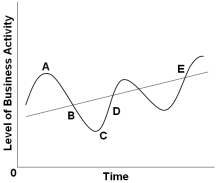 The diagram above illustrates the pattern of:
The following items describe the responses of four individuals to a Bureau of Labor Statistics (BLS) survey of employment. 1. Mollie just graduated from college and is now looking for work. She has had three job interviews in the past month, but still has not gotten a job offer.
2) George used to work in an automotive assembly plant. He was laid off six months ago as the economy weakened. He expects to return to work in a few months when national economic conditions improve.
3) Jeanette worked as an aircraft design engineer for a company that produces military aircraft until she lost her job last year when the Federal government cut defense spending. She has been looking for similar work for a year but no company seems interested in her aircraft design skills.
4) Ricardo lost his job last year when his company downsized and laid off middle-level managers. He tried to find another job for a year, but was unsuccessful and quit looking for work.
Refer to the above information. Which individual would be classified as a discouraged worker?
(Multiple Choice)
4.8/5 (84)
(84) In the 1920s, Germany after the First World War experienced an economic condition which can be best described as:
(Multiple Choice)
4.8/5 (94)
(94) In Year 1, the price level was 120 and the average nominal income was $30,000. In Year 2, the price level was 125 and the average nominal level of income was $32,000. What happened to real income from Year 1 to Year 2?
(Multiple Choice)
4.7/5 (69)
(69) Inflation that occurs when total spending is greater than the economy's ability to produce output at the existing price level is:
(Multiple Choice)
4.8/5 (95)
(95) 
Filters
- Essay(0)
- Multiple Choice(0)
- Short Answer(0)
- True False(0)
- Matching(0)