



 Chat with AI
Exam 16: Interest Rates and Monetary Policy

Exam 1: Limits, Alternatives, and Choices212 Questions
Exam 2: The Market System and the Circular Flow141 Questions
Exam 3: Demand, Supply, and Market Equilibrium202 Questions
Exam 4: Market Failures: Public Goods and Externalities155 Questions
Exam 5: Governments Role and Government Failure148 Questions
Exam 6: An Introduction to Macroeconomics123 Questions
Exam 7: Measuring Domestic Output and National Income157 Questions
Exam 8: Economic Growth114 Questions
Exam 9: Business Cycles, Unemployment, and Inflation143 Questions
Exam 10: Basic Macroeconomic Relationships142 Questions
Exam 11: The Aggregate Expenditures Model143 Questions
Exam 12: Aggregate Demand and Aggregate Supply152 Questions
Exam 13: Fiscal Policy, Deficits, and Debt164 Questions
Exam 14: Money, Banking, and Financial Institutions130 Questions
Exam 15: Money Creation127 Questions
Exam 16: Interest Rates and Monetary Policy174 Questions
Exam 17: Financial Economics136 Questions
Exam 18: Extending the Analysis of Aggregate Supply135 Questions
Exam 19: Current Issues in Macro Theory and Policy134 Questions
Exam 20: International Trade151 Questions
Exam 21: The Balance of Payments, Exchange Rates, and Trade Deficits152 Questions
Exam 22: The Economics of Developing Countries135 Questions
Select questions type


If nominal GDP is $2,000 billion and the amount of money demanded for transactions purposes is $500 billion, then on average each dollar will be spent about four times a year.

Free
(True/False)
4.8/5  (83)
(83) Correct Answer: Verified
True
The interest rate will fall when the:
Free
(Multiple Choice)
4.9/5 (89)
(89) Correct Answer:Verified
VerifiedB
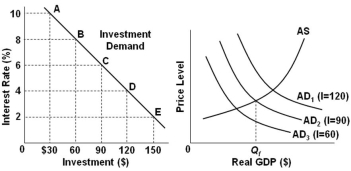 Refer to the graphs above, in which the numbers in parentheses near the AD1, AD2, and AD3 labels indicate the level of investment spending associated with each curve, respectively. All numbers are in billions of dollars. The interest rate and the level of investment spending in the economy are at point D on the investment demand curve. To achieve the long-run goal of a noninflationary full-employment output Qf in the economy, the Fed should try to:
Free
(Multiple Choice)
4.7/5 (77)
(77) Correct Answer:Verified
VerifiedB
Traditionally, the Fed often communicated its intentions to restrict or expand monetary policy by announcing a change in its target for the:
(Multiple Choice)
4.9/5 (75)
(75) Typically the largest asset item in the Federal Reserve Banks' consolidated balance sheet (as illustrated in the book, for April 2013) is:
(Multiple Choice)
5.0/5 (87)
(87) Which of the following best describes what occurs when monetary authorities sell government securities?
(Multiple Choice)
4.9/5 (92)
(92) Changes in interest rates, ceteris paribus, cause a shift in:
(Multiple Choice)
4.8/5 (78)
(78) A decrease in the nominal GDP, other things remaining the same, will decrease both the total demand for money and the equilibrium rate of interest in the economy.
(True/False)
4.7/5 (69)
(69) 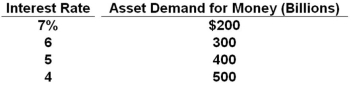 Refer to the table above. Suppose that the transactions demand for money is $300 billion and the money supply is $700 billion. A decrease in the money supply to $600 billion would cause the interest rate to:
 (Multiple Choice)
4.7/5 (87)
(87) The lending ability of commercial banks increases when the:
(Multiple Choice)
4.8/5 (71)
(71) Which of the following is considered an advantage of monetary policy compared to fiscal policy?
(Multiple Choice)
4.7/5 (74)
(74) 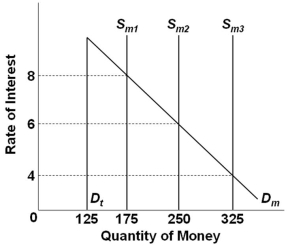 Refer to the graph above, in which Dt is the transactions demand for money, Dm is the total demand for money, and Sm is the supply of money. The market is in equilibrium at the 6 percent rate of interest. If the money supply then decreases as shown, the transaction demand for money will change by:
 (Multiple Choice)
4.9/5 (68)
(68) A few years ago, you bought a bond with no expiration and a fixed annual interest payment of $1000 at a price of $10,000. If the interest rate in the economy is now 12.5% a year and you want to sell the bond, the maximum price that you can get for it is:
(Multiple Choice)
4.8/5 (86)
(86) Which one of the following is a tool of monetary policy often used by the Fed for altering the reserves of commercial banks?
(Multiple Choice)
4.9/5 (88)
(88) The interest rate that the Fed charges banks for loans to them through the traditional channel is called:
(Multiple Choice)
4.9/5 (74)
(74) If the Fed sells government securities to the general public in the open market:
(Multiple Choice)
4.7/5 (77)
(77) Other things equal, an appreciation of the U.S. dollar would:
(Multiple Choice)
4.9/5 (80)
(80) Which of the following statements about quantitative easing (or "QE") and open market purchase is true?
(Multiple Choice)
4.9/5 (80)
(80) 
Filters
- Essay(0)
- Multiple Choice(0)
- Short Answer(0)
- True False(0)
- Matching(0)