



 Chat with AI
Exam 16: Interest Rates and Monetary Policy

Exam 1: Limits, Alternatives, and Choices212 Questions
Exam 2: The Market System and the Circular Flow141 Questions
Exam 3: Demand, Supply, and Market Equilibrium202 Questions
Exam 4: Market Failures: Public Goods and Externalities155 Questions
Exam 5: Governments Role and Government Failure148 Questions
Exam 6: An Introduction to Macroeconomics123 Questions
Exam 7: Measuring Domestic Output and National Income157 Questions
Exam 8: Economic Growth114 Questions
Exam 9: Business Cycles, Unemployment, and Inflation143 Questions
Exam 10: Basic Macroeconomic Relationships142 Questions
Exam 11: The Aggregate Expenditures Model143 Questions
Exam 12: Aggregate Demand and Aggregate Supply152 Questions
Exam 13: Fiscal Policy, Deficits, and Debt164 Questions
Exam 14: Money, Banking, and Financial Institutions130 Questions
Exam 15: Money Creation127 Questions
Exam 16: Interest Rates and Monetary Policy174 Questions
Exam 17: Financial Economics136 Questions
Exam 18: Extending the Analysis of Aggregate Supply135 Questions
Exam 19: Current Issues in Macro Theory and Policy134 Questions
Exam 20: International Trade151 Questions
Exam 21: The Balance of Payments, Exchange Rates, and Trade Deficits152 Questions
Exam 22: The Economics of Developing Countries135 Questions
Select questions type


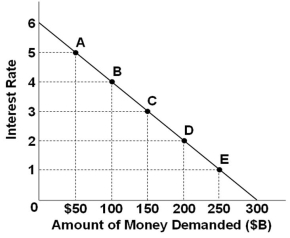 Refer to the graph above. If the equilibrium interest rate is 4 percent, the supply of money must be:
 (Multiple Choice)
4.8/5  (81)
(81) If the Fed buys government securities from commercial banks in the open market:
(Multiple Choice)
4.8/5 (84)
(84) 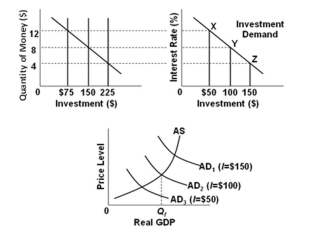 Refer to the graphs above, in which the numbers in parentheses near the AD1, AD2, and AD3 labels indicate the level of investment spending associated with each curve. All figures are in billions. The economy is at point Z on the investment demand curve. Given these conditions, what policy should the monetary authorities pursue to achieve a noninflationary full-employment level of real GDP?
 (Multiple Choice)
4.8/5 (88)
(88) If the Fed reduces the interest paid on banks' reserves, it is trying to make banks hold:
(Multiple Choice)
4.9/5 (75)
(75) The effects of expansionary monetary policy are strengthened by a liquidity trap.
(True/False)
4.8/5 (77)
(77) The Fed can induce banks to increase their reserve holdings by:
(Multiple Choice)
4.9/5 (76)
(76) A bond with no expiration date has a face value of $10,000 and pays a fixed 10 percent interest. If the market price of the bond rises to $11,000, the annual yield approximately equals:
(Multiple Choice)
4.7/5 (81)
(81) Among the worrisome consequences of the government's aggressive implementation of ZIRP and QE are the following, except:
(Multiple Choice)
4.9/5 (88)
(88) The discount rate is the interest rate at which commercial banks lend to their best corporate customers.
(True/False)
5.0/5 (84)
(84) A consumer holds money to meet spending needs. This would be an example of the:
(Multiple Choice)
4.8/5 (73)
(73) Other things equal, an improvement in the expected rate of net profit would:
(Multiple Choice)
4.8/5 (77)
(77) The major problem facing the economy is high unemployment and weak economic growth. The inflation rate is low and stable. Therefore, the Federal Reserve decides to pursue a policy to increase the rate of economic growth. Which policy changes by the Fed would tend to offset each other in trying to achieve that objective?
(Multiple Choice)
4.9/5 (94)
(94) If the Fed is targeting a lower federal funds rate, then it is pursuing a restrictive monetary policy.
(True/False)
4.9/5 (84)
(84) The most recently-introduced tool of monetary policy is the:
(Multiple Choice)
4.8/5 (73)
(73) An interesting development that happened in late 2008, relating to the Fed and bank reserves, is that the Fed:
(Multiple Choice)
4.9/5 (72)
(72) If real GDP is 2% below potential GDP, and the inflation rate is 1%, then according to the Taylor rule, the Fed should make the real federal funds rate:
(Multiple Choice)
4.8/5 (81)
(81) 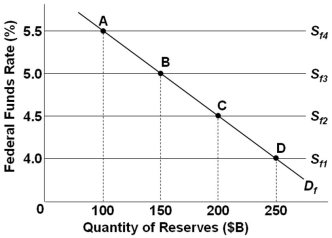 Refer to the figure above. If demand for overnight funds in the graph should increase by $50 billion at each and every point on the demand curve, but the Federal Reserve wants to keep the target rate at 5.0 percent, what will be the new equilibrium quantity of reserves?
 (Multiple Choice)
4.9/5 (85)
(85) The ZIRP (zero interest rate policy) of the Fed led to the so-called zero lower bound problem, which refers to the problem of:
(Multiple Choice)
4.9/5 (77)
(77) 
Filters
- Essay(0)
- Multiple Choice(0)
- Short Answer(0)
- True False(0)
- Matching(0)