



 Chat with AI
Exam 16: Interest Rates and Monetary Policy

Exam 1: Limits, Alternatives, and Choices212 Questions
Exam 2: The Market System and the Circular Flow141 Questions
Exam 3: Demand, Supply, and Market Equilibrium202 Questions
Exam 4: Market Failures: Public Goods and Externalities155 Questions
Exam 5: Governments Role and Government Failure148 Questions
Exam 6: An Introduction to Macroeconomics123 Questions
Exam 7: Measuring Domestic Output and National Income157 Questions
Exam 8: Economic Growth114 Questions
Exam 9: Business Cycles, Unemployment, and Inflation143 Questions
Exam 10: Basic Macroeconomic Relationships142 Questions
Exam 11: The Aggregate Expenditures Model143 Questions
Exam 12: Aggregate Demand and Aggregate Supply152 Questions
Exam 13: Fiscal Policy, Deficits, and Debt164 Questions
Exam 14: Money, Banking, and Financial Institutions130 Questions
Exam 15: Money Creation127 Questions
Exam 16: Interest Rates and Monetary Policy174 Questions
Exam 17: Financial Economics136 Questions
Exam 18: Extending the Analysis of Aggregate Supply135 Questions
Exam 19: Current Issues in Macro Theory and Policy134 Questions
Exam 20: International Trade151 Questions
Exam 21: The Balance of Payments, Exchange Rates, and Trade Deficits152 Questions
Exam 22: The Economics of Developing Countries135 Questions
Select questions type


Assume that the required reserve ratio is 25 percent. If the Federal Reserve sells $120 million in government securities to the general public, the money supply will immediately:
(Multiple Choice)
4.9/5  (77)
(77) 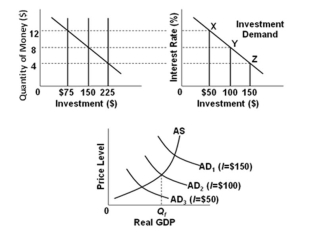 Refer to the graphs above, in which the numbers in parentheses near the AD1, AD2, and AD3 labels indicate the level of investment spending associated with each curve. All figures are in billions. The economy is at point X on the investment demand curve. Given these conditions, what policy should the Fed pursue to achieve a noninflationary full-employment level of real GDP?
 (Multiple Choice)
4.8/5 (83)
(83) One feature of the second round of QE ("QE2") was that the Fed engaged in "forward commitment," by pre-announcing exactly the quantity of bonds it was going to buy and for how long the buying would last. This change in policy was intended to:
(Multiple Choice)
5.0/5 (85)
(85) 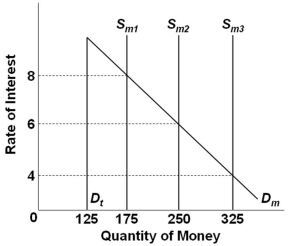 Refer to the graph above, in which Dt is the transactions demand for money, Dm is the total demand for money, and Sm is the supply of money. The market is initially in equilibrium at a 6 percent rate of interest. If the supply of money increases as shown, then the asset demand for money will increase by:
 (Multiple Choice)
4.8/5 (78)
(78) The effects on aggregate demand of an open market purchase and a tax cut are similar.
(True/False)
5.0/5 (79)
(79) If the Fed wants to maintain current interest rates, it would be buying government bonds in the open market when:
(Multiple Choice)
4.8/5 (91)
(91) According to the Taylor rule, if the inflation rate is one percentage point below the target of 2%, then the Fed should:
(Multiple Choice)
4.9/5 (95)
(95) When the Federal Reserve Banks decide to buy government bonds from banks and the public, the supply of reserves in the Federal funds market:
(Multiple Choice)
4.7/5 (79)
(79) The transactions demand for money is least likely to be a function of the:
(Multiple Choice)
4.8/5 (69)
(69) 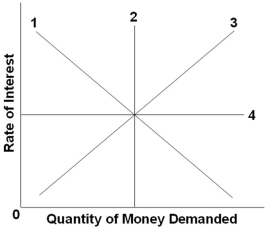 Which line in the graph above would best illustrate the asset demand for money curve?
 (Multiple Choice)
4.9/5 (84)
(84) The interest rate that banks charge one another for the loan of excess reserves is the:
(Multiple Choice)
4.8/5 (88)
(88) 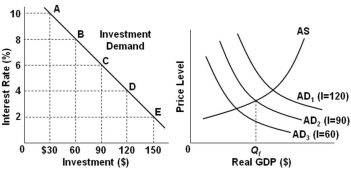 Refer to the graphs above, in which the numbers in parentheses near the AD1, AD2, and AD3 labels indicate the level of investment spending associated with each curve, respectively. All numbers are in billions of dollars. The interest rate and the level of investment spending in the economy are at point C on the investment demand curve. To achieve the long-run goal of a noninflationary full-employment output Qf in the economy, the Fed should try to:
 (Multiple Choice)
4.9/5 (85)
(85) The Federal Reserve alters the amount of the nation's money supply by:
(Multiple Choice)
4.8/5 (78)
(78) Other things equal, an increase in taxes on businesses will:
(Multiple Choice)
4.9/5 (87)
(87) An expansionary monetary policy is less effective in influencing aggregate demand compared to a restrictive monetary policy.
(True/False)
4.7/5 (82)
(82) 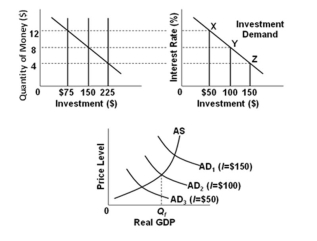 Refer to the graphs above, in which the numbers in parentheses near the AD1, AD2, and AD3 labels indicate the levels of investment spending associated with each curve. All figures are in billions. What is the desired level of investment spending in this economy if it is to achieve a noninflationary full-employment level of real GDP?
 (Multiple Choice)
4.8/5 (81)
(81) The purpose of an expansionary monetary policy is to increase:
(Multiple Choice)
4.8/5 (73)
(73) 
Filters
- Essay(0)
- Multiple Choice(0)
- Short Answer(0)
- True False(0)
- Matching(0)