



 Chat with AI
Exam 16: Interest Rates and Monetary Policy

Exam 1: Limits, Alternatives, and Choices212 Questions
Exam 2: The Market System and the Circular Flow141 Questions
Exam 3: Demand, Supply, and Market Equilibrium202 Questions
Exam 4: Market Failures: Public Goods and Externalities155 Questions
Exam 5: Governments Role and Government Failure148 Questions
Exam 6: An Introduction to Macroeconomics123 Questions
Exam 7: Measuring Domestic Output and National Income157 Questions
Exam 8: Economic Growth114 Questions
Exam 9: Business Cycles, Unemployment, and Inflation143 Questions
Exam 10: Basic Macroeconomic Relationships142 Questions
Exam 11: The Aggregate Expenditures Model143 Questions
Exam 12: Aggregate Demand and Aggregate Supply152 Questions
Exam 13: Fiscal Policy, Deficits, and Debt164 Questions
Exam 14: Money, Banking, and Financial Institutions130 Questions
Exam 15: Money Creation127 Questions
Exam 16: Interest Rates and Monetary Policy174 Questions
Exam 17: Financial Economics136 Questions
Exam 18: Extending the Analysis of Aggregate Supply135 Questions
Exam 19: Current Issues in Macro Theory and Policy134 Questions
Exam 20: International Trade151 Questions
Exam 21: The Balance of Payments, Exchange Rates, and Trade Deficits152 Questions
Exam 22: The Economics of Developing Countries135 Questions
Select questions type


The use of monetary policy to shift aggregate demand to the right in a severe recession is like:
(Multiple Choice)
4.9/5  (78)
(78) 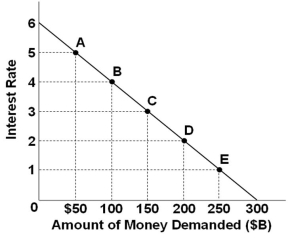 Refer to the graph above. If the initial equilibrium interest rate was 5 percent and the money supply increased by $100 billion, then the new interest rate would be:
 (Multiple Choice)
4.9/5 (70)
(70) The level of GDP, ceteris paribus, will tend to increase when:
(Multiple Choice)
4.8/5 (92)
(92) Quantitative easing (QE) differs from open-market purchases in that QE shrank the assets of the Fed whereas open market purchases expands the Fed's assets.
(True/False)
4.9/5 (77)
(77) Commercial bank reserves, most of which are held by the Federal Reserve Banks, are:
(Multiple Choice)
4.9/5 (82)
(82) The price of a bond with no expiration date is $1,000 and the fixed annual interest payment is $100. If the price of the bond falls to $800, the interest rate to a new buyer of the bond is now 20 percent.
(True/False)
4.9/5 (82)
(82) Assume the commercial banking system has checkable deposits of $20 billion and excess reserves of $2 billion when the reserve ratio is 25 percent. If the reserve ratio is then lowered to 20 percent, we can conclude that the:
(Multiple Choice)
4.9/5 (70)
(70) There is an asset demand for money primarily because of which function of money?
(Multiple Choice)
4.8/5 (80)
(80) If consumers and businesses are especially pessimistic, as in the Great Recession of 2007-2009, and do not want to borrow money from banks, then the use of an expansionary money policy is likened to:
(Multiple Choice)
4.8/5 (77)
(77) A newspaper headline reads: "Fed Raises Discount Rate for Third Time This Year." This headline indicates that the Federal Reserve is most likely trying to:
(Multiple Choice)
5.0/5 (73)
(73) In the recent financial and economic crises, the economy fell into a so-called liquidity trap, which means that:
(Multiple Choice)
4.8/5 (72)
(72) 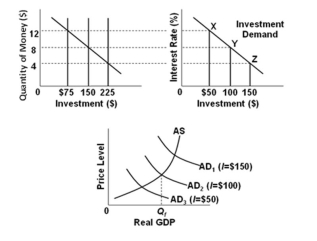 Refer to the graphs above, in which the numbers in parentheses near the AD1, AD2, and AD3 labels indicate the level of investment spending associated with each curve. All figures are in billions. The economy is at equilibrium at the intersection of the aggregate supply curve and aggregate demand curve AD3. What policy should the Fed pursue to achieve a noninflationary full-employment level of real GDP?
 (Multiple Choice)
4.8/5 (78)
(78) Answer the question based on the information given in the table below that shows the items and figures taken from a consolidated balance sheet of the twelve Federal Reserve Banks. All figures are in billions of dollars. 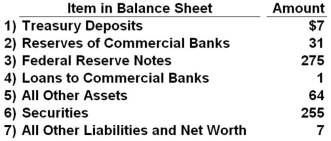 In the balance sheet above for the Federal Reserve, the assets would be items 5 and:
 (Multiple Choice)
4.8/5 (99)
(99) An expansionary monetary policy increases the money supply, lowers interest rates, and increases aggregate demand.
(True/False)
4.9/5 (79)
(79) Disequilibrium in the money market is mainly corrected via a change in:
(Multiple Choice)
4.9/5 (79)
(79) The purchase and sale of government securities by the Fed is called:
(Multiple Choice)
4.9/5 (73)
(73) 
Filters
- Essay(0)
- Multiple Choice(0)
- Short Answer(0)
- True False(0)
- Matching(0)