



 Chat with AI
Exam 16: Interest Rates and Monetary Policy

Exam 1: Limits, Alternatives, and Choices212 Questions
Exam 2: The Market System and the Circular Flow141 Questions
Exam 3: Demand, Supply, and Market Equilibrium202 Questions
Exam 4: Market Failures: Public Goods and Externalities155 Questions
Exam 5: Governments Role and Government Failure148 Questions
Exam 6: An Introduction to Macroeconomics123 Questions
Exam 7: Measuring Domestic Output and National Income157 Questions
Exam 8: Economic Growth114 Questions
Exam 9: Business Cycles, Unemployment, and Inflation143 Questions
Exam 10: Basic Macroeconomic Relationships142 Questions
Exam 11: The Aggregate Expenditures Model143 Questions
Exam 12: Aggregate Demand and Aggregate Supply152 Questions
Exam 13: Fiscal Policy, Deficits, and Debt164 Questions
Exam 14: Money, Banking, and Financial Institutions130 Questions
Exam 15: Money Creation127 Questions
Exam 16: Interest Rates and Monetary Policy174 Questions
Exam 17: Financial Economics136 Questions
Exam 18: Extending the Analysis of Aggregate Supply135 Questions
Exam 19: Current Issues in Macro Theory and Policy134 Questions
Exam 20: International Trade151 Questions
Exam 21: The Balance of Payments, Exchange Rates, and Trade Deficits152 Questions
Exam 22: The Economics of Developing Countries135 Questions
Select questions type


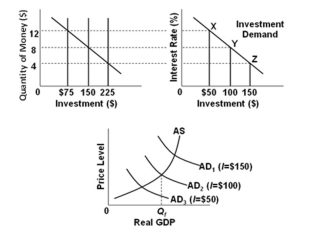 Refer to the graphs above, in which the numbers in parentheses near the AD1, AD2, and AD3 labels indicate the level of investment spending associated with each curve. All figures are in billions. The economy is at point Y on the investment demand curve. Given these conditions, what policy should the Fed pursue to achieve a noninflationary full-employment level of real GDP?
 (Multiple Choice)
4.8/5  (88)
(88) If nominal GDP is $4,000 billion and the amount of money demanded for transactions purposes is $800 billion, it can generally be concluded that:
(Multiple Choice)
4.8/5 (85)
(85) 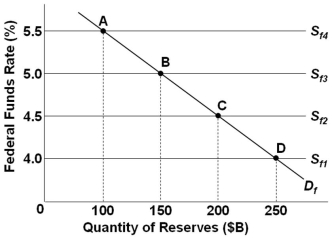 Refer to the figure above. If the Federal funds market is at equilibrium at point B and the Federal Reserve decides to change the rate by a percentage point in order to reduce the chances of the economy going into recession, the supply of funds curve will have to shift to:
 (Multiple Choice)
4.9/5 (88)
(88) 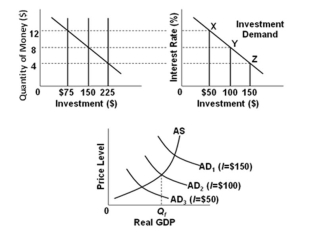 Refer to the graphs above, in which the numbers in parentheses near the AD1, AD2, and AD3 labels indicate the levels of investment spending associated with each curve. All figures are in billions. A shift in the aggregate demand curve from AD3 to AD2 can be achieved by Federal Reserve action to:
 (Multiple Choice)
4.9/5 (77)
(77) Compared to fiscal policy, monetary policy has a much shorter:
(Multiple Choice)
4.9/5 (88)
(88) Which of the following is a monetary policy intended to rein in inflation?
(Multiple Choice)
5.0/5 (74)
(74) There is an asset demand for money because households and business firms use money as a store of value.
(True/False)
4.8/5 (69)
(69) 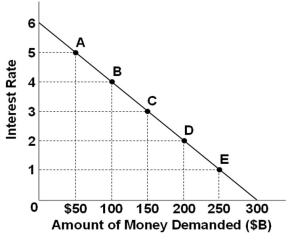 Refer to the graph above. If the supply of money was $200 billion, the interest rate would be:
 (Multiple Choice)
4.9/5 (88)
(88) Which of the following Fed actions increases the excess reserves of commercial banks?
(Multiple Choice)
4.9/5 (84)
(84) When the Federal Reserve raises the target Federal funds rate, it:
(Multiple Choice)
4.7/5 (89)
(89) A bond with no expiration date is priced at $10,000 when the interest rate in the economy is 6%. If the interest rate falls to 5.5%, then this bond's price would decrease.
(True/False)
4.8/5 (74)
(74) The fundamental objective of monetary policy is to assist the economy in achieving:
(Multiple Choice)
4.8/5 (73)
(73) In a supply-and-demand graph for the Federal funds market, the demand curve is downward-sloping because:
(Multiple Choice)
4.7/5 (80)
(80) If nominal GDP is $800 billion and, on average, each dollar is spent four times in the economy over a year, then the quantity of money demanded for transactions purposes will be:
(Multiple Choice)
4.8/5 (84)
(84) 
Filters
- Essay(0)
- Multiple Choice(0)
- Short Answer(0)
- True False(0)
- Matching(0)