



 Chat with AI
Exam 17: Financial Economics

Exam 1: Limits, Alternatives, and Choices212 Questions
Exam 2: The Market System and the Circular Flow141 Questions
Exam 3: Demand, Supply, and Market Equilibrium202 Questions
Exam 4: Market Failures: Public Goods and Externalities155 Questions
Exam 5: Governments Role and Government Failure148 Questions
Exam 6: An Introduction to Macroeconomics123 Questions
Exam 7: Measuring Domestic Output and National Income157 Questions
Exam 8: Economic Growth114 Questions
Exam 9: Business Cycles, Unemployment, and Inflation143 Questions
Exam 10: Basic Macroeconomic Relationships142 Questions
Exam 11: The Aggregate Expenditures Model143 Questions
Exam 12: Aggregate Demand and Aggregate Supply152 Questions
Exam 13: Fiscal Policy, Deficits, and Debt164 Questions
Exam 14: Money, Banking, and Financial Institutions130 Questions
Exam 15: Money Creation127 Questions
Exam 16: Interest Rates and Monetary Policy174 Questions
Exam 17: Financial Economics136 Questions
Exam 18: Extending the Analysis of Aggregate Supply135 Questions
Exam 19: Current Issues in Macro Theory and Policy134 Questions
Exam 20: International Trade151 Questions
Exam 21: The Balance of Payments, Exchange Rates, and Trade Deficits152 Questions
Exam 22: The Economics of Developing Countries135 Questions
Select questions type


Which one of the following would best describe a mutual fund?

Free
(Multiple Choice)
4.9/5  (77)
(77) Correct Answer: Verified
B
Financial investment refers to:
Free
(Multiple Choice)
4.9/5 (72)
(72) Correct Answer:Verified
VerifiedC
Time value of money refers to the idea that a specific amount of money:
Free
(Multiple Choice)
4.8/5 (83)
(83) Correct Answer:Verified
VerifiedC
What is considered to be the best measure of the risk-free interest rate?
(Multiple Choice)
4.9/5 (83)
(83) A Ponzi scheme can only succeed if the investors in the scheme believe that something is preventing:
(Multiple Choice)
4.9/5 (86)
(86) Investors face the risk that the economy could go into another recession. This risk is:
(Multiple Choice)
4.8/5 (84)
(84) 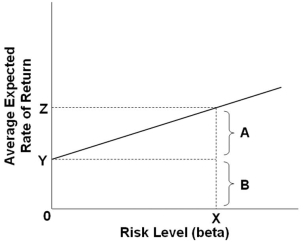 Refer to the graph above. The average expected rate of return for an asset with a beta equal to X would be:
 (Multiple Choice)
4.9/5 (89)
(89) Joe and Linda have the opportunity to purchase a new home. The house in Glen Oaks is currently worth $250,000 but is predicted to be worth $270,000 in a year. What is the rate of appreciation for the house from one year to the next?
(Multiple Choice)
4.9/5 (82)
(82) An investor owns bond #1 that has a rate of return of 10 percent, but a similar bond #2 has an 11 percent return and equal risk. By selling bond #1 and buying bond #2 to earn a higher return, the investor is engaging in:
(Multiple Choice)
4.9/5 (68)
(68) A bond that pays annual interest (or coupons) and a face value at maturity will fetch a price today that is equal to the:
(Multiple Choice)
4.8/5 (76)
(76) The compensation for bearing more risk in owning an asset is a higher rate of return for the asset.
(True/False)
4.9/5 (68)
(68) The "time value" of money is based on the fact that prices may increase over time.
(True/False)
4.9/5 (81)
(81) Other factors constant, if the interest rate is higher, the present value of a certain future amount will be smaller.
(True/False)
4.8/5 (66)
(66) Which of the following statements best describes the relationship between risk and the average expected return of investments?
(Multiple Choice)
4.8/5 (75)
(75) Rupert recently purchased a non-maturing bond for $10,000 that pays $350 semi-annual coupons. His expected rate of return per year on the bond is:
(Multiple Choice)
4.8/5 (77)
(77) You would like to have $50,000 for a new car in six years. If you deposit money today in a bank CD that pays 4% per year, how much must your deposit be?
(Multiple Choice)
4.8/5 (76)
(76) A strategy that attempts to reduce the overall risk of an entire investment portfolio by investing in a variety of assets is called:
(Multiple Choice)
4.9/5 (74)
(74) 
Filters
- Essay(0)
- Multiple Choice(0)
- Short Answer(0)
- True False(0)
- Matching(0)